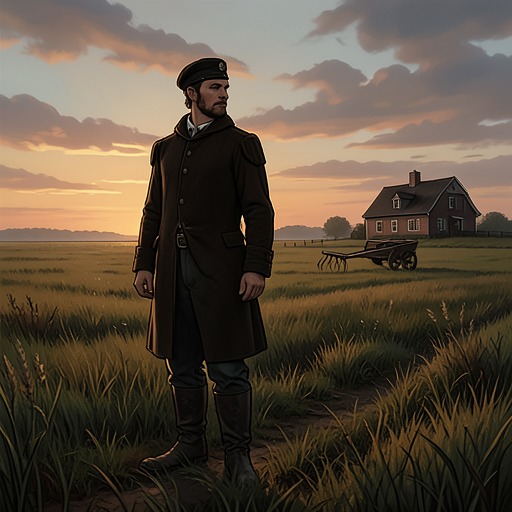
Cecily Thirsk
HarvestCecily Thirsk is Walter Thirsk’s dead wife, present in the narrative chiefly through his memories and grief. Though her life is only glimpsed through Walter’s recollections, she remains a vivid personal measure of belonging and a source of encouragement as he confronts the changes threatening his community.
Identity and Background
Cecily Thirsk was Walter’s wife. The narrative gives little independent account of her life, instead showing her through the intimate details Walter remembers: her way of widening her eyes to signal that he had a duty to perform, had said too much, or had not gone far enough. These recollections suggest a familiar, alert partnership, in which a look could carry a warning or an expectation without a spoken explanation.
Walter’s account also places their marriage within his gradual adoption of village life. When he first came to The Bottom, he was captivated by the landscape and its plants, while his neighbors measured them by their practical uses. After he found Cecily and took up husbandry himself, he came to understand the work and hardship that shaped the community. His memory links settling into the place with both marriage and labor, rather than with admiration of the countryside alone.
Marriage and Loss
Walter found Cecily dead in their bed. The account provides no cause or further circumstances of her death, but establishes that her loss marked him deeply: years later, he still measures his life as a widower from the day he discovered her. His grief is not confined to recollection. It makes the absent wife a continuing presence against which he tests his choices and his sense of himself.
At a moment when neighbors’ suspicions and danger leave Walter considering whether he should flee, he remembers the way the village has come to regard him as an outsider. That exposure is sharpened by his past: he had arrived from elsewhere, and after becoming a widower had received offers of companionship before stepping away from all but one. The passage does not make Cecily responsible for his later decisions, but shows how her death remains part of the social and emotional history through which he understands his place among the villagers.
Memory and Influence
Cecily returns most forcefully in Walter’s imagined gathering of witnesses before his act of defiance in the field. Alongside John Carr, Charles Kent, Mistress Beldam, and others, she appears to him alive and encouraging. In this private vision, she urges him to make her proud. The imagined scene makes his planned plowing more than a practical task: it becomes an action he wants those he loves and has lost to witness.
Her remembered gestures carry a similar force. Walter recalls her widened eyes as a way of prompting him to meet a duty or reconsider his behavior. In his vision of her, that old intimacy becomes encouragement to act boldly on behalf of the village. The scene reveals Walter’s need for affirmation, but it also gives Cecily a distinct presence within his memory: she is not merely the fact of his bereavement, but someone whose judgment he still imagines and values.
Narrative Significance
Cecily’s appearances are filtered through Walter’s consciousness, so they establish more about his grief and attachments than about her life beyond the marriage. The narrative moves between the certainty of her death and the vividness of his imagined reunion with her. That contrast makes memory an active force in the present: as Walter faces the enclosure of the land and the disintegration of village life, Cecily’s remembered counsel helps him frame resistance as a duty owed to others, and as an act for which he hopes to be worthy in her eyes.