Young Beldam
HarvestYoung Beldam is a displaced commoner whose story links the village’s punishment of outsiders to the enclosure that drove him from home. Imprisoned in the pillory alongside his father-in-law, he survives where the older man dies; later, his knowledge of plowing helps Walter Thirsk make a final mark in the barley field before the village is destroyed.
Identity and Background
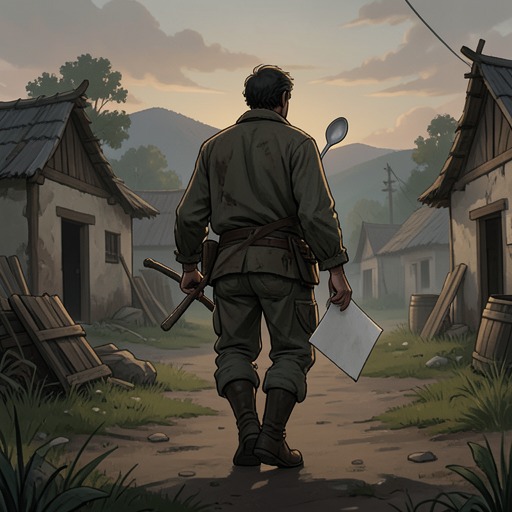
Young Beldam enters the account not by a personal name but as the surviving tenant of the pillory. Mr. Quill identifies him and Mistress Beldam as husband and wife, fugitives from sheep and exiles from their own commons. They have walked for six or seven days to reach the village after their ancient livelihoods were hedged and fenced against their needs. Their displacement places them within the wider conflict over land: they are not merely strangers passing through, but people driven from a customary way of life by the spread of sheep pasture.
The village first encounters him through punishment. Young Beldam has spent three nights fastened in the pillory when Walter Thirsk and Mr. Quill find him speaking quietly together. The villagers’ uneasy response registers a dawning recognition that they have treated the couple unjustly. Young Beldam’s father-in-law, Beldam senior, has died in custody; the survivor’s continued confinement makes the older man’s fate impossible to dismiss as an isolated misfortune. The villagers have withheld both the customary abuse they might have directed at a guilty prisoner and the ordinary kindness—food, ale, or even a greeting—that might have acknowledged his bereavement. Their shame is part of his introduction: he is an outsider, but the community’s failure toward him is also a breach of its own customs.
The Pillory and a Brief Alliance
As the villagers head toward the manor to demand action against Mistress Beldam, Philip Earle and Walter Thirsk remain behind at the Unbuilt Church Ground, beside the pillory where Young Beldam has been held. When his wife approaches through the night, the top beam rattles as he turns his head and shoulder. He does not call out a warning, though other men are nearby; instead, he gives a light whistle, a small signal that he is still alive and that she will not find another corpse. The moment sets his endurance against the village’s confused, belated sympathy: he cannot leave the wooden frame, but he can let his wife know he is there.
Walter later finds him weakened by the days of confinement. The village had treated the seven-day sentence as mild, especially beside punishments such as beating or hanging, and had also snapped the newcomers’ bows and clipped their hair. Yet the prisoner’s bruised wrists and throat, hollow eyes, cracked lips, and insect-bitten neck make the sentence’s bodily cost unmistakable. Summer has drained him; the strong arms with which he was first fastened to the wood no longer look muscular. The punishment has not simply marked him as an outsider. It has left him visibly diminished, after his father-in-law has already died in the same custody.
Walter approaches with a stolen key, although he has been instructed not to release Young Beldam before the full week is served. He explains that he is taking a risk and offers to walk away if the prisoner prefers. Young Beldam answers with indifference, then refuses to give his name, insisting that it belongs to him to keep. His reserve frustrates Walter, who briefly feels the impulse to strike him with the sword; instead, Walter lays the blade flat across the prisoner’s forehead and makes clear that he is now the only person able to help. The exchange does not establish trust, but it does bring the key—and the possibility of freedom—within reach. Young Beldam’s refusal to surrender even his name preserves a small boundary of his own inside a punishment designed to expose and control him.
Work, Release, and Retaliation
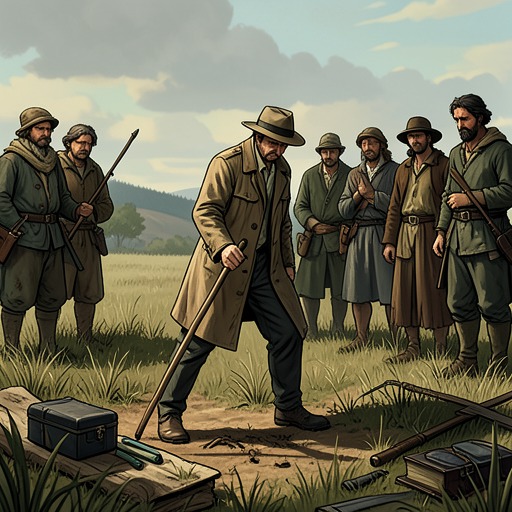
When Walter Thirsk takes Young Beldam to the barley stub, the newcomer’s former trade emerges in the way he moves: he must have been a plowman before displacement, and his uneven legs bear the familiar marks of work between furrow and ridge. Thirsk steadies the share-beam while Young Beldam assembles the blades, moldboard, and yoke. Their labor joins two workingmen to a pair of Oxen, and sets them to loosening the soil one final time. The field still records the village’s harvest in its stubble: the low, careful cuts of John Carr, the wavering swathes of Brooker Higgs, and the tall patches left by children and workers less able to reap. Young Beldam’s practical skill makes him more than the object of the villagers’ punishment; for a brief interval, he becomes Thirsk’s associate in preserving the possibility of another season.
That work is soon caught up in the couple’s retaliation against the village. The Beldams take a cart and the Oxen that had drawn the plow, and load it with goods pillaged from village homes and the manor house. Among the recognizable cargo are the master’s tapestries, better chairs, his wife’s old loom, and parts of the plow Young Beldam and Thirsk had assembled. The tools of planting and the furnishings of settled life are carried off together. Thirsk reads the theft against Beldam senior’s death: the father’s fate has, in his view, been paid back through the looting.
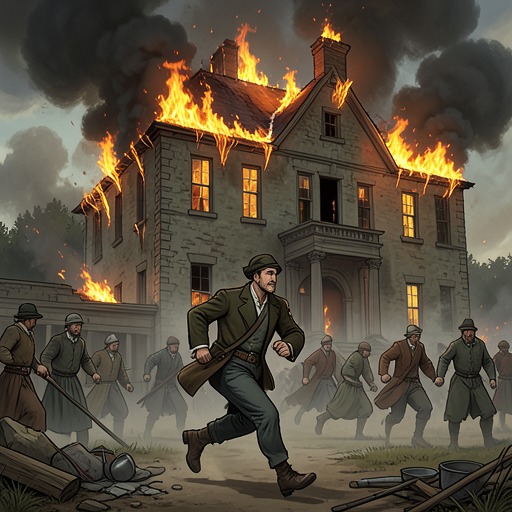
As the cottages, the tool barn, and the whitehouse burn, Young Beldam turns to the pillory that held him for most of a week. With an axe, he first strikes too high against the hard oak, then finds softer, weather-worn timber lower down. He cuts a hollow into the upright and works from the opposite side, striking until the old place of confinement lies broken at his feet. The labor recalls his competence with the plow, but now it serves a different purpose: where he had helped Thirsk prepare the field for a future harvest, he dismantles the structure of his own punishment amid the destruction of the village. His arc thus binds skilled work, forced displacement, and reprisal together without resolving the damage his escape leaves behind.
Relationships and Narrative Significance
The revelation that Mistress Beldam is Young Beldam’s wife unsettles the assumptions Walter Thirsk and Philip Earle have formed around her. They had imagined her as unattached, and Walter’s attraction does not diminish when he learns she is married; instead, he turns the new knowledge into further private fantasies about the couple. Young Beldam’s marriage therefore enters the narrative first through another man’s desire, while the husband himself remains bound to the pillory. His quiet whistle as his wife approaches makes that bond present without turning it into a speech: he signals that he is alive, and that she will not find another dead man.
His name remains similarly guarded. When Walter asks what he is called, Young Beldam says the name is his to keep; the label by which the account identifies him is not a name he volunteers. This withholding is one small refusal within a story in which other people have cut his hair, broken his bows, confined his body, and prescribed the time of his release. It does not undo those acts, but it prevents the village’s classification of him as a stranger from becoming the whole of his identity.
The contrast between the pillory and the plowed field gives his brief alliance with Walter its particular force. At the church ground, the wooden frame fixes him in place; in the barley field, the parts of the plow are assembled and put to work by a man whose uneven legs carry the marks of his former trade. The same newcomer who helps prepare soil for a possible next season later takes an axe to the structure that held him. The movement is not a simple passage from injury to reconciliation: the village’s destruction follows, and his skills serve both cultivation and reprisal. Through Young Beldam, displacement becomes more than a history of lost land; it returns as bodily punishment, labor, and an answer delivered against the village that failed him.