Christopher and Thomas Derby
HarvestChristopher and Thomas Derby are the village’s only twins, two unmarried brothers whose actions help turn a post-harvest prank against the master’s Doves into a fire and then into a false accusation against newcomers. The account identifies Christopher as the elder and usually quieter twin; it gives less distinguishing information about Thomas. Together with Brooker Higgs, they move from a woodland outing to an effort at concealment, while the damage their scheme causes falls first on the estate and then on strangers blamed in their place.
Identity and Place in the Village
The twins are bachelors in a village described as having dismayingly few unmarried women. Their outing follows the final day of barley harvesting, when the work is complete and a rest day precedes the customary gleaning. That pause matters: they are not shown gathering mushrooms during the harvest itself, but leaving for The Woods after the community has finished its labor and expected ordinary seasonal customs to resume.
The narrator has known the experience of eating Fairy Caps raw, having tried them during an earlier summer of settlement. The twins and Brooker Higgs appear to have eaten some as well, and the narrator judges them affected by the mushrooms when they return. That context helps explain their conduct without turning the mushrooms into a proven excuse: they remain responsible for the decisions made during the night, while the narrator’s account distinguishes their apparent impairment from a deliberate intention to burn the estate.
The Moonball and the Stable Fire
When the trio passes the cottages, the narrator asks whether they have had any luck. They reveal a bulky sack containing Fairy Caps saved for later and a giant Moonball, already producing spores and too dry to cook. The narrator wonders why they picked the Moonball rather than kicking it aside. In retrospect, its usefulness is not as food but as a means of carrying fire.
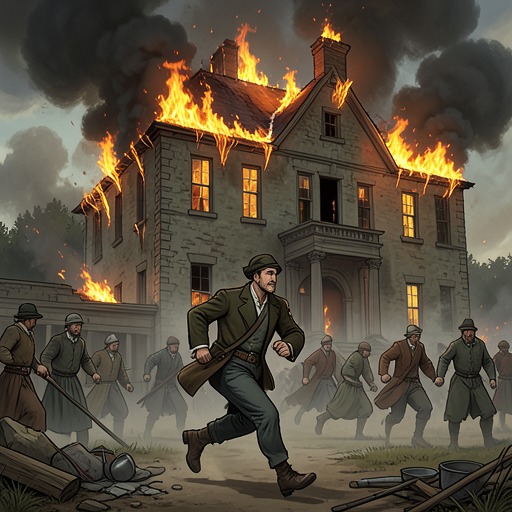
The narrator reconstructs the plan as an attempt to make smoke and drive the master’s birds out, not to kill them or set fire to the buildings. Before dawn, the Moonball is pushed into the dovecote loft, where dry nesting material catches. The fire spreads from the loft into roof timbers and the summer hay. The stable roofs and hay lofts burn, and the painted dovecote is lost; the surviving account does not establish a precise count of the birds killed. The fire’s consequences therefore exceed the apparent aim of the scheme: an effort directed at the Doves becomes a destructive blaze at Charles Kent’s property.
Once the fire is visible, the twins and Brooker Higgs make a conspicuous show of helping to fight it. They take part in bringing water from the pond and cisterns and in beating at the flames with spades. The narrator reads their energy as an attempt to appear loyal and tireless in Charles Kent’s service, even as their role in the fire gives them reason to fear discovery. Their performance makes their guilt seem more, rather than less, apparent to the narrator.
Accusation Against the Newcomers
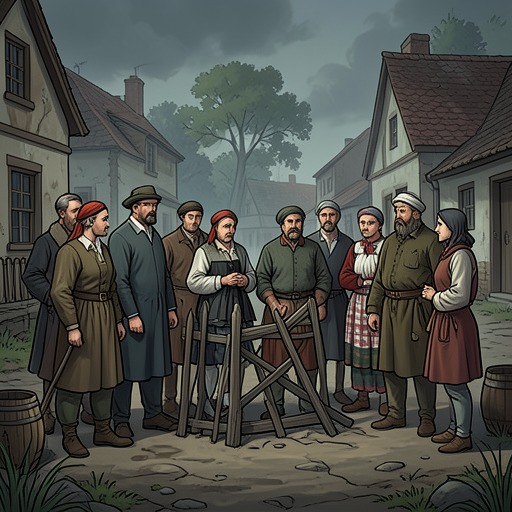
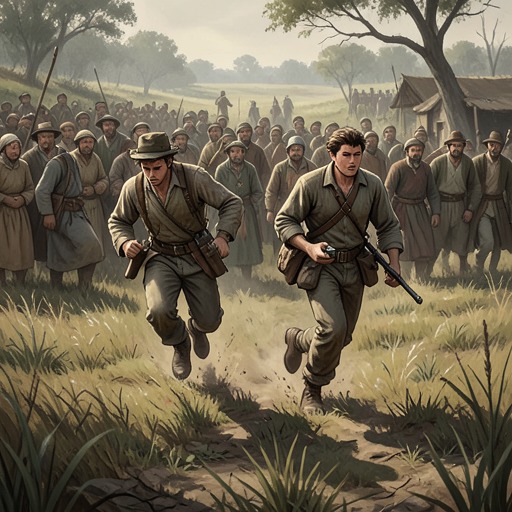
Brooker Higgs, described as the trio’s orator, takes the lead in organizing a search for those responsible. Instead of supporting an accidental explanation, he argues that the fire was maliciously started, then directs suspicion away from the villagers and toward newcomers camping beyond the fields. The narrator connects this maneuver to the blackened ricking ladder, which the trio had leaned against the stable wall to reach the dovecote. The account thus places the twins within a shared effort to redirect blame, though Brooker is the one specifically credited with speaking and organizing.
At a clearing near The Bottom, the group finds bird bones beside the newcomers’ dwelling. Christopher, ordinarily the quieter twin, points to the remains and presents them as evidence that the newcomers had eaten one of Charles Kent’s birds. His confidence gives the accusation a tangible object, but the identification is disputed by details on the ground: John Carr inspects the remains and judges that the bird had dark feathers, short bones, and a yellow beak, unlike the master’s white Doves. The villagers nevertheless prefer the claim that the newcomers had disguised their plunder. The bones therefore serve not as conclusive proof but as a focus for a suspicion the community is already prepared to believe.
The newcomers do not appear when summoned, and Brooker Higgs strikes at their makeshift dwelling. The twins’ participation in the accusation matters beyond the immediate search: the narrator later judges that the newcomers were punished unjustly because of the men’s deceit and silence. The available account does not specify a formal penalty imposed on Christopher or Thomas for their part in the fire or the false charge.
Later Suspicion and Narrative Significance
After Willowjack dies, the narrator considers whether the twins and Brooker Higgs might have been responsible. The possibility is framed as speculation: news that the village and its livelihoods might be surrendered to sheep could have given the trio cause for anger, and the horse might have become a target. The narrator also notes their strong fists. But this proposed explanation is rejected. In the days after the dove incident, the three have been moving about like chastened men, fearful that their involvement will be exposed; the narrator sees no reason to suppose that the Fairy Caps could have driven them to kill a horse they knew the village loved.
This distinction preserves an important uncertainty in the twins’ part of the story. Their role in the dove scheme and the turn against the newcomers is reconstructed by the narrator from their conduct and the evidence of the ladder and bird remains; Willowjack’s death remains unassigned. Christopher and Thomas are therefore not presented as the proven agents of every later act of violence. Their narrative significance lies instead in the chain that begins with a limited intention, proceeds through conspicuous attempts at loyalty, and depends on silence and misdirection when strangers become available as scapegoats. The twins’ shared identity makes them part of a small village group, but the contrast between Christopher’s quietness and his forceful accusation shows how readily even the quieter brother can lend authority to a claim the evidence does not settle.