Young Edmund Jordan
HarvestYoung Edmund Jordan is the blood cousin who claims the Jordan Estate after Lucy Kent’s death, and the force behind its planned conversion from a working village to enclosed sheep pasture. His authority rests on inheritance law, but his project reaches far beyond the family dispute: it threatens the commons, the village’s subsistence economy, and the customs through which its people understand their place on the land. The narrative presents him as courteous and physically frail, yet determined to make both people and property conform to a profitable design.
Identity and Inheritance Claim
Young Edmund Jordan is a relative of Charles Kent and a blood heir to the estate. The old Edmund Jordan and his wife had a daughter, Lucy, but no son. After Lucy married Charles, her father died and the manor passed to her as his sole heir. The inheritance document, however, directed that the property be divided at Lucy’s death among her male heirs by blood. Lucy died in childbirth in the spring; her infant was a girl, and Charles, as her husband, was not a blood heir. Young Edmund therefore arrives asserting a claim that displaces Charles from the position of landowner.
The claim is not presented as a simple contest between a rightful outsider and an illegitimate usurper. It has documentary force, and Charles himself has employed Philip Earle to prepare maps and charts for changes that Young Edmund demands. Yet Walter Thirsk understands that Charles does not want those changes. Inheritance law gives Young Edmund a basis for control; it does not make the consequences of that control welcome or inevitable to the people who work the estate.
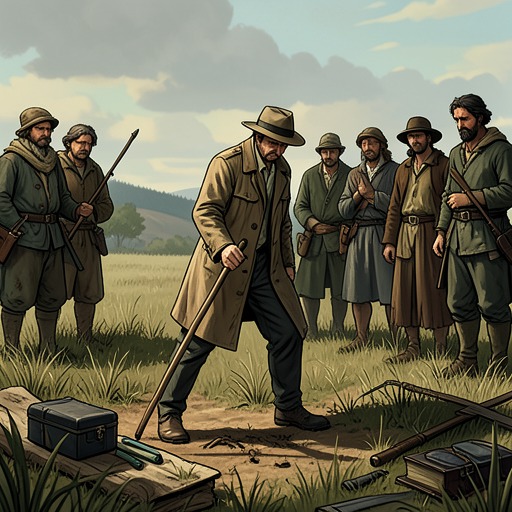
The first impression of Young Edmund complicates the authority he is about to exercise. He is not yet thirty, dressed for the open air rather than for manual labor, with a carefully shaped beard and a stiff left arm and shoulder. His uneven movement suggests a body poorly suited to rough fields, and his expression bears a trace of past illness. He is nevertheless exceptionally ready to smile. The villagers watch him and wonder whether the marks he makes on his board may also mark them, an early image of the gap between the mild mapmaker’s appearance and the power his plans carry.
Arrival and Competing Jurisdictions
Young Edmund’s judgment of the earlier dispute with the newcomers reveals how he understands justice. Charles recounts the fires, the doves, the bows, and the punishment in the pillory; Young Edmund replies that Charles makes problems for himself by being kind. In his view, the men in the pillory received what they deserved. Even the older man’s death falls within the bounds of the law as Young Edmund understands it. He considers a severe sentence, including the possibility of mutilation and execution, a normal response to a sturdy vagabond accused of setting fires.
He also insists that the younger prisoner should complete his week-long sentence, arguing that a public offense requires punishment in the community’s full view. Because the prisoner has threatened Charles and blames him for his kinsman’s death, Young Edmund proposes taking him away when the party leaves. His proposal combines legal penalty with removal from the place where the conflict arose. He dismisses the woman associated with the men as no danger to Charles and treats the dead man’s burial as a matter of little concern, suggesting disposal where animal remains are left rather than burial in consecrated ground.
This approach contrasts with Charles’s reluctance to destroy the lives of working families. Earlier, after the stable and dovecote fire, Charles had considered beating the guilty men, sending them beyond the estate boundary, and taking animals in recompense, while rejecting a punishment that would put their lives at stake. Young Edmund instead treats the law’s harsher possibilities as legitimate and views leniency as a source of disorder. The contrast is not merely between two temperaments: Charles’s discretion and the villagers’ customary expectations confront an incoming authority that can invoke formal procedure when it serves its purposes.
Enclosure and the Wool Economy
Young Edmund presents his program as improvement and obligation. He claims that he did not arrange to inherit the estate, but that a final testament must be observed regardless of its consequences. His stated project is to impose a tidier, more profitable system on the property. He does not intend to become a resident country landowner; he prefers to remain in his merchant house in the market town and monitor wool, cloth, and the profits recorded in his accounts.
The practical work is assigned to Baynham, Young Edmund’s steward, whom he identifies as experienced in preparing land for sheep. Philip Earle is to complete the maps before the week is out, and Baynham is to use them to organize the land with fences, dykes, and walls before the first snow. Young Edmund proposes reclaiming woodland and cutting trees whose shade, in his calculation, produces no direct profit. The commons are to be cleared and privately enclosed; the fields are to become pasture, and the plow is to disappear from the estate’s future.
His economic argument recasts a risky agricultural life as an inefficient system awaiting rational management. Charles had earlier offered the villagers a gentler vision: wool would yield a steadier livelihood than crops exposed to sun, rain, wind, disease, and birds, while spinning and weaving would provide work. Young Edmund’s version is colder. It is a scheme for profit, not a promise that every household will prosper. When Charles points out that the village has just under sixty people to feed, Young Edmund leaves their employment to Baynham and acknowledges that economies will be necessary. Some may find work as shearers or shepherds; he gives no assurance that there will be a place for everyone.
Power, Community, and Character
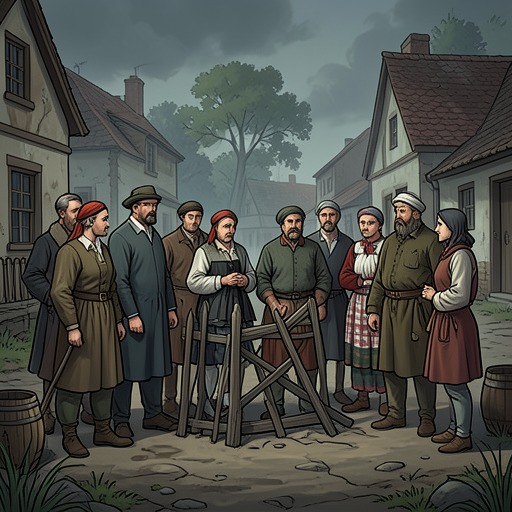
Young Edmund’s confidence depends on treating the village’s existing life as a problem of management. The villagers’ harvest customs require collective labor because their numbers have fallen and the grain is not abundant. Children weed among the barley; workers reap and bind; older people make the stooks. The work is both a means of securing food and a shared practice that brings the community together. Enclosure threatens not only access to land but the arrangements through which households meet their needs and recognize common claims.
The villagers understand those claims as rights attached to long use, even where they have no deeds or formal documents. They know that Charles owns the fields in law, but insist that working the land gives them a possessive relation to it and to its common resources. Young Edmund’s maps and boundaries convert this lived relationship into a plan that can be measured, partitioned, and enforced. His confidence in inherited documents and commercial calculation thus meets a customary order whose authority is grounded in labor and survival.
His manner sharpens the threat. He can speak patiently and smile, but his patience does not extend to the village’s disorder or to the needs that complicate his design. When he surveys the inhabitants and land, he imagines sheep in place of the people already there, reading their fearfulness and dependence as evidence that they are fit to be replaced. His joke turns the proposed livestock into an assessment of the villagers themselves. The scene makes clear that enclosure is not simply a change in agricultural technique: it is also a judgment about who is useful, who can remain, and whose needs count.
Narrative Role and Unresolved Outcome
Young Edmund enters as both heir and reformer, joining a family succession dispute to a larger conflict over land and livelihood. His claim gives the enclosure project legal leverage; the maps translate that leverage into planned boundaries; and his invocation of public justice shows how discipline may reinforce economic change. The treatment of the newcomers and the proposed removal of a prisoner establish that his authority can reach beyond property into the bodies and movements of people on the estate.
The narrative does not reduce him to a mere villain of avarice. His claim follows the terms of the inheritance, and his commercial reasoning belongs to a coherent project of estate management. But the consequences he accepts are stark: the commons will be enclosed, the plow displaced, trees cut for their timber, and employment limited to the hands the new system requires. His courteous exterior and impaired body do not soften the structural force of those decisions. In the supplied episodes, the outcome of his rule remains unsettled; what is already clear is the scale of the change he intends and the unequal authority by which he means to impose it.