Lizzie Carr
HarvestLizzie Carr is the village girl crowned Gleaning Queen, whose green sash makes her both a cherished figure of communal custom and a suspect in Edmund Jordan’s search for Willowjack’s killer. Her arrest begins with a misunderstanding of her ceremonial clothing, but her questioning draws Philip Earle into a witchcraft accusation and ends with Lizzie being taken away under guard. Walter Thirsk recounts much of this through rumor and reconstruction, so Lizzie’s experience is visible chiefly in the details others attach to her: the sash, the flowers, and the grains that once made her Queen.
Identity and Place in the Village
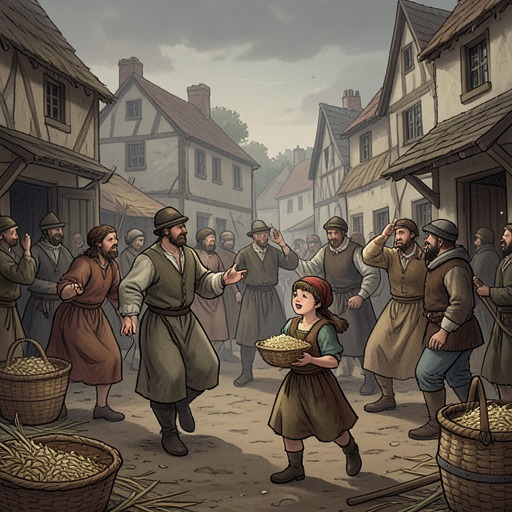
Lizzie is repeatedly described as a girl, and as too young to fit the feared image of the woman whom Edmund Jordan’s men have been encouraged to find. Her prominence comes not from rank or authority but from the village’s gleaning tradition. At the annual ceremony, she became Queen for a year after finding a single grain of barley. Her father and her uncle John Carr had lifted her in a chair formed by their hands and urged her to search; the small grain she found was enough to earn the village’s cheer and the title. Walter remembers her blowing away the husk and holding the barley grains in her palm. That memory gives the title a material and communal meaning: it belongs to a child participating in the harvest, not to a position of formal power.
The green sash marks that distinction in public. Lizzie wears it as the Gleaning Queen, alongside yellow blossoms that she hopes to renew after leaving the threshing barn. The clothing is valuable enough to attract attention, yet its significance to her is bound up with the village ceremony and her year-long honor. To Edmund Jordan’s men, however, expensive fabric is potential evidence. They connect Lizzie’s sash with the bloodstained velvet shawl associated with Mistress Beldam and with their search for Willowjack’s killer. The same kind of object that makes Lizzie recognizable as Queen thus makes her suspicious to people who do not understand the custom.
Arrest and Questioning
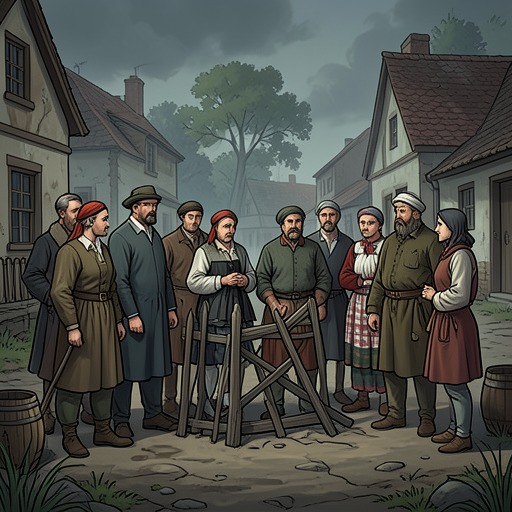
Walter first learns that Lizzie is in custody alongside Kitty Gosse and Anne Rogers. His account at this point is explicitly uncertain: he has heard that the women and girl have been taken, but has not yet seen them. He reports that the village is unsettled and that several young men have left, leaving fewer people prepared to resist the arrests. In this atmosphere, Lizzie’s movement beyond the barn becomes consequential. Edmund Jordan had instructed people not to stray that day, and the men challenge her when she leaves the threshing barn to replace her blossoms.
Walter imagines the encounter rather than claiming to have witnessed it. In his reconstruction, the men question why Lizzie is in the lane and how a village girl came to wear such fine cloth. She tells them that Charles Kent gave her the sash and that she is Queen for the year, but they doubt her explanation and take her before Edmund Jordan. This distinction between observed fact and imagined sequence matters: Walter can report Lizzie’s custody, but the precise beginning of her arrest reaches him as conjecture. The incident nevertheless shows how quickly a familiar village sign can be interpreted as an incriminating clue when authority is searching for a different story.
The later account describes a more formal interrogation. Lizzie is brought into the room after a day in custody, wet-cheeked, and is promised that she may keep her sash if she proves herself wise and honest. Her testimony is then presented as support for a supposed covenly intrigue. She says she was frightened by Philip Earle and associates him with her crowning and with an attempt to touch her. The men interpret this allegation alongside stories about Earle’s artistic work and his account of having been struck by lightning. Because Lizzie has been questioned and her sash is made conditional on what she says, her statement appears within a process already shaped by suspicion and pressure; the account does not establish that the accusations are true.
The Sash and the Gleaning Queen
The sash changes meaning across Lizzie’s story. At her crowning it signifies the village’s recognition of a child who has taken part in gleaning. During the search, it becomes one of the costly garments the authorities believe may reveal the killer. Under questioning, it is used as an inducement: Lizzie is told she can keep it if she satisfies her interrogators. By the time Walter sees her leaving the Manor House, it is still tied around her throat, but it is dirty and torn. The ceremonial token remains visible even as the ceremony’s meaning has been displaced by official suspicion.
Walter’s memory of the crowning sharpens the contrast. He recalls Lizzie as nervous but willing to step down from the chair made by her father and uncle and find one grain. In that earlier scene, the community turns a small act into an honor and promises to cheer her. In custody, the same child is asked to prove her honesty to men who have already connected her clothing to their investigation. Her status as Queen offers her no protection; instead, it makes her conspicuous. The narrative therefore places the village custom and the authorities’ procedure side by side without treating them as equivalent forms of recognition.
Departure and Narrative Significance
When the prisoners emerge from the Manor House, Lizzie is part of a line of captives tied at the wrists and waist. Walter sees Kitty Gosse, Anne Rogers, and the girl, but hesitates rather than approaching them. He remembers Lizzie’s former appearance as he sees her now, and judges that she is frightened and diminished by the ordeal. His account does not supply her thoughts or a later fate; it records the visible contrast between the child crowned at the gleaning and the captive leaving the estate.
Lizzie is seated on a loaded horse and secured among the luggage as the party departs. Kitty Gosse and Anne Rogers walk beside the panniers, while the wounded groom sets the slow pace. Walter hopes Lizzie will reach a safe and comfortable place, but the passage establishes only that she is being taken away, not what happens after the journey. Her departure is therefore both a concrete removal from the village and an unresolved ending. Through Lizzie, the narrative shows how a child’s customary honor can be detached from its communal setting, misread as suspicious display, and carried away as part of an official case. The green sash survives as the clearest thread connecting her public celebration to her forced passage into custody.