Anne Rogers
HarvestAnne Rogers is a fiery village woman, Kitty Gosse’s closest friend, and the mother of a son who leaves with the other Rogerses. Her intervention when Young Edmund Jordan’s men seize Lizzie Carr carries her from the familiar work of the harvest into custody and interrogation. Through Walter Thirsk’s uncertain reconstruction and later account of the prisoners’ departure, Anne emerges as both a determined defender of her neighbors and a target of authority that can compel testimony while denying the villagers control over what happens to them.
Identity and Village Position
Anne is identified as Kitty Gosse’s best friend and as the piper’s mother. Walter describes her as fiery and warns that disagreeing with her is unwise, even for someone in her family. The brief characterization suggests a woman accustomed to making herself heard; it also helps explain why, in Walter’s imagined account of the arrest, she would not simply watch a child being taken away.
Her place in village life is also marked by the departure of her family. When Lizzie, Kitty, and Anne are held in Young Edmund Jordan’s custody, Walter notes that Anne cannot know her son has abandoned her and gone with the other Rogerses. By the time the prisoners are brought out, he sees only one neighbor remaining nearby: Walter himself, lurking in the shadows. Anne’s personal ordeal thus unfolds alongside a wider scattering of households, leaving her separated not only from the village’s customary protections but, apparently, from her son and other kin.
Intervention in the Arrest of Lizzie Carr
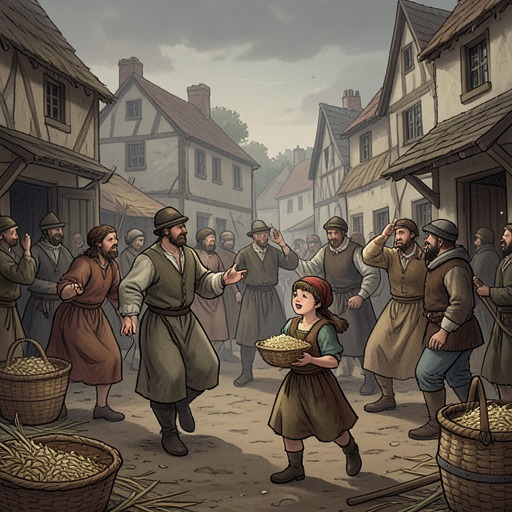
Walter does not witness the arrest as he later imagines it. He speculates that Anne and Kitty may have been working at the threshing barn’s entrance, within sight of the lane, when three of Young Edmund Jordan’s men took Lizzie away. Their stated restriction against straying beyond the barn gave the men an immediate pretext for removing the child; Lizzie’s status as Gleaning Queen, and the fine dressing on her head, also made her appearance an object of scrutiny. Walter pictures the women intervening because the men had been present that morning when a neighbor was prophesied to hang from an oak by sundown.
In Walter’s conjecture, the ensuing struggle is a tug-of-war over Lizzie. The women kick and resist, but are outnumbered and outmuscled, and are eventually dragged away with the child. He imagines Anne’s battling voice drawing workers out of the barn to watch. The interruption ends threshing and winnowing early; it also provides, in Walter’s reading, the moment when Brooker Higgs and Christopher and Thomas Derby decide to flee before their own secrets can be exposed. These details are presented as Walter’s reconstruction, not as a witnessed account, and his uncertainty matters: he can infer the violence and its effects without knowing exactly how Anne and Kitty became involved.
Captivity and Coercive Questioning
Later, Walter pieces together Anne’s questioning from what Charles Kent has heard beneath the manor-house roof. The men in charge, he supposes, were emboldened by their unusual authority, away from wives and mothers and without witnesses they considered consequential. They could claim to be acting on their master’s orders. Walter imagines that Kitty tried to resist, but that the questioning and torment left little room to refuse cooperation. Anne, too, was bruised and exhausted by the time she answered.
According to Charles Kent’s account, Kitty identified herself when required and insisted that neither she, Anne, nor Lizzie had been a ringleader. Pressed to explain their role, the women described themselves as foolish followers. They then supplied names, first of women and later of men. Walter is surprised that John Carr is among those named, while he himself is not. He wonders whether Kitty has protected him, but presents that thought as a temptation rather than a certainty. The interrogators dismiss the village names as unimportant, and the questioning turns toward assigning responsibility to someone of greater standing.
Friendship, Resistance, and Blame
Anne’s friendship with Kitty is integral to how Walter understands the episode. He imagines the two women resisting together and later reports that Anne joined Kitty in answering the interrogators. Under pressure, they name people they describe as followers rather than leaders; their immediate agreement, Walter suggests, may also have been an effort to salvage some reputation for their men and friends. Their testimony is therefore both an act extracted by force and an attempt to manage the consequences for people they know.
When asked who was most responsible, Anne answers that it was the gentleman. The interrogator asks which gentleman, and Anne pauses before repeating the identification. Walter believes she may have imitated Philip Earle’s uneasy walk, crunching up her shoulders, as she indicated him. She does not need to say his name for Charles Kent to understand. Her gesture makes accusation legible while leaving it indirect: the man who appears to be a gentleman is named as the source of responsibility, rather than the ordinary villagers whose names the interrogators have collected. Anne’s answer does not undo the coercion of the proceeding, but it refuses to let the questioning’s hierarchy decide, unchallenged, who counts as culpable.
Departure and Narrative Significance
Walter sees Anne again when the prisoners leave the manor house. She comes out in a line with Kitty and Lizzie, their wrists and waists tied. Her hands are crossed on her apron and her shoulders hang like a penitent’s. Walter hesitates instead of approaching them. Although he hopes Charles Kent’s intervention will eventually secure their freedom, he is too shocked by how unfamiliar the prisoners look to offer comfort. He cannot tell whether Kitty’s face twists at the sight of him or from pain; Anne’s appearance likewise gives no clear measure of what she has endured.
The scene distinguishes visible injury from the damage of detention. The groom is plainly bloodied, while the women are not visibly wounded in the same way; nevertheless, Anne, Kitty, and Lizzie no longer seem to Walter like the people he knows. Their bound procession makes the authority of Young Edmund Jordan’s party physically visible, while Anne’s earlier accusation has already located responsibility above the villagers it interrogates. Walter’s account keeps the limits of his knowledge in view: he reports what he sees, reconstructs what he cannot, and marks the difference between the two. Within that fractured telling, Anne’s resistance and her answer to the interrogators preserve a voice of judgment even as her body is taken into custody.