Philip Earle
HarvestPhilip Earle is a mapmaker, painter, and musician whose work gives the proposed transformation of The Village a beautiful, persuasive form. His colored charts let residents see their land from a perspective unavailable on foot, but their order also conceals the labor, distance, and communal life that make the place what it is. A courteous outsider who becomes Walter Thirsk’s companion and prospective employer, Earle is drawn into a political struggle that turns his maps and artistic materials into evidence against him. He vanishes during the witchcraft accusations and is later found dead in the manor house; the account does not establish when or by whose hand he was killed.
Identity and Arrival
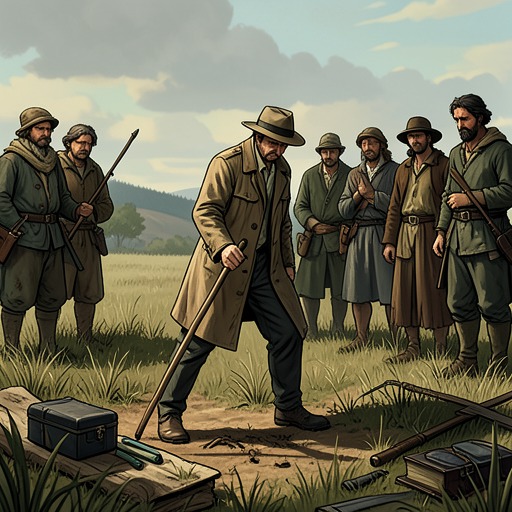
Earle first appears as the unfamiliar gentleman recording the landscape while the villagers harvest barley. At Master Charles Kent’s request, he measures and marks fields, woods, ponds, lanes, and cottages. His working equipment and methods set him apart from the harvesters: they cut the crop with scythes while he studies the land with brushes and quills. Though dressed for the open air, he is not suited to rough fieldwork. He is under thirty, wears sturdy boots, breeches, a jerkin, and a plain cap, and keeps his beard shaped to a point with wax. His left arm and shoulder are stiff, and he moves with an uneven, stumbling gait. The narrator notices signs of past illness but also Earle’s readiness to smile.
At the village feast, Charles Kent introduces him by name as a trusted acquaintance employed to map the common ground and estate. Earle is to record the land and prepare petitions for the courts as part of Kent’s proposed reorganization. The villagers first know him as Mr. Quill, a name that reflects his drawing tools and work; after he joins the music, they jokingly recast him as Mr. Fiddle. His other public designation, the Chart-Maker, becomes prominent when suspicion replaces familiarity.
Maps, Art, and the Land
Earle’s charts begin as measured marks and geometric shapes, then become vivid painted compositions. Walter recognizes the skill and beauty in them, comparing their intricate patterns to forms he has found in bark, lichen, moss, and leaves. Earle’s designs are more colorful than those natural patterns, and he presents one as an account of the land as it exists before Young Edmund Jordan’s improvements. A second chart depicts the planned sheep fields. Its smaller, neatly edged parcels make enclosure visually legible, even attractive.
Walter’s local knowledge also reveals what the charts leave out. On the ground, a route between fields follows slopes, a cow track, a wooded ridge, and a thorn-lined lane; the two fields cannot be viewed together from the walk. On the map, they sit side by side, compressed into a single glance. The painted land has no shadows or difficult climbs, and it cannot register how long a journey, a task, or a season takes. Earle’s representation is therefore compelling without being a full account of lived terrain. It simplifies by arranging and selecting: the future sheep map is tidier and more patterned, but the wood has nearly disappeared, along with the face of the landscape’s sturdy, living presence.
The tension is not simply between an accurate map and a false one. Earle’s pictures move Walter, who learns to locate himself and the village on them, yet their beauty cannot answer what will become of that place. The map makes land available to an overseeing gaze and turns communal ground into bounded parcels. Its visual appeal gives a practical and political proposal a form that can be surveyed, discussed, and advanced through legal petitions.
Earle and Walter Thirsk
Earle’s association with Walter develops through work and shared attention to the estate. He asks Walter to identify plants, records their names, and sometimes presses leaves or flowers into a handwritten Natural History. Walter supplies knowledge of useful, medicinal, poisonous, and supposedly magical herbs, as well as the plain local names for fields, woodland, and other places. Their different ways of knowing complement one another: Earle classifies and records, while Walter explains how people use and move through the land.
Earle also confides a family and inheritance matter to Walter. He explains that Lucy Kent, Charles Kent’s wife, inherited the property from her father, Edmund Jordan, and that the legal arrangement divided it among her male heirs by blood upon her death. Lucy died in childbirth that spring, leaving no son; her daughter was also dead, and Charles was her sole heir. Earle says another Jordan is expected and has a claim on the estate, making clear to Walter why Charles is distressed. The private disclosure turns the mapmaking commission into part of a larger struggle over who may control the land.
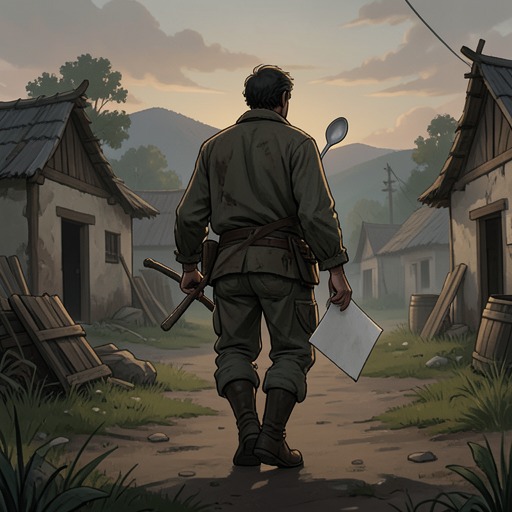
Walter later imagines leaving Charles Kent’s service to work for Earle, an alternative to remaining under the expected rule of the incoming Jordan. He is anxious about the prospect of parting from Charles, whose companionship has shaped his life, but finds the possibility less fearful than serving Charles’s cousin. Walter works to prepare calfskin vellum for Earle’s final charts, taking the skin through soaking and preparation and bringing it into the manor’s scullery. Their professional association thus becomes a possible route out of the village’s threatened future, although the narrative never shows Walter taking up employment with Earle.
Enclosure and Resistance
When Young Edmund Jordan outlines the future of the estate, Earle is the only person in the room to challenge the language of economy. Jordan proposes clearing and enclosing the commons, converting the land to pasture, and replacing most existing work with sheep rearing. He says a small number of villagers might be employed as shearers or sheep-boys. Earle objects that the plan will not produce economies, directly contesting the justification for reforms that threaten the livelihoods of the village’s fewer than sixty inhabitants. His intervention is brief but consequential in tone: the disabled mapmaker, whom Jordan treats as physically and socially unfit, proves willing to speak against the policy in front of its author.
Earle’s charts later contribute to the suspicion directed at him. Neighbors interpret his closeness to newcomers, his welcome to a woman whose shelter was destroyed, and his association with the pillory-bound younger stranger as signs of conspiracy. They also connect the missing velvet shawl to him, despite the competing claim that it belonged to Charles’s late wife. Their suspicion folds his welcome, his art, and his maps into a story of collusion. The evidence establishes that these are accusations, not proof of the alleged alliance.
Accusation, Disappearance, and Death
During the witchcraft inquiry, Earle is treated as a suspected sorcerer. His room supplies objects that his accusers interpret as incriminating: small grinding bowls and blocks, pestles, powders, paints, and his plant book with recipes for potions and spells. His fiddle is called a devil’s instrument, while the colorful, unlabeled charts are presented as incantatory rather than practical. The same materials that express his work as an artist and observer are stripped of that context and used to strengthen the case against him. Lizzie Carr’s account that Earle had made her Gleaning Queen and tried to touch her is also invoked as corroboration.
Earle is not in his room when the men come to collect him. Walter learns that he has gone to the pillory, put an arm around the older captive, and then pursued Mistress Beldam through the night. Charles Kent confirms that Earle has not returned and that Jordan’s men are searching for him. His absence leaves the accusation unresolved and makes his position increasingly precarious.
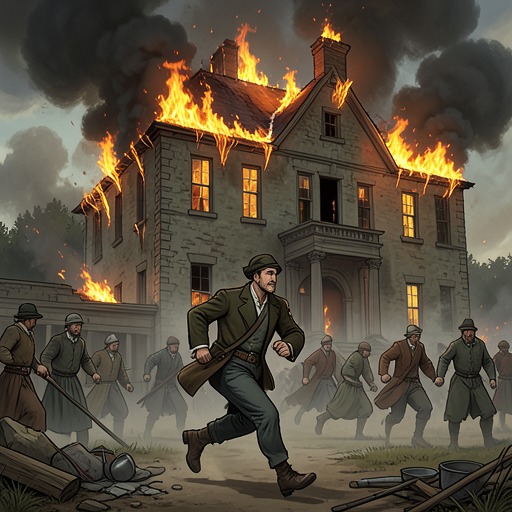
Later, Walter finds Earle dead in an attic room of the manor. He recognizes him by his clothes, paint-stained fingers, shaped beard, and uneven posture. The account identifies a sword as the likely weapon but cannot determine when the killing occurred: it may have happened after the accusations or on the night the women named him. Neither the killer nor the exact circumstances are established. In the final destruction of the manor, Walter burns Earle’s two preparatory charts, one depicting the commons and the other the proposed pastures, but keeps an unmarked sheet of calfskin vellum he had prepared for the work. Earle’s finished representations are destroyed; the blank surface remains open to another account of the land.