John Carr
HarvestJohn Carr is Walter Thirsk’s long-standing neighbor, a capable animal handler, and a trusted member of the village community. His story is defined less by a single ambition than by practical acts of care: working beside Walter, helping with animals, and standing up for his family. When suspicion and witchcraft accusations unsettle the village, those bonds are tested. The changing distance between John and Walter makes visible how a community built on shared labor can close ranks against someone it no longer knows how to trust.
Identity and Place in the Village
John is Walter’s neighbor from the time Walter first settles in the village, and their acquaintance continues for more than a decade. Their friendship has its own quiet customs. They talk outdoors rather than visiting each other’s homes, respecting the idea that neighbors should not pry into private life. That boundary is a sign of mutual regard, not estrangement: they understand each other well while leaving each other’s domestic spaces alone.
John is also part of a shrinking community whose shared work depends on people contributing what they can. Harvest requires the village’s available hands, and its routines join labor to the exchange of news and jokes. The evidence places John within this communal world without making him a spokesman for it. His importance appears instead through particular relationships and tasks: his closeness to Walter, his care for animals, and his family’s connection to the younger generation.
Work and Care for Animals
John is especially skilled with animals. Walter has seen him stop a moving group of cattle, including animals made excitable by other cattle, and calm a barking dog with a steady touch. The ability is both practical and gentle: John can control an animal without treating force as the only answer. The villagers call on him when an animal must be slaughtered, and he kills the calf served at Charles Kent’s feast. The calf’s hide is later set aside for the work of making vellum, connecting John’s task to the village’s material crafts as well as its food supply.
This expertise makes John a plausible suspect when Willowjack is killed. Anne Rogers’s account describes a method that Walter thinks John could carry out with the necessary skill and speed, and John’s role as the village slaughterman gives that possibility a practical basis. Walter nevertheless rejects the suspicion. He remembers John’s short, work-worn hands and, above all, his kindness and close attachment to animals. John’s competence therefore has a double meaning: it could be misread as evidence against him, but in Walter’s judgment it is inseparable from the care that characterizes him.
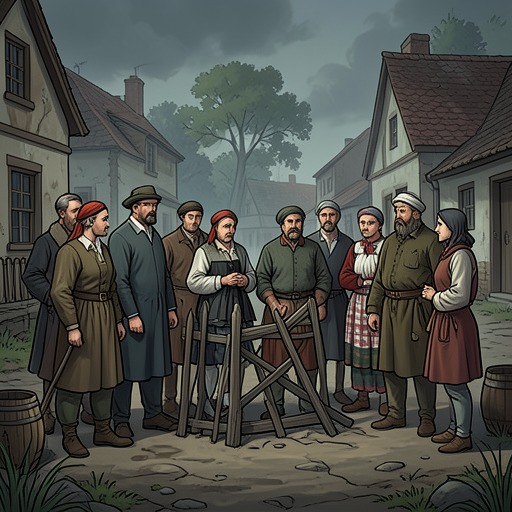
John’s knowledge and labor also matter in less dramatic acts of neighborly help. When Walter considers how to provide a raised place for the older newcomer held in the pillory, he cannot manage the heavy stone alone and plans to ask John for help at first light. He thinks they might move the stone together or carry the ends of a bench, and considers asking boys to find a log instead. The passage records the plan rather than confirming that John carries it out; its significance lies in Walter’s instinct to turn to him as a reliable partner.
Friendship with Walter Thirsk
The friendship between John and Walter is grounded in shared experience rather than frequent entry into one another’s homes. They once went mushrooming together in the woods during Walter’s first summer in the village. Later, when fire threatens the estate’s stable buildings, John goes beside Walter into the dangerous work of trying to move burning hay to safety. Walter’s hand is badly burned in the effort. John’s presence is not ceremonial: he is a companion in the practical risk of trying to save the estate’s winter feed.
Their habits of privacy become especially important when the village is searched. Walter is embarrassed to reach the Carrs’ home with the search party because he and John have never made a practice of entering each other’s cottages. He asks the men to take care, but they go in impatiently. Walter senses that his warning has made them more suspicious, and he steps away, unable to bear the disturbance. He knows John will not understand why he did not enter and try to stop the search. Their ordinary discretion, once a mutual courtesy, cannot protect John’s household when outside authority overrides it.
Family and Community Ties
John is Lizzie Carr’s uncle, and he joins her father in carrying her at the Gleaning Queen ceremony. When the young girl is chosen, Charles Kent places a green sash on her head, and John and her father make a chair by joining their hands across each other’s wrists. They carry Lizzie to the edge of the harvested field, where she is guided to step barefoot onto the stubble and find a grain. John’s role in the ceremony places him within a public family moment: his niece is at its center, and he helps physically carry her into the community’s tradition.
The episode also shows how collective customs depend on practical participation. Lizzie is very young and uncertain about what is expected of her; her father and uncle provide the means for her to take part. John’s presence links kinship to the village’s seasonal ritual, where a child’s discovery of a grain makes the harvest’s labor visible in miniature. His family is not separate from communal life: it helps enact it.
Suspicion, Loyalty, and Estrangement
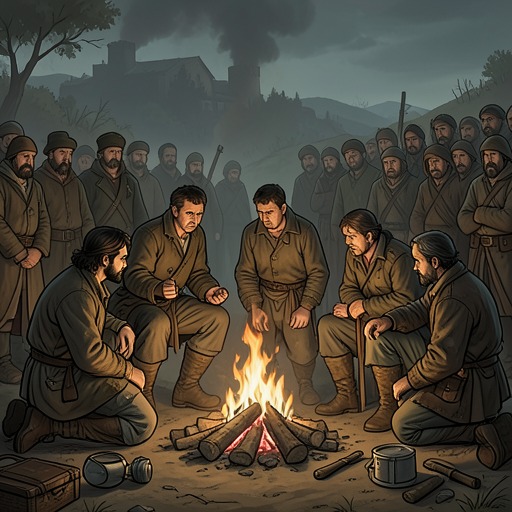
After three women and Lizzie are taken into custody, John becomes cautious with Walter. He meets him inside Walter’s cottage rather than on their usual outdoor bench, avoids being seen from the lane, and speaks quietly. He reports that the villagers had been kept waiting outside the manor house and that Charles Kent was unavailable to them. Baynham eventually told the crowd that three women were already in custody and suggested they gather fuel for a fire. John recalls that the villagers’ anger then burst into speech, and admits that they had to take care of their own. His guarded account tests whether Walter is still someone he can trust.
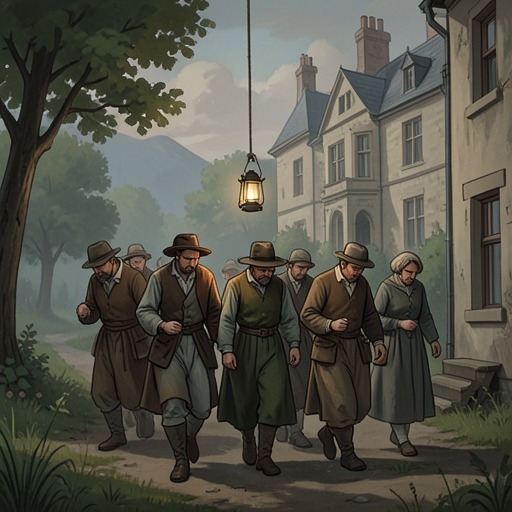
Walter answers with a restrained gesture and an assurance of loyalty. John accepts the answer only with a warning that Walter must not be deceiving the villagers. He then advises Walter to follow Brooker Higgs and Christopher and Thomas Derby, who have already left, and to save himself. John’s caution is an act of concern, but it also marks the distance between them: he does not simply assume that their old friendship places Walter inside the group’s circle of trust.
That distance has developed through a series of visible choices. Walter has spent time with Mr. Quill, helped prepare materials for the land chart, and failed to join the village in some of its gatherings and confrontations. The villagers associate him with Charles Kent and the Chart-Maker, and John’s earlier account shows that they suspect Walter of involvement in a conspiracy. John does not present these suspicions as established truth; rather, his reluctance and his warning show how thoroughly fear has unsettled their customary confidence.
The friendship remains real, but it no longer guarantees belonging. John is kind enough to speak when he would rather withdraw, and he gives Walter a chance to answer before urging him to leave. At the same time, he speaks from within the villagers’ defensive circle and cannot promise Walter a place in it. Through John, the narrative sets the durable intimacy of shared work and neighborly care against a crisis that makes loyalty conditional. His capacity to calm animals offers a pointed contrast to the human community around him: in the face of rumor and accusation, even an old friend may have to approach cautiously.