Brooker Higgs
HarvestBrooker Higgs is one of three village bachelors responsible for a fire that destroys the dovecote and damages the stable. Their attempt to drive away the master’s pigeons becomes a larger disaster, and Brooker’s response turns concealment into a second injury: rather than admit what happened, he helps redirect blame toward newcomers, who are punished while the villagers keep silent.
Identity and Background
Brooker is an unmarried man in a village short of unmarried women. He is closely associated with Christopher and Thomas Derby, the village’s only twins; the three go wooding together and, on the evening before the fire, return without game or fuel. Walter Thirsk notices that they seem unusually pleased with themselves. Their sack is bulky but nearly weightless, and their laughter gives away their excitement before its contents do.
When Walter asks whether they have had luck, the men show him the sack. It contains Fairy Caps they have saved for later, golden shawls, and a large Moonball, too dry and hollow to cook. Walter recognizes the signs of mushroom intoxication: he himself ate Fairy Caps in his first summer after settling in the village. That memory makes him especially able to read the bachelors’ excitement, but it does not make him a participant in their later plan.
The Fire and Its Causes
The previous day, the harvest has ended and the last sheaf has been cut. The villagers expect the customary rest and subsequent gleaning, and most settle at home reassured that Master Kent will not sell their fields. The three bachelors instead go to The Woods. Walter connects their discovery of the Moonball with the fire: its dry, tinder-like interior can carry a flame, and the men use it as a lantern to take fire into the master’s yards.
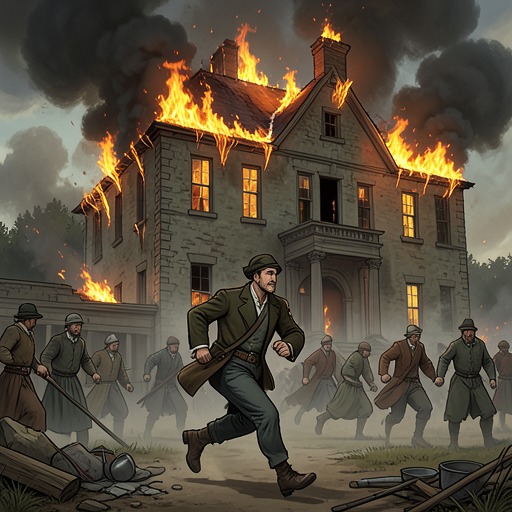
Their stated purpose, as Walter reconstructs it, is to make smoke and drive away the pigeons that have been eating village bread and ale. The plan is not to kill the birds or burn the buildings. But the smoking Moonball is pushed into the dovecote before first light, among dry chaff and nesting litter. The smolder catches; the fire spreads along the roof beams and reaches the stored hay. The pigeons cannot escape the smoke and flames, and the stable yard bears the loss of the birds as well as the buildings and hay.
Brooker’s responsibility is collective with that of the Derby twins, not separable in the evidence into a distinct act by him alone. Walter identifies all three as the perpetrators, and later describes them as the men who used the access ladder to reach the dovecote. Their intended target was the pigeons, which they hoped to steal for food; the fire’s spread and the birds’ deaths exceed that purpose.
Concealment and the Accusation Against Strangers
When Master Kent arrives to watch the stable burn, Brooker and the twins make a conspicuous show of helping. They fetch water from the pond and cisterns, beat at the flames with spades, and appear eager to prove their loyalty. The display does not erase their guilt. Brooker is particularly noticeable because he becomes the orator in the effort to find someone responsible for the blaze.
He agrees that the fire must have been deliberate, then helps frame the evidence to point away from the villagers. The ladder used to reach the dovecote is blackened by the fire, but Brooker suggests it was put there by someone trying to steal the master’s pigeons. He argues that no hungry villager would need to steal food when Master Kent has promised a calf for the harvest feast. The reasoning conceals the central fact: Brooker and his companions did want the pigeons, and they had used the ladder themselves. He directs suspicion instead toward strangers camped beyond the fields, whose own plume of smoke can be seen across the trees.
Master Kent says the strangers will be visited after the buildings are safe. The villagers subsequently leave two men in the Village Pillory, and the account makes clear that they bear blame for the fire despite not having set it. Brooker and the twins could correct the accusation and perhaps make amends, but they do not confess. At the harvest feast they sit together, unusually quiet and away from the lantern light. Walter thinks they could offer an almost-honest explanation without great fear of punishment, yet their reluctance to risk the truth leaves the newcomers exposed to the sentence.
Later Suspicion and Narrative Role
After Willowjack and the abandoned man from the pillory are found dead, Walter considers whether Brooker and the Derby twins might have killed the mare. He imagines a possible motive: the bachelors may have heard that the village and its work are to be surrendered to sheep, leaving them angry at a future in which thousands of sheep would outnumber the people. He also speculates that the men might have been restless after hearing lovemaking, or affected by eating more Fairy Caps. These are possibilities Walter tests, not established facts about Brooker’s motives or actions.
Walter ultimately rejects the accusation. The three bachelors have been skulking about, chastened and afraid that their part in the dovecote fire will be discovered. Their earlier deceit has helped expose innocent newcomers to punishment, but Walter judges them too frightened now to kill the master’s mare. Brooker’s later role is therefore defined less by a confirmed second crime than by the contrast between the mischief that began the fire and the fear that follows its concealment.
Through Brooker, the account shows how a relatively small act of retaliation can grow into grave harm when its authors choose secrecy over responsibility. His energetic efforts to fight the fire and his confident redirection of blame are parts of the same evasion: one makes him appear helpful, the other shifts the consequences onto outsiders. His silence at the feast completes that pattern, leaving the villagers’ shared knowledge intact while the newcomers endure the punishment.