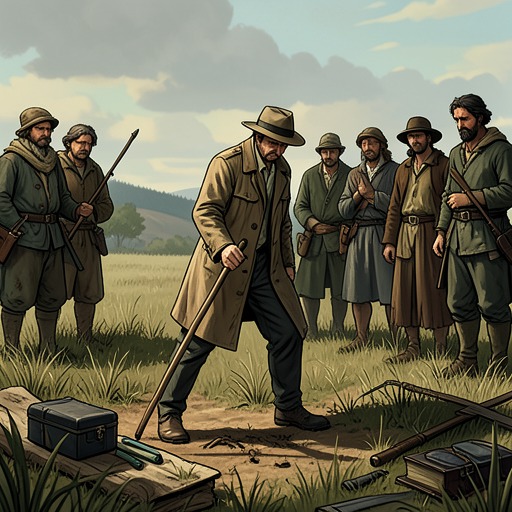
Walter Thirsk
HarvestWalter Thirsk is both a participant in the village’s struggle and the voice through which its customs, loyalties, and losses are examined. Once Charles Kent’s serving man and boyhood companion, he has made a life in the commons through his marriage to Cecily and his work on the land. But widowhood has loosened his sense of belonging. As enclosure threatens the community and suspicion falls on him, Walter’s defining movement is from guarded, self-reproachful observation toward action: he helps free Mistress Beldam’s husband and sows wheat as a final answer to the sheep planned for the fields.
Identity and Background
Walter’s relationship with Charles Kent begins before either man has taken up his adult place. Walter’s father served Charles’s father as a clerk, and Walter’s mother was Charles’s milk nurse; the boys grew up almost as contemporaries, playmates in the elder Kent’s yards. Charles shared books with him, and Walter learned to read, write, and calculate, skills he remembers using less clumsily than his companion. The difference in their social stations remains real, however. Walter refuses to call Charles his brother, even while acknowledging the unusual intimacy of their shared childhood and the debt that binds their families.
He served Charles from youth and was the only attendant who accompanied him when Charles married Lucy Kent and took charge of the estates. Walter’s own departure from direct service came after he fell in love with Cecily. Charles allowed him to leave and take up work in the fields beside her and her neighbors. When Walter explained that his love extended to the village earth as well as to Cecily, Charles advised him to plow it. Walter’s life in the commons thus began not as an inheritance but as a chosen attachment, enabled by the very master whose authority later becomes entangled with the village’s fate.
Life in the Commons and Widowhood
Walter recalls first arriving in the countryside as a young man who had known market towns but not such giving land and sky. During his first week, he walked through the commons toward the forest edge, touching what he encountered: the bark of a tree, ants at work, a flower he put in his cap. The place seemed to him a treasury. His courtship of Cecily took the form of labor at her side, tending her soil and putting his shoulder to the plow. Work was bodily, difficult, and inseparable from affection; the countryside snagged and bruised him, but its demands were precisely what made village life compelling after the insulated distance of town.
Twelve years in the village have not made Walter feel wholly at home. Cecily died of fever, and he describes the loss as a theft that removed love from his labor. He continues to work from duty, but no longer experiences the same bond between effort and desire. He sees that long-established neighbors such as the Rogers, the Derbys, and the Higgses are woven into the place in a way he is not. Their apparent richness lies in taking their customary world for granted; Walter, by contrast, regards himself as a visitor who stayed. The arrival of newcomers unsettles him partly because it makes visible another world beyond the forest: one of maps, redrawn boundaries, and futures that may disregard the old seasonal order.
His relation to the harvest is similarly divided. Walter knows the village’s anxiety over the crop, remembers the late warm rains and weak early shoots, and recognizes the customary labor of sowing and tending as a collective dependence on weather. Yet he admits that he sometimes longs for the wind to flatten the fields, then wakes ashamed of the wish. His private discontent does not erase his attachment to his neighbors; it makes that attachment harder to inhabit without contradiction.
Loyalty, Suspicion, and the New Order
Walter’s loyalty to Charles is practical as well as affectionate. He has taken it upon himself to speak for Charles among the neighbors and to raise grievances with him before they damage his standing. When called upon to assess livestock, tend fruit trees, or repair a roof, Walter has answered without bargaining for advantage. He presents this as a sensible mutual arrangement, not saintly obedience: their shared interests have long made service feel like a form of friendship. That history also complicates his response when the estate’s new direction threatens the people and land to which he has attached himself.
The younger Edmund Jordan sees Walter through a different lens. After surveying the village’s disorder, he appears to regard its inhabitants as idle and dependent, already fit to be replaced by sheep. He singles Walter out by name and seems to wonder whether a man who once came from outside might share his judgment of the village. Walter’s nod confirms only that he has heard him, but Edmund may take it for compliance. The scene exposes Walter’s precarious position: his earlier outsider status can make him legible to authority as a potential ally even when his lived ties are elsewhere.
That precariousness becomes explicit when neighbors accuse Walter and Philip Earle of conspiring with the newcomers. The accusation also serves to redirect suspicion away from Anne Rogers, Kitty Gosse, and Lizzie Carr, who are being held by the estate’s men. Walter hears that his longstanding habits of work and service have been recast as evidence against him: he is said to spend his time with Philip Earle rather than labor beside his neighbors or attend Charles. When John Carr advises him to flee, Walter recognizes the danger but does not simply accept the accusation’s terms. He asks Charles directly whether his name was included in the alleged conspiracy. Charles confirms that it was, then reports that his cousin has decided Walter is someone he can rely upon. The trust is uneasy and unexplained, but it places Walter between competing powers rather than safely within either one.
From Hesitation to Resistance
Walter’s first response to the punishment of Mistress Beldam’s family is compromised by fear. At night he approaches the two men at the pillory and identifies himself as someone who did not accuse them, cut their hair, or march them there. He does not disclose that he failed to speak on their behalf. He tries to find a stone to give the older man a perch, but his previously burned, weeping hand begins to hurt again. The church stones are difficult to move; he cannot find a suitable object at home, and the rain and darkness make further effort impractical. He decides to protect his hand and postpone the task until morning, telling himself the problem is not his alone and that the older man can endure the night. His departure leaves him embarrassed by the gap between his conscience and what he has done.
Later, Walter again considers escape. He could leave before completing his service to Edmund Jordan, and he regrets not having joined the neighbors who departed. Yet Charles’s frightened look and what Walter has understood from the previous night give him a task he cannot abandon. He dresses, takes an old short sword associated with the first Edmund Jordan, and searches the manor for Charles’s mostly unused keys. He intends to release Mistress Beldam’s husband from his sentence if the man will help him with the plow. The choice converts Walter’s divided loyalty into a concrete alliance: he uses access and authority acquired through service to undo, at least in this instance, a punishment imposed by the estate.
The work in the field makes that resistance more than symbolic. Walter and Mistress Beldam’s husband plow together with oxen, while Walter talks through the week’s troubles, recalls Cecily and Charles, and praises Philip Earle. Their shared labor creates an intimacy Walter understands as physical and practical, carried across the oxen’s backs. Afterward, he sends his companion to rest and prepares seed alone. He chooses the heaviest wheat from a bag, using a casting shovel and sacking, and sows without waiting for the turned earth to mellow as good practice would recommend. There is no time for the ideal method. The narrow strip of winter wheat becomes Walter’s farewell gift and his countryman’s revenge on Edmund Jordan’s plan for sheep pasture. His action does not restore the commons or settle his own belonging, but it marks the ground with a future other than the one being imposed.