Willowjack
HarvestWillowjack, Charles Kent’s cherished sorrel mare, is more than a prized animal: her alarm first draws the villagers to the burning farm buildings, and her later death turns a village already strained by suspicion into the scene of an investigation. Because she is loved by Kent and regarded as an unusually fine horse, her killing carries a personal cost while becoming a contested sign of guilt, revenge, and supposed conspiracy.
Identity and Place
Willowjack belongs to Charles Kent, the village landowner. She is described as a fancy sorrel mare, and her quality is made clear by comparison with the horses of Edmund Jordan’s groom: when the groom remarks that Willowjack would benefit from brushing, Walter Thirsk considers her twice as fine as the groom’s mounts. Kent’s attachment is equally plain. When the fire threatens the stable, he stands at a distance beside his rescued mare, watching the buildings burn; the loss of the stable and its contents leaves his home and peace of mind scorched. Later, Walter recognizes that Kent loved Willowjack, making her death a wound to her owner as well as a crime to be solved.
Willowjack’s presence also marks the practical and emotional importance of animals in the village. She is kept among Kent’s paddocks and garths, and her safety is part of the villagers’ concern when they rush to help at the fire. Her resistance to strangers is noted in the account of her death: even removing a blood tick from her ear could earn a nip. That reputation makes the first assumptions about her killer seem plausible, but it does not prove who was responsible.
The Stable Fire and Willowjack’s Warning
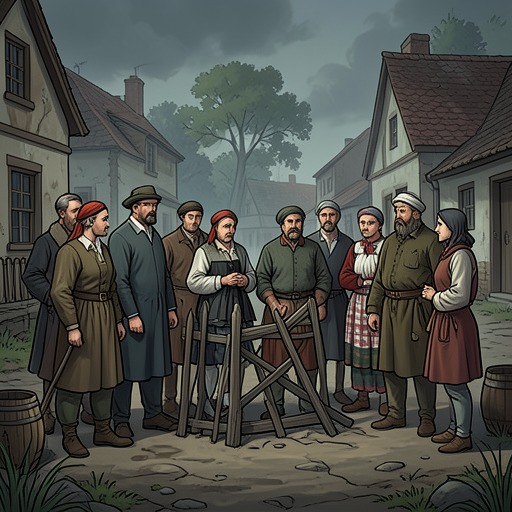
The villagers wake after the harvest’s final sheaf has been cut, expecting a day of rest. At first they fear the manor house itself is burning. Willowjack’s alarm at the smoke is what rouses them to hurry toward Kent’s property and offer help. They find that the flames are consuming the hay lofts and stable roofs, while the painted dovecote has already burned; Kent’s home is not yet on fire. Willowjack’s warning therefore brings the people to the scene before the blaze reaches the house.
The stable fire is later understood as deliberate. Christopher and Thomas Derby and Brooker Higgs had returned from the woods the previous evening with a sack and conspicuous laughter after gathering fairy caps. They are too eager in their show of assistance, organizing the hunt for whoever started the blaze while trying to appear loyal to Kent. Their conduct makes the fire part of an existing pattern of deception and mistrust. Willowjack survives that first attack on the estate, but her survival is brief, and the later killing makes the stable fire seem like an opening disturbance in a worsening sequence of violence.
Death and the Search for the Killer
At first light, Anne Rogers brings news of Willowjack’s death to Kitty Gosse’s door, where Walter is also present. A metal tethering prong taken from the winter tool chest has been used to kill the mare, and a large square stone from the churchyard is found in the straw. The stone is later kept on Kent’s mantel shelf. The villagers plan to search for whoever wielded the tools, and Walter’s immediate concern is that the crime will be insufferable for Kent.
The first theories focus on people thought strong enough to have attacked the horse. Anne Rogers’s hints direct suspicion toward Abel Saxton, the village blacksmith, who is related to Walter’s late wife Cecily and was once loved by her. Walter also considers Edmund Jordan’s groom, who had looked at Willowjack with what Walter reads as envy, and Brooker Higgs and the Derby twins, whose strength and earlier deceit make them other possible suspects. He rejects the last theory as unlikely: the three young men have been cowed by the consequences of the fire, and their earlier guilt does not, in his judgment, make them capable of killing Kent’s horse.
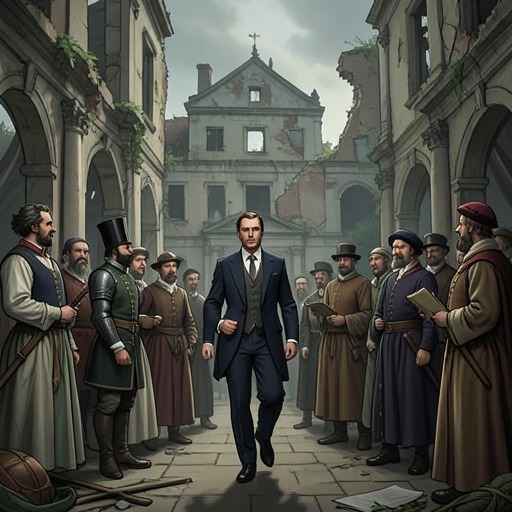
Walter then revises the assumption that the killer must have been a large, powerful man. Willowjack had been lying down asleep when she was killed, so an attacker did not need to be accustomed to handling her or able to reach her while she stood. A woman or child might have committed the act. That correction widens the field of suspicion: the search now concerns the clothes of more than sixty people, including the manor’s guests, rather than a single type of culprit. Edmund Jordan orders the cottagers to remain in the threshing house while their dwellings and gardens are searched, arguing that the horse’s blood would have marked the killer’s clothes. The investigation raises the prospect of severe punishment without lawful process.
The Shawl and Competing Explanations
A bloodied velvet shawl becomes the key to linking the killing with a woman living in a derelict dwelling. Walter leaves Edmund Jordan to identify the garment and its owner, while Kent recognizes that it belonged to his late wife, Lucy Kent. Kent does not identify the woman associated with it to his cousin. He accepts that the woman who had spat at Willowjack also killed her, but he also recognizes the grievance behind her anger: a kinsman, probably her father, had been placed in the pillory and left there. His response acknowledges the wrong done to her family without claiming that Willowjack deserved the consequences.
Edmund Jordan’s party draws a different conclusion. Once the shawl, the woman’s presence, and the horse’s killing are discussed together, they treat the death as part of a dark ritual and connect it to other suspicions about the shawl and the woman. The accusation is not established as fact; it is an interpretation shaped by a search for a culprit and by the authorities’ desire to build a case. The same death can therefore register as a bereaved owner’s loss, an act of retaliation against an unjust punishment, or alleged proof of witchcraft, depending on who is telling the story.
Aftermath and Narrative Significance
Willowjack’s death leaves a material trace that recurs after the killing: the square stone used in the attack remains on Kent’s mantel, and Walter later finds it on a stripped mantel shelf amid the damage inflicted on the manor. Its presence joins the horse’s death to the house’s other preserved horrors, including the abuse of Kitty Gosse and the tears of Lizzie Carr. Willowjack is thus bound into a larger record of injuries that the estate’s powerful occupants have inflicted or failed to prevent.
The mare’s fate also helps expose the instability of the village’s social order. Her death provokes suspicion, searches, and accusations at the moment when the villagers already fear losing their homes and work to Jordan’s plans. The authorities turn an unresolved killing into support for a conspiratorial account, while Kent’s silence about the shawl’s owner protects the woman’s identity but cannot restore the mare or undo the punishment that helped provoke the attack. Willowjack’s narrative role is consequently both intimate and political: she is a beloved animal whose loss matters in itself, and the contested evidence through which private grief is absorbed into a struggle over justice, authority, and blame.