Charles Kent
HarvestCharles Kent is the landowner of The Village, but the novel repeatedly separates his title to the soil from the labor and customary claims that make it productive. Widowed and without a surviving male heir, he faces the loss of his inheritance to Edmund Jordan; as the village empties and its old economy gives way to a planned sheep estate, his authority proves both humane and painfully limited.
Identity and Inheritance
Charles holds the estate through his marriage to Lucy Kent, the only daughter of Edmund Jordan, the former landowner. After her father’s death, Lucy inherited the manor and property; the legal arrangement, however, directs the estate to her male heirs by blood. Lucy dies in childbirth in the spring, and the child is a girl. Charles is therefore her sole heir in the immediate household but not, under the claim explained to Walter Thirsk by Philip Earle, an heir by blood. Edmund Jordan, Charles’s cousin, arrives asserting that claim and treating the estate as his entitlement.
Charles’s legal position rests on deeds, titles, and inheritance documents, yet the narrative sets those papers against a more immediate dependence. Fields cannot be harvested by ownership alone: Charles needs the villagers’ hands, while they understand themselves to possess customary rights in the ground and commons despite having no comparable documents. Their shared dependence gives the dispute a material edge. Charles owns the property, but the community’s labor sustains it, and the villagers’ sense of belonging is not erased by his title.
Authority and the Village
Charles is presented as a just but timid landowner, especially where punishment is concerned. The narrator describes him as more willing to tolerate an offender among his working people than to deprive a family of a father, husband, or son. In a distant settlement without a magistrate or constable, his discretion is also the village’s practical system of justice. For the stable fire, the anticipated penalty is limited: a beating, a period of rough sleeping beyond the boundaries, and perhaps the seizure of animals in compensation, not death. His restraint is a personal disposition and a way of preserving the laboring community on which his estate depends.
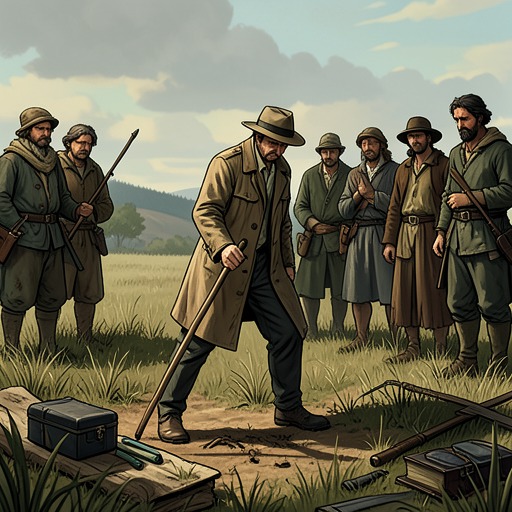
That restraint does not amount to an easy rejection of formal authority. When the villagers set out to confront the newcomers, Charles rides behind them on Willowjack, his recovered mare, and eventually brings her forward to the clearing. He orders the longbows put aside and attempts to curb the crowd’s rough conduct. His intervention recognizes that something unreasonable has happened and that it must be stopped, but it also asserts his authority as landowner over an angry community. He does not simply stand apart from the villagers: he tries to redirect their force while responding to a situation in which customary claims and written law pull in different directions.
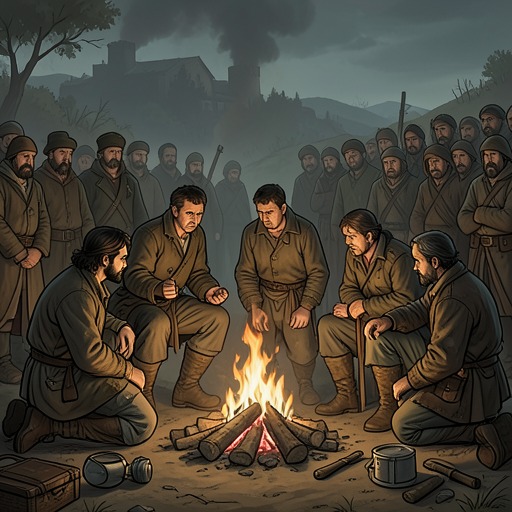
The stable fire tests that authority before the inheritance contest fully unfolds. Charles watches his buildings burn after the mare has been brought to safety, and the loss includes the stable, dovecote, hay, and doves. Walter Thirsk holds back information about the moonball lantern, while the suspected men make an conspicuous show of helping. Charles chooses to call on the newcomers only after the fire is controlled, rather than immediately turning suspicion into punishment. The scene makes his caution visible: he is distressed and conscious of his duty, yet does not rush to impose a verdict without testing the explanation.
Conflict with Edmund Jordan
Edmund Jordan’s plans expose the limits of Charles’s stewardship. Jordan proposes fences, dykes, and walls, the clearing of woodland, the enclosure of the commons, and the conversion of the land to pasture. When Charles points out that fewer than sixty people depend on the village, Jordan answers that only some will be needed as shearers or sheep-boys and that economies must be made. The promise of charity, a church, and a priest accompanies a transformation that would displace much of the community. Charles’s appeal on behalf of the inhabitants cannot undo Jordan’s power to impose the new arrangement.
Their disagreement also reaches the treatment of the newcomers. Jordan regards the pillory punishment as lawful and deserved, and is prepared to leave the older man’s body without burial on hallowed ground. Charles has to face the consequences of a sentence issued under his own authority, while his cousin regards severity as an ordinary instrument of rule. Their conflict is not simply between a kind man and a cruel one: Charles has participated in the system of punishment, but he remains troubled by its human cost; Jordan treats that cost as subordinate to order and property.
Charles’s response to the death of Willowjack further complicates his conduct. The mare mattered to him, and he has reason to connect the horse’s killing with the punishment of the older newcomer’s kin. Yet when Jordan asks about a velvet shawl found in the investigation, Charles identifies it as Lucy Kent’s garment instead of identifying its actual wearer. He offers the account of a passing intruder as an explanation for its disappearance. The story does not make his concealment uncomplicated: it places his loyalty to the dead and his response to the earlier punishment against the formal search conducted by his cousin.
Loyalties and Final Intervention
Charles’s relationship with Walter is rooted in a childhood intimacy that crosses, but does not erase, their difference in station. Their parents served the older household, and the two boys grew up as playmates; Charles shared books with Walter and allowed him to learn reading, writing, and arithmetic. Walter later became Charles’s serving man and accompanied him when he married Lucy and took charge of the estate. When Walter found a life with Cecily and the village, Charles released him from direct service rather than insist on retaining him. Their bond combines affection with a long-standing arrangement of service, and Walter continues to defend Charles among the villagers even when the estate’s decisions injure them.
After the villagers leave, Charles describes the loss as belonging to both himself and the community. He has considered fleeing and even setting fire to his own home rather than witness the changes ahead, but he remains long enough to negotiate for the detained women. With the villagers gone, Jordan’s interest in the captives and in accusations of sorcery diminishes. Charles uses that shift to ask that Kitty Gosse, Anne Rogers, and Lizzie Carr be released. Jordan agrees to have them escorted to a marketplace three days away and released there; Charles insists on accompanying them so that the promise is kept. The agreement is compromised by Jordan’s power to exclude the women from his estate, but it secures their freedom beyond its boundaries.
Charles’s last exchange with Walter is an embrace in the orchard as the horses are prepared for departure. He says he cannot imagine returning. The farewell gathers together his personal grief, the loss of his household, and the disappearance of the village he once governed. His final act is neither a recovery of the estate nor a victory over Jordan. It is a limited exercise of authority on behalf of people whom the new order would otherwise leave in custody, and a departure from the land whose title he held but whose community he could not preserve.