Mistress Beldam
HarvestMistress Beldam enters the village as an apparent stranger and is soon made to carry its fears and grievances. Her story gradually emerges as one of displacement: she and her family have been driven from their commons by sheep enclosure, and her father’s death in the pillory turns an encounter between newcomers and villagers into a lasting conflict. Her final departure with her husband, amid the burning and plunder of the village, leaves her neither a simple victim nor a neatly explained villain.
Identity and First Appearance
At first, the villagers know Mistress Beldam only as the woman living with two men in a crude shelter. She has been concealed inside while the men remain among the trees, and she appears when a village crowd confronts the newcomers. In the confusion, she is injured, and Philip Earle steps forward to help her out of the shelter. Her appearance is described through the villagers’ suspicious gaze: dark hair and eyes, a small build, and an expensive velvet shawl of mauve fabric threaded with silver. The shawl immediately attracts attention because no one in the village can remember seeing such a garment there. Its quality becomes a basis for class judgment and suspicion, even before anyone knows who owns it.
Her name is also a local construction. Charles Kent calls her Mistress Beldam, a label that the narrator expects to stick; the name evokes both a sorceress and a beautiful lady. When Edmund Jordan later demands her identity, Walter Thirsk says he has no name for her. That answer is partly evasive: he can recognize and describe her, but the byname supplies no reliable account of who she is. The gap between a visible woman and an uncertain identity allows rumor to take hold. She is alternately treated as an intruder, a suspected criminal, and a source of supernatural disorder.
Arrival, Confrontation, and Punishment
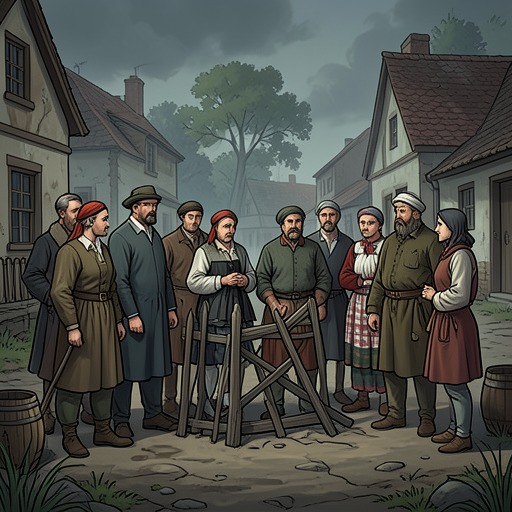
The first confrontation begins as an armed stand-off between the villagers and the newcomers. Charles Kent attempts to impose order, telling the armed men to put aside their bows and proposing punishment for taking fowl: a week in the pillory, the destruction of their bows, and shaved heads to mark them as suspicious travelers. Mistress Beldam challenges the villagers’ claim to better manners, answering their threatened force with an accusation that they have shown her family nothing but rough treatment. Her intervention shifts attention from the men’s alleged theft to the conduct of those claiming authority over them.
The confrontation also reveals a divide within the village. Once the crowd sees that she has been hurt, the women call for restraint and the men lower or abandon their weapons. Philip Earle disregards the danger of the bow aimed at him and helps her into the open. The action interrupts a possible escalation, but it does not undo the punishment. Later, her husband remains in the pillory, and her father dies there. The punishment that is supposed to restore order instead becomes the personal loss around which her later actions gather.
At a barn gathering, Mistress Beldam appears again, now with a roughly shaved head and the velvet shawl. Her silent arrival stops the music and unsettles the celebration. Some villagers briefly imagine welcoming her as their Gleaning Queen, a figure who might be brought into the community’s customary ceremony. But this imagined reconciliation has no time to become action: she withdraws from the gathering and leaves. Charles Kent subsequently asks Walter to find her and offer shelter for the night, recognizing that a woman alone outdoors may face dangers even if she has been accused of crimes. The offer shows a protective impulse, but also exposes the village’s failure to make her safe within its own bounds.
Family, Displacement, and Suspicion
The family relationships that the villagers initially speculate about are eventually clarified by Philip Earle: Mistress Beldam is married to the younger man, Young Beldam, and the older man who died was her father. The family has traveled six or seven days on foot after sheep enclosure fenced them away from their long-established livelihood on their own commons. Their arrival is therefore not merely a trespass into the village’s space. It is the consequence of a wider dispossession that has already made them exiles.
The disclosure changes how Walter understands her, but it does not dissolve his fascination. Before learning she is married, he and Philip have imagined her as unattached; afterward Walter acknowledges that his attraction persists, while recognizing that she is no longer available to his fantasies of an unencumbered stranger. This response makes his view of her morally uneasy: her actual life and bereavement repeatedly press against the stories he constructs about her. The text distinguishes what he knows from what he imagines, especially when he pictures her visiting Young Beldam in the pillory.
In one observed visit, she approaches her husband carrying food in a piece of sacking and a stoppered bottle of cordial. She moves quietly but with confidence, and her hair has begun to grow back after the shaving. Walter and Philip wait rather than reveal themselves, allowing her to greet and comfort her husband first. The scene counters the village’s image of a dangerous apparition with a concrete act of care. It also confirms that her connection to Young Beldam persists despite the punishment separating them.
Suspicion gathers around her after Willowjack, Charles Kent’s cherished horse, is killed. Walter concludes that Mistress Beldam entered the barn, took a spike, and used a heavy stone in the killing; he connects this suspected act to her father’s treatment and death in the pillory. The narrative presents this as an inference, not a settled public finding. Meanwhile, villagers attribute a widening catalogue of misfortunes to her, from disordered cottages and spoiled milk to bad weather and the presence of sheep. They accuse her of sorcery while also insisting that the authorities are persecuting innocent local women. In this atmosphere, the accusation tells as much about the village’s need for someone to blame as it does about what Mistress Beldam has actually done.
Reprisal and Departure
After two days without news of Mistress Beldam or Philip Earle, Walter imagines several possible fates for them. He fears that she may be dead, but also suspects that she has lured Philip into danger. The narrative does not confirm this fear. Walter’s uncertainty is important: his attraction, anxiety, and guilt repeatedly make him turn an incomplete account into a story, and the reader is not given confirmation that Mistress Beldam killed Philip.
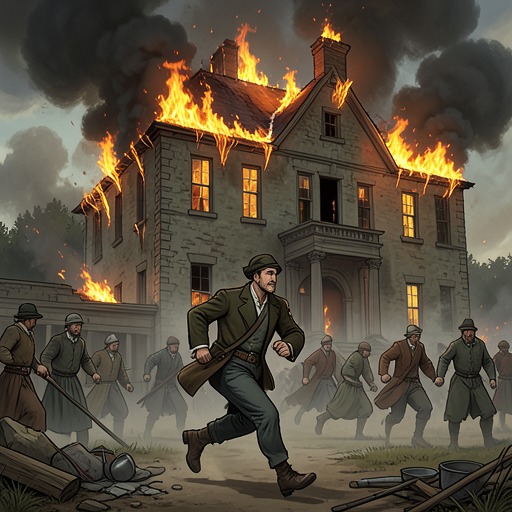
Later, she is seen helping to destroy what remains of the village. With her head and shoulders wrapped in velvet against the smoke, she carries a burning faggot between cottages and holds Walter’s short-bladed sword. Young Beldam takes a cart and a pair of oxen used in plowing the barley field. Their load includes possessions from village homes and the manor house: tapestries, better chairs, Lucy Kent’s old loom, and parts of the plow. Walter understands the looting as payment for the death of Mistress Beldam’s father, though that judgment belongs to his interpretation of the family’s motives. The destruction is at once reprisal and an answer to the dispossession that first drove them from their commons.
The couple leave together. Young Beldam leads the oxen while Mistress Beldam rides on the loaded cart, the sword across her knees and the velvet shawl around her shoulders. As they recede behind hedges and walls, Walter watches them pass beyond the village’s bounds. Her departure resolves the immediate story of her presence without resolving the questions surrounding her: the village has driven her family into conflict, made her a receptacle for collective fears, and then suffered the consequences of her return as an avenging force.
Narrative Role
Mistress Beldam’s shifting visibility shapes the novel’s account of how communities turn a stranger into a story. She first appears half-hidden in a dwelling, becomes conspicuous through her unusual shawl, vanishes from a communal celebration, and later returns in scenes where others project guilt, desire, or danger onto her. Even her identity is repeatedly mediated: villagers name her, Walter claims not to know her, and only later does Philip disclose her family ties and history of displacement.
Her actions cannot be reduced to the accusations made against her, but neither does the narrative erase the harm she causes. The suspected killing of Willowjack and the later burning and looting give her a forceful role in the village’s collapse; her father’s death and her family’s loss of common land give those acts a history. That tension is central to her significance. Mistress Beldam exposes the weakness of a justice system that punishes strangers while failing to reckon with the violence of enclosure, and her final retreat beyond the parish leaves the village facing a ruin it helped create.