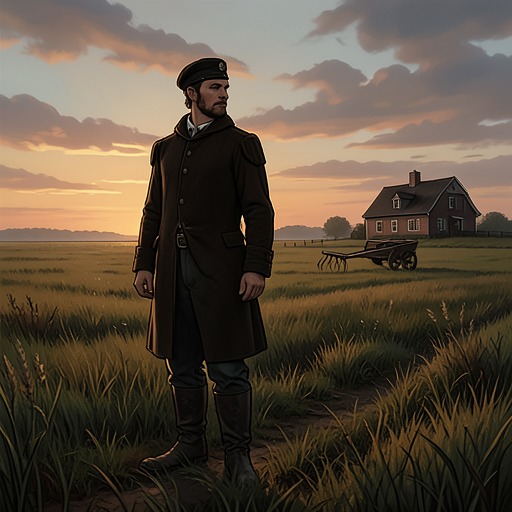
Cecily
HarvestCecily, Walter Thirsk’s wife, is present in the narrative chiefly through the work, marriage, and grief that Walter remembers. Raised in a village tenement, she becomes the person for whom he chooses a life rooted in the land; after her death from fever, he continues to belong to that place without feeling wholly at home in it. His memories preserve her not as a distant emblem but as a particular woman whose laugh, freckles, sturdy body, and remembered touch remain inseparable from his sense of love and loss.
Identity and Background
Cecily was raised in a tenement whose rubble remains among the village’s dwellings. Walter recalls the building as part of a row of cottages, some of them now derelict or converted to makeshift byres. Its ruins connect his intimate history with the visible decline of the settlement: the place where his wife grew up survives as a broken dwelling, while the family life that gave it meaning is gone.
Walter’s account gives only glimpses of Cecily’s life before their marriage. He remembers her hearty laugh, her freckled throat, and her sturdiness, and says that he discovered her while serving Charles Kent. Those details are not a full portrait, but they keep his recollection grounded in her physical presence. She is not simply the lost wife in his account; she is the woman whose character and companionship drew him into a life he had not known before.
Courtship and a Life on the Land
When Walter first came to the countryside, he was still in Charles Kent’s service and encountered the land with the wonder of a newcomer. He touched its trees and flowers, watched its small creatures, and found the fields unlike the market-town world he had left. But the landscape alone did not make it home. Walter says that seeing Cecily gave him the chance to build a future there.
His courtship took the form of labor beside her in her fields. He worked at her elbow, attending to the hunger of the soil; putting his shoulder to the plow became, in his recollection, an act of love. The physical demands of farming changed him as he sought to share her life: his muscles grew accustomed to the work, and he became tough through the effort of cultivating the land. His move from Kent’s direct employ to a life among Cecily and her neighbors marks a decisive change in allegiance and belonging. He told Charles Kent plainly that he loved Cecily and the village earth, and Kent answered by telling him to plow it.
This origin shapes Walter’s understanding of rural labor. The country is not a gentle pastoral refuge in his memory; it snags, bruises, and exhausts those who work it. Yet its hardships first mattered to him because he encountered them through Cecily. The land’s demands and the marriage’s beginnings become bound together: toil had meaning because it was shared with the woman he loved.
Marriage, Intimacy, and Loss
Walter and Cecily shared a life lasting more than eleven years. His recollections of their marriage distinguish her from Kitty Gosse, with whom he later has a physical relationship. Walter describes Cecily as less sexually uninhibited than Kitty, and remembers a characteristic gesture in bed: Cecily’s hand rested tenderly across his chest, whereas Kitty’s hand lay lower on his abdomen. The contrast conveys more than a difference in physical appetite. It marks the distinct place Cecily holds in his memory as a wife with whom he shared a life, rather than a partner in an affair he describes as bodily and emotionally limited.
After Cecily’s death, Walter continues to inhabit their marriage bed. He remembers the hollows her shoulders and hips left in the rough mattress and takes comfort from their physical trace, even while recognizing that she is not watching over him. The bed thus becomes an intimate record of an absence: its remembered impressions offer consolation, but also make the loss tangible. When Walter goes to Kitty’s cottage, he sometimes hesitates to call her inside because the bed belongs in his mind to Cecily and to their marriage.
Fever took Cecily. Walter describes the illness as a midnight pillager, a brutal thief, and says that without her his labor has no love in it; it is only dutiful. Her death does not end his work or remove him from the place where they made their life. Instead, it alters what that work means. He has a portion and a place, but without Cecily he doubts that twelve years in the village have made him truly at home.
Memory and Narrative Significance
Cecily’s importance is registered through the way Walter’s memories return to her at moments when the present threatens to make him feel merely displaced. He contrasts his own lasting attachment to her with his physical encounters with Kitty, and the remembered tenderness of a hand across his chest with the urgency of present desire. These returns do not resolve his grief. They reveal how his present intimacy, his labor, and his sense of belonging remain measured against a marriage that death has ended but memory continues to inhabit.
Her connection to the fields also gives Walter’s account of rural life its personal stakes. The land first seemed to offer him freedom and possibility; through Cecily, working it became a way of loving someone and building a future. Later, the same labor continues after the relationship that gave it emotional purpose has been taken away. Cecily therefore stands at the point where place and attachment meet: she is the reason Walter chose to stay, and her absence explains why staying does not make him feel entirely at home.