Captain Mayhew
Moby-DickCaptain Mayhew is the commander of the Jeroboam of Nantucket, a whale-ship encountered by the Pequod during a passage complicated by epidemic, dangerous weather, and the pursuit of Moby Dick. He is defined less by personal ambition than by conscientious restraint: he keeps his distance to protect the Pequod’s crew, yet still communicates across the water and recounts the catastrophe that befell his chief mate, Macey. Through Mayhew, the encounter becomes a meeting between two models of command—one governed by quarantine and communal safety, the other by Captain Ahab’s single-minded hunt for the White Whale.
Identity and Command
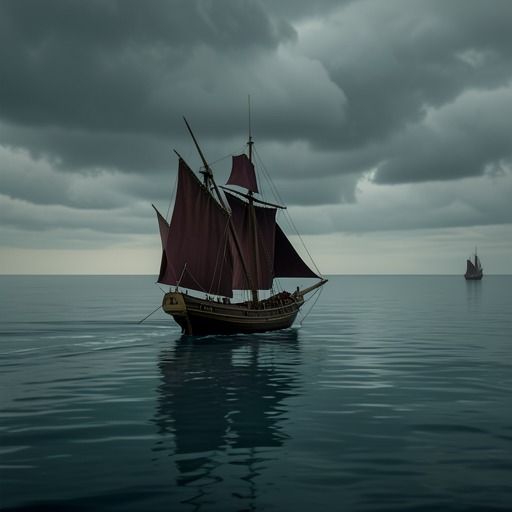
Captain Mayhew appears as the master of the Jeroboam, a Nantucket whale-ship belonging to the same dispersed maritime world as the Pequod. When the two vessels recognize one another by their private signals, the Jeroboam lowers a boat and approaches, but Mayhew refuses to come aboard. An epidemic has broken out on his ship, although Mayhew and the boat’s crew remain untainted. He therefore observes a maritime quarantine, maintaining several yards of separation even though open sea and air lie between the vessels.
Mayhew’s caution is practical and ethical rather than merely fearful. The Jeroboam’s boat keeps parallel with the Pequod while both ships move through a freshening sea, allowing conversation without direct contact. His conduct places the safety of the larger company above the social convention of a ship-to-ship visit. The episode also contrasts his discipline with the disorder aboard the Jeroboam, where the crew has come under the influence of Gabriel, a fanatic who claims authority over the epidemic and is treated by credulous sailors almost as a god.
The Meeting with the Pequod
The encounter is marked immediately by tension between Mayhew’s quarantine and Ahab’s impatience. From the Pequod’s bulwarks, Ahab tells Mayhew that he does not fear the epidemic and invites him aboard. Mayhew does not accept the invitation. His refusal preserves the physical boundary that has governed the meeting, while Ahab’s challenge reveals how little ordinary danger restrains the Pequod’s commander.
Mayhew nevertheless allows an extended exchange. He begins a dark account of Moby Dick, though Gabriel repeatedly interrupts whenever the White Whale is named. The Jeroboam had learned of Moby Dick’s destruction from another whale-ship. Gabriel interpreted the whale as an incarnation of the Shaker God and warned the captain against attacking it, but Macey, the chief mate, later insisted on making the attempt. Mayhew’s role in this account is that of witness and custodian of a painful maritime history: he does not turn the story into prophecy, but reports how ambition, fanaticism, and a real animal’s violence became entangled.
Macey’s Death and the White Whale
Mayhew relates that Macey persuaded five men to man his boat after Moby Dick was sighted. The boat made repeated unsuccessful attacks before finally fastening one iron. Gabriel, watching from the main-royal mast-head, continued to proclaim disaster. As Macey stood in the bow preparing another assault, a broad white shadow rose from the sea and struck him bodily into the air. He fell roughly fifty yards away and sank permanently, while the boat itself and the other oarsmen escaped without damage.
The death gives Gabriel greater authority among the Jeroboam’s sailors. He cries out that the vial has been fulfilled, and the crew mistakes his general warnings for a specific foreknowledge of Macey’s death. Mayhew’s narrative therefore distinguishes between an event and the interpretation imposed upon it afterward. The whale’s attack is concrete and lethal; Gabriel’s influence grows through the frightened crew’s belief that the catastrophe confirms his supernatural power.
Macey’s death also becomes personally legible through a letter. Ahab discovers a message addressed to Harry Macey and realizes that it is from the dead officer’s wife. Because the ships cannot safely draw together, Starbuck splits the end of a cutting-spade pole so the letter can be passed without contact. Mayhew responds with grief, calling the dead man a poor fellow and asking to receive the letter. Gabriel instead seizes it, impales it on a boat-knife, and sends it back toward the Pequod before ordering the oarsmen away. The failed delivery turns private mourning into another scene of separation, quarantine, and fanatic interference.
Conflict with Ahab
Mayhew’s account directly tests Ahab’s purpose. After hearing the story, he asks whether Ahab intends to hunt the White Whale if the opportunity arises. Ahab answers affirmatively. Mayhew does not persuade him, and Gabriel’s warning that the blasphemer will meet the dead man’s end only makes the opposition more explicit. Ahab turns aside from the warning and concentrates on the letter-bag, treating the practical business of communication as a momentary counterpressure to the prophetic terror surrounding Moby Dick.
The exchange presents Mayhew as a foil to Ahab. Mayhew commands a ship threatened by disease and has already witnessed the fatal consequences of attacking Moby Dick, yet he does not convert either danger into a grand metaphysical campaign. His authority is bounded by responsibility to his crew and by the facts of the sea. Ahab, by contrast, accepts the risks not as reasons for restraint but as further occasions to pursue the White Whale. Mayhew’s caution cannot stop Ahab, but his testimony enlarges the reader’s understanding of the danger Ahab knowingly embraces.
Narrative and Maritime Significance
Captain Mayhew’s appearance links several recurring structures of the novel: the whale-ship as a mobile community, the ocean as a space of intermittent contact, and knowledge as something transferred through uncertain channels. The Jeroboam and the Pequod recognize one another by signal, communicate from separated boats, and attempt to exchange a letter by means of a pole. Even information about Moby Dick travels through ships, reports, warnings, and imperfect interpretations rather than through secure authority.
His episode also sets individual human suffering against the vast, shifting life of the ocean. Elsewhere, the Pequod encounters brit, Right Whales, sharks, squid, and immense herds of Sperm Whales; these scenes show a world in which human pursuit is only one force among feeding, breeding, migration, predation, and mutual protection. Mayhew’s testimony belongs to that same ecological and maritime network. His ship is exposed to disease, his crew to fanaticism, and his officer to the sudden violence of a whale, while the sea continues to carry ships, messages, and warnings beyond any single commander’s control.
Mayhew ultimately remains a figure of limited but important resistance. He cannot redirect Ahab, overcome Gabriel’s influence, or restore Macey to his wife, yet his conduct preserves a standard of humane command amid the novel’s escalating obsession. By maintaining quarantine, recounting the death accurately, and grieving over the undelivered letter, he represents the ordinary obligations that Ahab’s pursuit steadily casts aside.