Starbuck
Moby-DickStarbuck is the chief mate of the Pequod and one of the clearest embodiments of disciplined, practical judgment in the novel. A native of Nantucket and a Quaker by descent, he is shaped by hard labor, religious seriousness, domestic memory, and long familiarity with mortal danger. His importance lies in the tension between what he understands and what he can bring himself to do: he sees that Captain Ahab has converted a whaling voyage into a personal war against Moby Dick, but the ship’s hierarchy, his own sense of duty, and the force of Ahab’s authority keep him from breaking that command.
\
Identity and Character
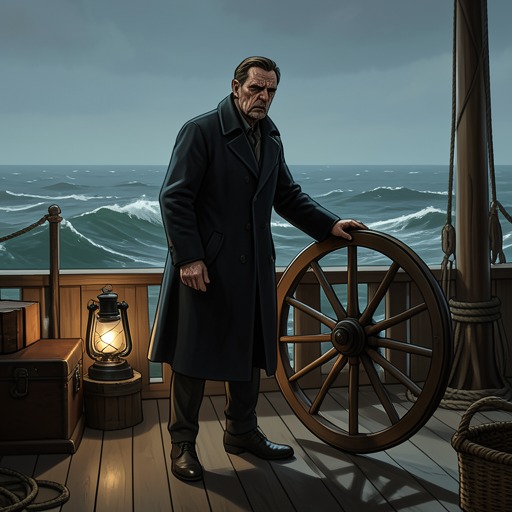
Starbuck is described as long, lean, and intensely durable, a man whose body seems condensed rather than weakened by hardship. His tightly fitted strength is matched by a temperament marked by steadiness, conscientiousness, and restraint. The dangers visible in his eyes are not trophies of bravado but memories of perils calmly confronted. His life is presented less as a succession of speeches than as a “telling pantomime of action”: he is a practical officer whose character appears in what he does, refuses, and endures.
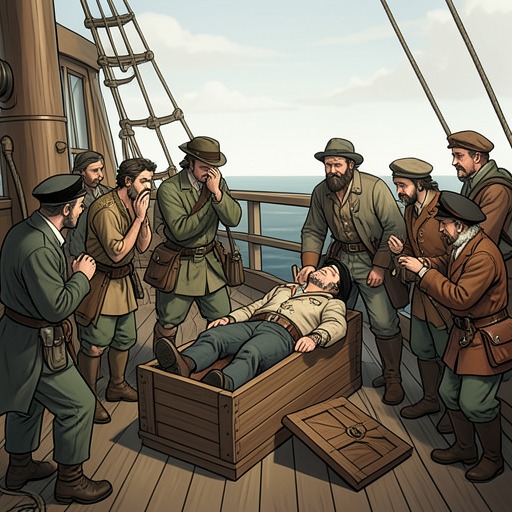
His religious reverence does not make him ignorant or credulous. Rather, his superstition is connected with intelligence, conscience, outward portents, inward presentiments, and a mind alert to signs of consequence. Memories of his young Cape wife and child soften his original ruggedness and make him more receptive to the restraints that prevent reckless daring. The remembered fate of his father and the torn remains of his brother deepen his knowledge of what whaling can cost. Family is therefore not a decorative background to Starbuck’s character; it is one of the forces that makes him value survival over glory.
\
Practical Courage and the Work of Whaling
Starbuck’s governing principle is that courage must be proportionate to danger and useful to the work at hand. He declares that he will have no man in his boat who is not afraid of a whale, meaning that a reliable sailor must estimate peril honestly, while a person who feels no fear may become more dangerous than a coward. Stubb recognizes him as an unusually careful man, but Starbuck’s care is not timidity. He does not seek danger for its own sake, and he treats courage as a necessary provision of the ship, comparable to food, that must not be squandered.
For this reason he dislikes lowering for whales after sundown and opposes continuing a fight with a whale that persistently fights back. His purpose is direct: he has come into the critical ocean to kill whales for his living, not to be killed by them. The deaths of men in the fishery, including the unresolved fate of his own father and brother, give this position a personal gravity. Starbuck’s judgment also resists the grand rhetoric that turns whaling into martial heroism. The narrator’s defense of whaling as a dangerous and economically powerful vocation places Starbuck within a profession celebrated for its global importance, but Starbuck himself measures that profession by survival, competence, and common livelihood rather than by conquest.
\
Position within the Pequod’s Organization
As chief mate, Starbuck occupies the first position beneath Captain Ahab in the Pequod’s formal chain of command. The ship’s quarter-deck imposes elaborate external forms: officers may display confidence on deck, yet become deferential when they enter the captain’s cabin and sit at his table. Starbuck participates in this hierarchy even while recognizing its dangers. He is the officer who reports changes in the deck’s affairs, supervises the ship’s immediate operations, and helps convert the captain’s decisions into collective action.
Ahab’s authority is strengthened by these maritime forms. He does not need to demand theatrical homage; implicit and instantaneous obedience is enough. The quarter-deck’s customs become an organizational apparatus through which his private will acquires public force. Starbuck’s position exposes the contradiction especially sharply. He is capable of bold resistance in principle, but habitual obedience reasserts itself whenever command is formally exercised. The contrast between his visible authority as first mate and his constrained conduct before Ahab shows how an institution can preserve order while allowing that order to be commandeered by a single obsession.
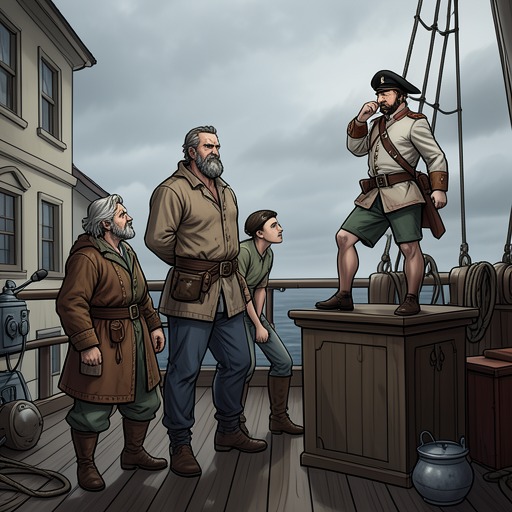
When Ahab summons the entire company aft, Starbuck is part of the assembled structure through which the captain turns the crew into a collective audience and then into participants in his vow. The harpooneers stand with their weapons, the mates flank Ahab with lances, and the rest of the crew forms a circle around them. Starbuck’s presence gives the ceremony official weight, even though the purpose exceeds ordinary whaling business. His professional office is thus made to serve a mission he does not share.
\
Conflict with Captain Ahab
Starbuck’s central conflict with Ahab begins when the captain demands pursuit of the white whale. Starbuck does not deny the possibility of confronting Moby Dick; he says he is ready to face the whale’s crooked jaw and even Death’s jaws when they fairly arise from the business of whaling. His objection is to motive. He came to hunt whales, not to carry out his commander’s vengeance, and he asks what profit vengeance against Moby Dick could produce in the Nantucket market. The question separates communal labor from private passion: the crew’s work yields oil and wages, whereas Ahab’s desired triumph yields no ordinary livelihood.
Ahab answers by claiming that his vengeance will command a premium beyond money. Starbuck recognizes the hollow grandeur of this reasoning, while Stubb notices the captain’s chest and hears in it an immense but empty resonance. Starbuck’s resistance is therefore both economic and ethical. He refuses to let the language of heroic destiny conceal the fact that a captain is risking other men’s lives for a personal wound.
His opposition becomes more intimate and more dangerous in the cabin. He approaches Ahab with respectful caution, admitting that a better man might overlook in Ahab what would be resented in a younger or happier man, and asks whether they cannot understand one another better. The attempt is not a simple challenge to authority. Starbuck wishes to preserve the relationship and the ship by appealing to mutual recognition, but Ahab treats even critical thought as insubordination. The exchange reveals Starbuck’s unusual combination of courage and restraint: he dares to speak, yet still frames his dissent as an effort at understanding rather than a bid for power.
\
Crisis, Hesitation, and the Final Pursuit
The deepest test of Starbuck’s character comes when Ahab’s conduct makes the danger unmistakable. Before entering Ahab’s state-room to report a fair wind, Starbuck pauses before the bolted door and sees loaded muskets in the rack, including the weapon Ahab once pointed at him. The sight awakens the thought that Ahab might have to be removed to prevent him from dragging the ship’s company to destruction. Starbuck reasons that if Ahab is allowed to continue, the captain will become the wilful murderer of more than thirty men.
This moment is significant because Starbuck’s resistance reaches the threshold of action. He touches and examines the musket, notices that it is loaded, and considers spilling its powder. Yet he cannot complete the act. Reason, remonstrance, and entreaty have failed with Ahab, but Starbuck cannot convert his judgment into mutiny or assassination. The hierarchy he knows to be corrupt remains stronger than his willingness to violate it. His hesitation is not ignorance of the stakes; it is the tragic form taken by his conscience when duty and moral responsibility become incompatible.
During the final chase, Starbuck continues to function as the voice of practical survival. After two days of pursuit, repeated wrecking of boats, and the renewed danger to Ahab’s already injured body, he protests that every warning has been fulfilled. He asks whether the crew must continue chasing a murderous fish until the last man is swamped, dragged to the bottom, or towed into the infernal world. His language invokes impiety and blasphemy because Ahab’s pursuit has crossed from hazardous labor into a defiance of limits.
Ahab answers that he has become strangely moved toward Starbuck since the moment when they recognized something in each other’s eyes, but he immediately commands him to become a blank face before the whale. Ahab then declares that his act has been decreed, that he is the lieutenant of the Fates, and that the crew must obey. Starbuck’s defeat is thus not a defeat in argument. Ahab acknowledges the bond and the truth of Starbuck’s perception, then absorbs both into the rhetoric of destiny. The first mate is left to carry out the orders he has judged fatal.
\
Narrative and Thematic Significance
Starbuck is the novel’s principal counterweight to Ahab’s monomania. He does not possess an alternative grand theory of the universe; instead, he represents the modest but essential disciplines of work, fear, family, religious reverence, and responsibility to a shared enterprise. Against Ahab’s insistence that the chase was rehearsed before history and decreed by the Fates, Starbuck holds to the immediate facts of bodies, weapons, weather, boats, and men who can die.
His character also reveals how collective organization can be captured by personal authority. The Pequod’s formal structure should distribute expertise and restrain arbitrary action, but the same customs that enable coordinated labor make resistance difficult. Starbuck sees the danger early, reports faithfully, protests openly, considers direct intervention, and finally remains within the command structure. His tragedy is not that he lacks knowledge; it is that knowledge does not automatically produce freedom.
At the same time, Starbuck’s caution is not presented as absolute wisdom. Whaling itself remains a violent industry, and even the ship’s ordinary purpose requires men to kill whales. His distinction is between danger accepted as part of a common occupation and danger intensified by an individual’s vengeance. That distinction gives his opposition its moral force without making him innocent of the larger violence surrounding the voyage. Starbuck stands inside the world he criticizes, and precisely for that reason he can identify the moment when professional risk becomes collective ruin.
In the final confrontation, Ahab’s body is cut down and supported by a shattered lance, while his purpose continues to drive the ship. Starbuck’s warnings have proved accurate, but accuracy cannot save the Pequod once obedience has become the vessel of obsession. He remains the officer who understands the cost, names the cost, and still cannot prevent it—a figure of conscience defeated not by lack of courage, but by the institutional and psychological power of command.