Pip
Moby-DickPip is a small Black sailor aboard the Pequod, known by the nicknames Little Pip and Black Little Pip. Initially treated as an insignificant member of the crew, he is remembered for his tambourine and for helping call the watches. His position at the edge of the ship’s hierarchy makes him both a source of comic energy and a particularly exposed figure within the dangerous economy of whaling. When circumstances force him into a whale-boat, the consequences reveal how quickly the ship’s discipline can turn a vulnerable worker into expendable human cargo.
Identity and Place Aboard the Pequod
Pip serves among the ship-keepers, the hands who remain aboard while the boats pursue whales. The arrangement is practical but also socially revealing: the men considered slender, clumsy, timid, or otherwise unsuited to the boats are especially likely to be assigned this role. Pip is therefore placed at the very margin of the Pequod’s hunting labor. His earlier appearance as the bell-boy and ship’s-crier, associated with the repeated call of “Pip! Pip! Pip!” and with his tambourine, establishes him as a figure of sound, interruption, and communal amusement rather than command.
The ship’s formal hierarchy intensifies his vulnerability. The officers can display boldness on deck yet become deferential when they enter Captain Ahab’s cabin, while the assembled crew responds to Ahab’s summons and ritual commands as a single body. Within this structure, Pip has neither authority nor protection. His value is measured against the whale and against the efficiency of the hunt, a logic made brutally explicit when Stubb warns that a whale would sell for thirty times what Pip would. The remark does not merely insult him; it reveals the economic principle governing the ship’s benevolence.
The Whale-Boat and Abandonment
Pip enters the boat crews only because Stubb’s regular after-oarsman sprains his hand during the ambergris affair. His first lowering with Stubb is marked by nervousness, but he avoids close contact with the whale and is not wholly disgraced. Stubb urges him to cultivate courage, presenting fear as a defect that labor must correct rather than as a rational response to mortal danger.
On the second lowering, the boat paddles directly upon the whale. When the iron strikes, the whale’s customary blow comes beneath Pip’s seat. Terrified, he leaps from the boat with his paddle still in hand. A section of slack whale-line catches across his chest and neck; as the wounded whale begins its fierce run, the line tightens and drags him foaming toward the boat’s chocks. The accident turns a moment of panic into a life-threatening entanglement, showing how the apparatus of the hunt can seize the inexperienced sailor as readily as it seizes the whale.
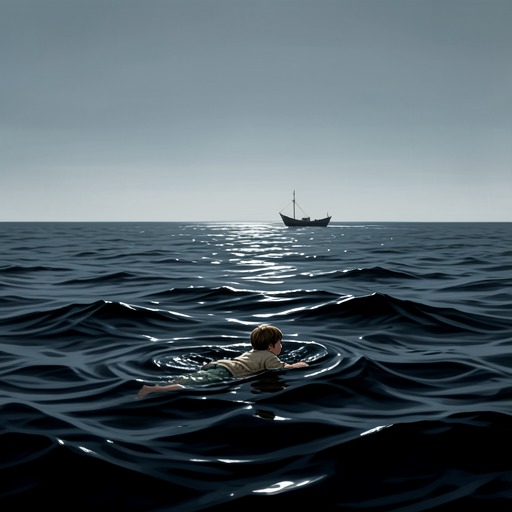
Stubb curses Pip and gives him contradictory advice: ordinarily he must stick to the boat, although in some circumstances leaping away might be safer. He finally converts the uncertainty into an absolute command, threatening not to pick Pip up if he jumps again. Pip nevertheless jumps under nearly identical circumstances during another lowering. This time he fails to carry the line with him. The whale runs, the boat continues after it, and Pip is left behind on the open sea. Within three minutes, a mile of water separates him from Stubb’s boat; his dark head bobs alone in the calm expanse.
The abandonment is not presented as a simple act of deliberate cruelty. Stubb expects the two boats following behind to rescue Pip, but those boats spot whales and turn toward the chase. Stubb and his crew remain intent upon their fish, while Pip’s horizon widens around him. The Pequod eventually rescues him by chance, but the delay has already altered him. The episode exposes the collision between communal dependence and commercial appetite: the crew shares a common fate, yet the pursuit of a valuable whale can momentarily override responsibility for an individual sailor.
Madness, Vision, and Prophecy
After his rescue, Pip goes about the deck as an idiot, or at least as one whom his shipmates call mad. The narrative, however, treats his condition as more than a simple loss of reason. The sea has preserved his body while carrying his consciousness into depths where ordinary distinctions between sanity and madness no longer hold. His apparent derangement becomes a kind of visionary knowledge, a perspective formed by confronting absolute isolation and the immensities beyond human control.
Pip speaks of cosmic and divine realities that his companions cannot recognize. To the crew, such speech confirms his insanity; to the narration, it suggests that human reason may mistake celestial insight for absurdity. His madness thus reverses the ship’s usual hierarchy of intelligence. The officers command, calculate, and pursue, but Pip—apparently the least competent of the crew—has encountered the sea’s metaphysical terror most directly. His abandonment becomes a prophecy of the Pequod’s own later isolation and destruction: the ship that leaves him behind will itself be exposed to a greater loneliness and a more final loss.
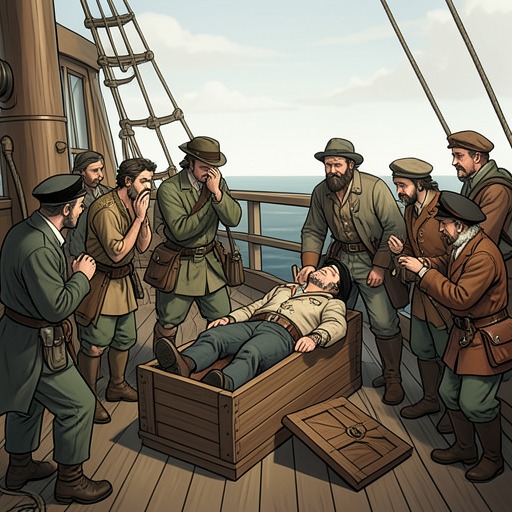
His tambourine remains a material trace of the earlier Pip, the cheerful childlike figure associated with songs and watches. When Queequeg is preparing his coffin, Pip approaches with soft sobbing while holding that tambourine. He imagines Queequeg as a rover whose journey may carry him toward the Antilles, and asks him to find another Pip who has long been missing. The speech blends grief, displacement, and self-division: Pip is physically present, yet he speaks as if the lost Pip were someone else. The instrument links the comic ship’s musician with the castaway who has crossed into a mental world no longer governed by ordinary chronology.
Relationship with Captain Ahab
Pip’s transformation draws Captain Ahab toward him. When Ahab encounters him, Pip appears in the guise of the ship’s crier, offering the absurd announcement of a reward for the missing “coward.” Ahab responds not with the contempt that has marked the crew’s treatment of Pip but with recognition. He declares that Pip’s home shall be his cabin and that the boy is tied to him by the cords of his heart.
The bond is reciprocal but not simple. Ahab sees in Pip a fellow damaged being: Pip has been altered by the sea, while Ahab bears the physical and psychic consequences of his pursuit of Moby Dick. Ahab’s hand, described through the texture of velvet shark-skin, becomes for Pip a possible man-rope, something a weak soul might hold. Pip asks that old Perth rivet the black hand and the white together, converting racial and bodily difference into an image of attachment. The gesture makes their connection concrete: Pip seeks an anchor, while Ahab, who has made his own life an instrument of pursuit, briefly becomes one.
Ahab orders that Pip be treated as if he were captain and placed in Ahab’s own screwed chair. Yet when Ahab prepares to go on deck for the final hunt, he prevents Pip from following. He says that Pip contains something curative to his malady, but that for this hunt his malady has become his most desired health. Pip begs to be used as Ahab’s lost leg, offering himself as a living support. Ahab interprets this desperate fidelity as evidence of the power of human loyalty, even while recognizing that Pip’s devotion is itself bound up with his mental disturbance.
The relationship therefore creates a temporary counterforce to Ahab’s monomania without curing it. Pip awakens tenderness and self-recognition in Ahab, but he cannot detach Ahab from the hunt. Ahab can protect Pip by keeping him below, yet he cannot protect the crew from the consequences of his own purpose. The cabin becomes a shelter for Pip and a brief chamber of human contact, while the deck remains the arena in which Ahab’s obsession claims its final authority.
Narrative and Thematic Significance
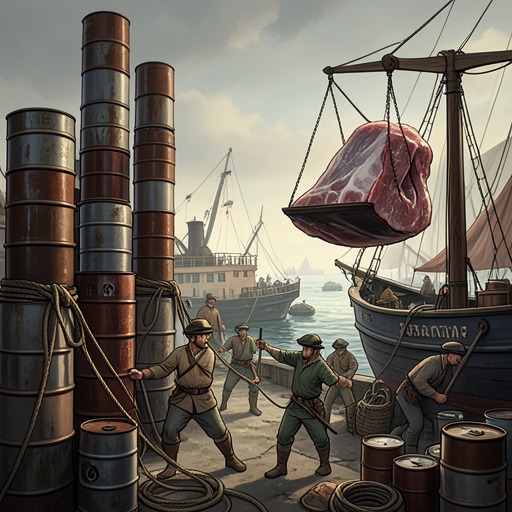
Pip embodies the human cost hidden beneath the Pequod’s heroic language of courage, discipline, and profitable whaling. The broader narrative praises the whale-ship as a global force: it supplies lamps and candles, commands fleets, explores uncharted seas, opens commercial routes, aids settlements, and helps carry missionaries toward Polynesia. Yet Pip’s story places a single vulnerable body inside that grand account. The same industry that presents itself as adventurous and civilizing can abandon a frightened sailor because boats have sighted more valuable prey.
His story also complicates the ship’s systems of rank and knowledge. Ahab’s authority is maintained through quarter-deck forms, cabin rituals, obedience, and the collective mustering of the crew around weapons and drink. Pip possesses none of these institutional resources. His knowledge comes instead from being cast outside the group and suspended in the ocean. The resulting madness is socially produced by abandonment, but it becomes, in the narrative’s treatment, a vantage from which the limits of ordinary reason are revealed.
Pip’s final significance lies in the contrast between his smallness and the scale of what he perceives. He is repeatedly marked as insignificant, cowardly, and physically slight, yet his experience anticipates the Pequod’s fate. The crew leaves him behind while chasing the whale; later, Ahab’s pursuit places the entire company in the same moral and existential condition. Pip’s survival is therefore not a triumph over the system that endangered him. It is a living warning carried aboard the ship, a reminder that the supposedly weakest member may understand its destiny more clearly than the men who command it.