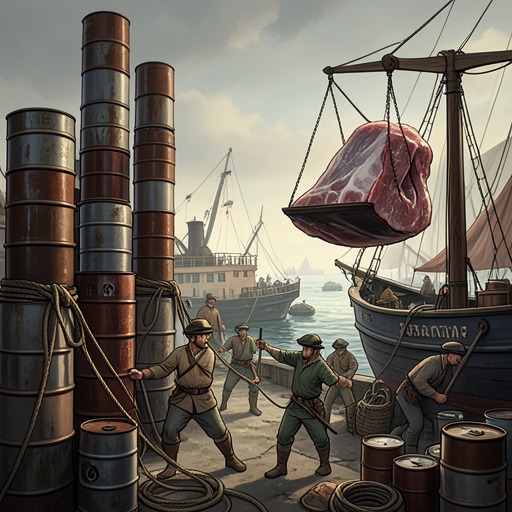
Captain Peleg
Moby-DickCaptain Peleg is the retired seaman who helps make the Pequod ready for its voyage and serves as one of the ship’s principal owners and agents. Formerly her chief mate, he has also helped shape the vessel’s extraordinary appearance, adding to her inherited antiquities a grotesque profusion of whale-bone ornament. His authority is practical rather than ceremonial: he recruits crew, supplies the ship, negotiates shares, and gives Ishmael his first substantial account of Captain Ahab. Yet his rough humor and explosive temper coexist with sound judgment, making him an important threshold figure between shore-bound uncertainty and the Pequod’s dangerous world.
Identity and Authority
Captain Peleg first appears aboard the Pequod in a temporary wigwam behind the mainmast, a conical structure made from enormous slabs of right-whale bone. Half concealed in this strange shelter, he is seated in an old carved oaken chair. His body and clothing are comparatively ordinary: he is an elderly, brown, brawny seaman wrapped in blue pilot-cloth. The fine network of wrinkles around his eyes, produced by years of looking into hard gales, gives his face a permanent scowl. The setting therefore introduces him through a contrast between human familiarity and the ship’s cannibalistic maritime grandeur.
Peleg is not the Pequod’s acting captain. When Ishmael approaches the wigwam and asks whether he is speaking to the captain, Peleg answers with guarded authority before identifying himself. He explains that he and Captain Bildad are part owners and agents responsible for fitting out the vessel, supplying its needs, and obtaining its crew. The ownership structure is itself unusually dispersed: beyond the major shares held by Peleg and Captain Bildad, other interests belong to old annuitants, widows, fatherless children, and chancery wards, each possessing only a small fraction of the ship. Peleg consequently occupies both a maritime and an administrative position, joining the informal force of an experienced sailor to the commercial machinery behind the voyage.
Recruitment of Ishmael
Peleg becomes Ishmael’s first serious point of contact with the Pequod’s command structure. Ishmael approaches him because he is seeking someone with authority to whom he can propose himself as a candidate for the voyage. When Ishmael says that he is thinking of shipping, Peleg does not merely accept the application; he offers a warning about the nature of whaling before the commitment becomes irrevocable. He tells Ishmael to look upon Captain Ahab and points out that Ahab has only one leg, thereby making bodily injury the first concrete sign of the dangers of the profession.
Peleg describes Ahab’s lost leg in deliberately violent language, saying that it was devoured and crunched by an enormous Sperm whale. His account gives Ishmael a compressed introduction to the traumatic history that will govern the Pequod’s voyage, while Peleg’s theatrical delivery also reveals his own manner: blunt, comic, boastful, and accustomed to turning terror into a sailor’s anecdote. Ishmael is briefly shaken, but remains determined to go whaling. Because the Pequod seems to him as good as, and perhaps the best of, the available ships, Peleg agrees to take him on and leads him below to sign the papers.
The enlistment is recorded in the language of the ship’s economic system. Peleg assigns Ishmael the three hundredth lay, a fractional share of the voyage’s common return rather than a fixed wage. When Ishmael asks whether he may bring a friend who also wishes to ship, Peleg readily tells him to fetch the man so that the owners can inspect him. His willingness to consider the friend helps open the way for Queequeg’s eventual connection with the Pequod and shows Peleg acting as a practical gatekeeper rather than as a distant proprietor.
Relation to Captain Ahab
Peleg’s portrait of Captain Ahab is admiring even when it is apprehensive. He tells Ishmael that Ahab is difficult to see, keeping himself inside his cabin in a condition that is neither ordinary sickness nor ordinary health. Peleg calls him a queer man but also a good one, and presents him as a figure far above common standards. Ahab has been in colleges, has lived among cannibals, and has confronted deeper and stranger wonders than the sea. Peleg’s praise culminates in the image of Ahab as a crowned king, invoking the biblical Ahab while emphasizing the Pequod captain’s exceptional force.
This speech reveals Peleg’s ambivalence. He does not understand Ahab completely, and he warns Ishmael to listen carefully whenever Ahab speaks, but he does not treat the captain’s difference as disqualifying. Ahab is described as ungodly and god-like at once: a man whose authority exceeds the ordinary categories by which a shipmaster might be judged. Peleg’s confidence helps normalize Ahab’s isolation and prepares Ishmael to accept a command structure whose danger is already visible before the voyage begins.
The relationship between Peleg and Ahab is also institutional. Peleg and Captain Bildad fit out the ship, but Ahab commands it once the voyage is under way. The owners’ authority therefore gives way to the captain’s operational supremacy. Later descriptions of the Pequod’s discipline clarify the tension: Captain Ahab demands implicit and instantaneous obedience, and although he does not rely on shallow displays of rank, he uses the formal usages of the sea as external supports for an almost irresistible dictatorship. Peleg is part of the system that places this power in Ahab’s hands, even though the evidence does not show him anticipating the full consequences of Ahab’s obsession.
Temper and Practical Competence
Peleg’s authority is not calm or polished. When Captain Bildad raises objections during the enlistment and outfitting process, Peleg erupts into anger and rushes at him. The scene briefly makes Ishmael fear that the Pequod is questionably owned and temporarily commanded. Yet the disturbance ends in a characteristic reversal: Bildad, evidently accustomed to Peleg’s impenitent ways, simply sits down again, while Peleg settles after his outburst and returns to business. His rage is real, but it is neither permanent nor administratively disabling.
Immediately afterward, Peleg resumes the work of recruitment and assigns Ishmael his lay. This movement from fury to paperwork captures his distinctive competence. He can shout, threaten, and behave like a volatile old sailor, but he also knows how to restore the ordinary process by which the ship is staffed. His temperament belongs to the rough social world of whaling, while his actions keep that world functioning.
Peleg’s role continues as the Pequod leaves port. After the ship has been hauled away from the wharf, he and Captain Bildad emerge from the cabin to inspect the final preparations. Peleg asks Starbuck whether everything is in order, confirms that Captain Ahab is ready, and orders all hands to be mustered. His language remains abrupt and profane, while Bildad calls for restraint and repeats the command in more decorous terms. Together they represent two complementary forms of shore-based authority: Peleg’s impatient practical energy and Bildad’s religiously inflected propriety.
Narrative and Thematic Significance
Captain Peleg occupies a threshold in Ishmael’s experience. He is the man Ishmael encounters before meeting Captain Ahab, and he translates the unknown captain into a mixture of biography, warning, legend, and recommendation. Through Peleg, Ahab is simultaneously made more comprehensible and more mysterious. The reader learns of the lost leg, the hidden cabin, the captain’s unusual education and experience, and the extraordinary obedience he commands, but none of this reduces Ahab to an ordinary personality.
Peleg also helps establish the Pequod as an organization whose material and ceremonial structures can support individual obsession. The ship is physically adorned with the bones of whales, economically assembled through many partial investments, and socially ordered through strict maritime forms. Peleg participates in each of these dimensions. He is associated with the vessel’s grotesque whale-bone construction, owns and administers part of it, recruits its labor, and hands operational control to Ahab. His practical decisions thus contribute to the chain by which a commercial whaling expedition becomes the vehicle of a private pursuit.
At the same time, Peleg belongs to Ishmael’s broader defense of whaling as a demanding, globally consequential occupation. The narrative presents whaling as a hazardous business in which crews share profits, vigilance, labor, and risk, and as an enterprise that explored remote seas, opened routes, carried supplies and missionaries, and helped connect distant regions. Peleg’s experience as a retired chief mate and owner gives personal substance to that public claim. He is not an abstract spokesman for the dignity of whaling, but a working maritime authority whose knowledge has been converted into the institution that sends the Pequod across the world.
Peleg disappears from the central action once the voyage passes into Ahab’s command, but his early function remains decisive. He opens the ship to Ishmael, brings the captain’s history into view, and establishes the practical framework that makes the later command possible. His rough humor, sudden anger, and resilient competence mark the last comparatively ordinary face of authority before the Pequod’s voyage is subsumed by Captain Ahab’s pursuit of Moby Dick.