Fedallah
Moby-DickFedallah, also called the Parsee, is the most mysterious member of the Pequod’s crew and the closest embodiment of the occult, prophetic dimension of Captain Ahab’s pursuit of Moby Dick. He appears suddenly as the leader of a hidden boat crew, serves as an extraordinary night lookout, and remains bound to Ahab by an influence that the narrator never fully explains. His death, lashed to Moby Dick’s back, transforms earlier hints of prophecy into a visible sign of the chase’s fatal design.
Identity and Arrival
Fedallah first appears as one of five dark figures who seem to have formed out of the air while the Pequod is preparing its first lowering. He stands by the bows of the captain’s boat, tall and dark, with one white tooth protruding from steel-like lips. His clothing intensifies his strangeness: a black Chinese jacket and loose black trousers are crowned by a shining white plaited turban made from his braided hair. The men accompanying him have a vivid yellow complexion associated by the narrator with aboriginal natives of the Manillas, and their sudden presence gives the scene the atmosphere of an apparition rather than an ordinary addition to a ship’s complement.
Captain Ahab addresses the white-turbaned leader directly, asking whether everything is ready, and Fedallah answers that it is. Ahab then orders the boat lowered. This exchange establishes Fedallah not as an accidental passenger but as a prepared participant in Ahab’s private arrangement. The subordinate strangers soon find places among the sailors, although they remain somewhat distinct from them; Fedallah alone continues to resist assimilation into the ordinary social order of the ship.
Mystery and Influence over Ahab
The narrator repeatedly emphasizes that Fedallah’s origin and status remain unknown. No one knows from where he came, what tie connects him to Ahab’s peculiar fortunes, or whether his influence might even amount to authority over the captain. He is not merely an exotic sailor whose appearance attracts attention. He is described as a muffled mystery who seems to belong to a world outside the familiar categories of civilized domestic life, and his presence gives the Pequod another layer of strangeness amid the many nations and castaways gathered aboard whaling ships.
Fedallah’s position is therefore informal but powerful. The Pequod possesses a visible hierarchy governed by maritime custom, command, obedience, and ritual. Captain Ahab ordinarily uses those forms to turn his authority into an irresistible dictatorship, requiring implicit and instantaneous obedience. Yet Fedallah occupies a different kind of power relation: he does not command the ship openly, but he is linked to Ahab’s private destiny in a way the officers cannot understand. When the crew gathers at Ahab’s summons, Fedallah is part of the armed circle around the capstan, standing among the harpooneers and beneath the captain’s imperious ceremony. His presence helps convert a naval order into a private rite of allegiance to Ahab’s purpose.
Watcher of the Night Sea
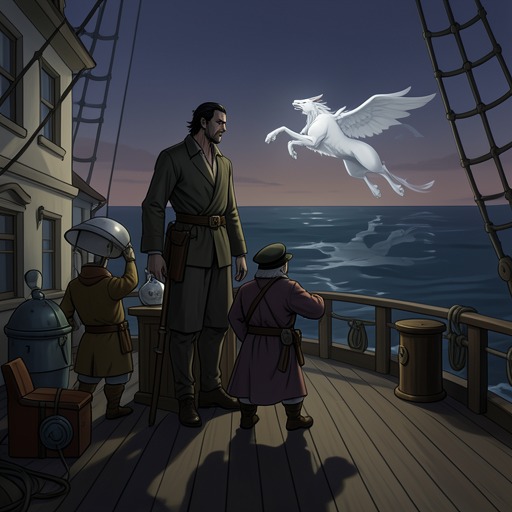
Fedallah’s most distinctive practical role is his night watch from the mainmast head. On moonlit nights he climbs aloft with the same precision he would use in daylight, even though almost no whaleman would willingly lower boats for whales seen at such an hour. His turban and the moon appear together in the sky, making the lookout seem less like an ordinary sailor than a figure stationed between the human crew and the supernatural sea.
After spending the same interval aloft for several successive nights without speaking, Fedallah finally announces a silvery, moonlit spout far ahead of the ship. His cry, “There she blows!”, electrifies the Pequod. The sailors are startled as though a spirit had entered the rigging, yet their reaction is not chiefly terror; they feel excitement and instinctively wish to lower the boats. Fedallah’s silence gives the cry unusual force, while his ability to see and announce what others cannot perceive makes him the instrument through which the ship is repeatedly summoned onward.
The spout disappears whenever the Pequod attempts to approach it, then returns on later nights, sometimes after an interval of one, two, or three days. It seems always to be moving farther ahead. Some sailors come to believe that the apparition is produced by one whale alone and that the whale is Moby Dick. The recurring, unreachable spout thus becomes an omen of the white whale’s presence and a lure toward increasingly remote and dangerous waters. Fedallah is its first observer, so his watchfulness helps fuse his identity with the ship’s supernatural interpretation of the chase.
Prophecy, Dream, and Fatal Alliance
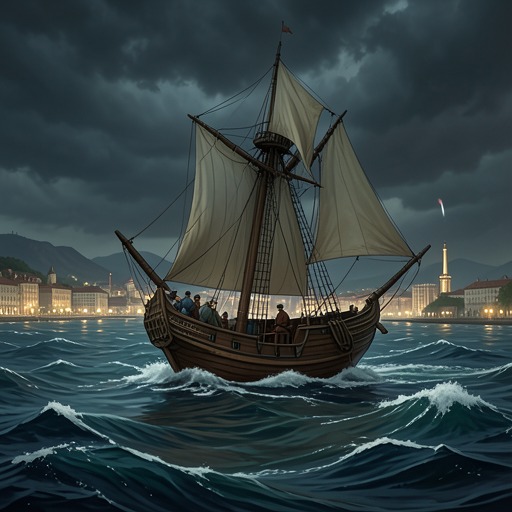
During the stormy passage toward the Cape of Good Hope, the Pequod’s crew becomes practically fatalistic, secured to the bulwarks while the ship drives through dangerous seas. Ahab stands for hours gripping a shroud, his ivory leg fixed in its accustomed place, staring into the blast. In the midst of this ordeal, Fedallah’s significance is intensified by the contrast between the captain’s visible command and the Parsee’s concealed knowledge. Ahab says little, but the pursuit continues as though the ship were being carried by an inner necessity rather than by ordinary navigation or prudence.
Later, while four whales lie dead around the ship, Fedallah remains awake beside Ahab’s boat through the night, crouched in the bow and watching the sharks circling the whale. When Ahab awakens and finds him there, the two men seem like the last survivors of a drowned world. Ahab says that he has dreamed again, and Fedallah asks whether the dream concerned hearses. He denies that either hearse or coffin will belong to Ahab. The exchange connects Fedallah with Ahab’s visions and with a prophecy whose exact terms remain only partly disclosed. His role is not that of a comforting interpreter; he is the presence before whom Ahab’s death-conscious imagination becomes articulate.
Fedallah’s bond with Ahab also explains why the Parsee is treated as something more than a subordinate. Ahab’s private obsession is organized through the ship’s formal command structure, but Fedallah belongs to the hidden alliance beneath that structure. The officers can observe Ahab’s orders, rituals, and threats; they cannot see the full logic by which Fedallah’s predictions and Ahab’s self-conception reinforce one another. The captain’s pursuit consequently becomes both a military operation and a prophecy that appears to demand fulfillment.
Death and Narrative Significance
Fedallah dies during the third day of the chase. After Moby Dick rises through the boats and scatters them, the whale turns and exposes its flank. Lashed repeatedly to the whale’s back by the lines that have reeled around him, the half-torn body of the Parsee becomes visible. His black clothing hangs in shreds, and his distended eyes face Captain Ahab directly. Ahab’s harpoon drops from his hand when he sees him.
The sight completes the earlier imagery of hearses and coffins. Ahab recognizes Fedallah as the figure who has gone before him and understands the whale as the hearse promised in the prophecy. Yet even this confirmation does not release him from the chase. Instead, he interprets the prophecy literally and continues to command the surviving boats, insisting that the second hearse has yet to appear. Fedallah’s death therefore functions as both fulfillment and acceleration: it confirms that the pursuit has entered its final fatal phase, while Ahab converts the confirmation into a reason to proceed.
Fedallah’s body also becomes an image of the Pequod’s fate before the ship itself is destroyed. The Parsee, once concealed and mysterious, is now physically bound to Moby Dick, his human form displayed as part of the whale’s violence. His death exposes the cost of the private alliance between Ahab and the supernatural-seeming logic of revenge. As a character, Fedallah remains deliberately underexplained; his origins, beliefs, and inner life are withheld. His narrative power lies instead in his position between roles: sailor and apparition, subordinate and influence, lookout and prophet, human companion and sign of the doom that Ahab refuses to evade.