Queequeg
Moby-DickQueequeg is a native of Rokovoko, an island far away to the west and south that is absent from every map, yet his importance to the narrative is unmistakably concrete. A royal-born islander who becomes a harpooneer in Christian lands, he first appears to Ishmael as a terrifying stranger and soon becomes his bosom friend, shipmate, protector, and moral counterexample. Through Queequeg, the narrative repeatedly tests the difference between civilized appearance and humane conduct, showing that courage, courtesy, generosity, and fidelity may flourish most fully in the person whom conventional society labels a savage or cannibal.
Identity and Background
Queequeg comes from Rokovoko, an island that the narrator calls unmapped because true places are not always those officially recorded. His family gives him a royal and priestly inheritance: his father is a High Chief and King, his uncle a High Priest, and his maternal aunts are wives of unconquerable warriors. He therefore possesses what the narrative describes as excellent blood, although his early life is also associated with the cannibal propensity he developed in an untutored youth. His identity combines several categories that Christian maritime society treats as opposites: he is both prince and working sailor, both islander and traveler, both pagan and resident among Christians, both feared outsider and reliable companion.
His movement toward Christendom begins with an act of extraordinary determination. When a ship from Sag Harbor visits his father’s bay, Queequeg seeks passage but is rejected because the vessel already has its full complement of seamen. His father’s influence cannot change the decision, so Queequeg acts alone. He paddles to a distant strait, hides his canoe among mangroves beside a coral reef, waits for the ship to pass, then darts out, capsizes his canoe, climbs the chains, and throws himself onto the deck, gripping a ring-bolt and swearing not to let go. The episode establishes the physical resolve that later makes him an exceptional harpooneer, while also revealing that his entry into the Christian world is self-chosen rather than passively imposed.
Friendship with Ishmael
Queequeg’s relationship with Ishmael begins in fear. Sharing a room with a stranger who carries a tomahawk, smokes in bed, and is identified as a cannibal, Ishmael initially imagines himself in mortal danger. The landlord eventually explains that Queequeg would not harm him, and Queequeg confirms the reassurance through conduct: he invites Ishmael into the bed, moves aside, puts away the tomahawk and pipe when asked, and makes clear through gesture that he will not touch his companion. Ishmael’s fear then turns into recognition. Beneath the tattooing, Queequeg appears clean and comely; more importantly, Ishmael realizes that Queequeg is a human being with as much reason to fear him as Ishmael has to fear Queequeg.
Their friendship develops through shared, bodily acts rather than fluent speech. They examine a book together, exchange attempts at conversation, and pass Queequeg’s wild pipe from one to the other. The social smoke thaws whatever indifference remains between them. Queequeg presses his forehead against Ishmael’s, clasps him around the waist, and declares that they are married, using his country’s phrase for bosom friendship and a readiness to die for one another. The suddenness of the bond would seem suspicious if judged by the conventions of a countryman, but the narrative presents those conventions as inadequate to Queequeg’s direct and generous mode of attachment.
Queequeg extends friendship into material sharing. He gives Ishmael an embalmed head, divides roughly thirty dollars in silver into two equal portions, and forces one portion into Ishmael’s pockets when Ishmael tries to object. His generosity is not ceremonial but practical: possessions, money, lodging, danger, and future movement all become common concerns. Ishmael’s recognition of their bond is equally decisive. After watching Queequeg rescue a drowning greenhorn, Ishmael says that he clings to him like a barnacle, a devotion that lasts until Queequeg’s final long dive.
Religion and Cultural Boundaries
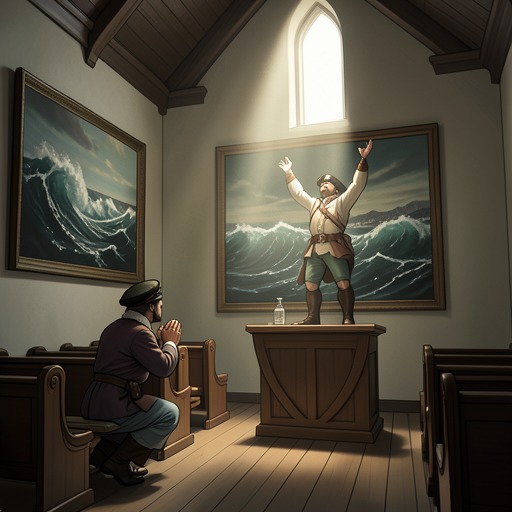
Queequeg’s religious life unsettles Ishmael’s inherited assumptions. Queequeg practices the worship of a small wooden idol, Yojo, while living among Christians, wearing their clothes, and trying to speak their language. Ishmael initially wonders how a member of the Presbyterian Church could join an idolator in worship. He then reasons that worship consists in doing the will of God, and that the will of God is to treat one’s fellow human being as one wishes to be treated. Since Queequeg is his fellow human being, Ishmael concludes that he must join Queequeg in his form of worship just as he would wish Queequeg to join him in Presbyterian worship.
This reasoning does not erase the differences between their traditions; it changes the standard by which those differences are judged. Ishmael helps prop up the idol, kindles shavings, and offers burnt biscuit with Queequeg. The scene makes religious fellowship an ethical practice rather than a demand for doctrinal uniformity. Queequeg’s paganism is not presented as an obstacle to friendship, and Christian affiliation is not treated as proof of superior conduct. His calm hospitality and Ishmael’s willingness to participate together expose the narrowness of any civilization that mistakes its own ritual for the whole of moral truth.
Queequeg himself remains divided between inherited identity and acquired experience. Although he lives among Christians and has been made into a harpooneer, he remains an idolator at heart. Asked whether he plans to return home and claim his expected coronation, he says not yet, because Christianity, or Christians, may have unfitted him to ascend the pure throne of the thirty pagan kings before him. He intends for the time being to sail through all four oceans, treating the harpoon as a substitute for a sceptre. The image captures his altered status: royal authority has been displaced by maritime labor, but the dignity of the king remains within the harpooneer.
Courage and Life at Sea
Queequeg’s usefulness aboard ship is first demonstrated not by reputation but by immediate action. When a schooner’s main-sail strain parts the weather-sheet and the boom sweeps violently across the deck, the crew panics. Queequeg drops to his knees, crawls beneath the boom’s path, secures a rope to the bulwarks, and lassoes the spar on its next sweep, trapping it and restoring safety. When a greenhorn is thrown overboard, Queequeg strips to the waist, leaps into the freezing foam, swims for several minutes, dives beneath the surface, and returns dragging the lifeless man. The boat recovers them, and the greenhorn is restored.
The rescue changes Ishmael’s allegiance permanently, but Queequeg himself treats the feat as ordinary duty. He asks only for fresh water to wash away the brine, puts on dry clothes, lights his pipe, and leans against the bulwarks. His action and his lack of self-congratulation together define his heroism. He does not require a medal from humane societies; he behaves as though the world were a mutual joint-stock enterprise in every latitude, one in which cannibals must help Christians. The narrative’s moral inversion is unmistakable: the man marked as savage performs the most instinctively humane act, while civilization’s categories are left looking absurdly inadequate.
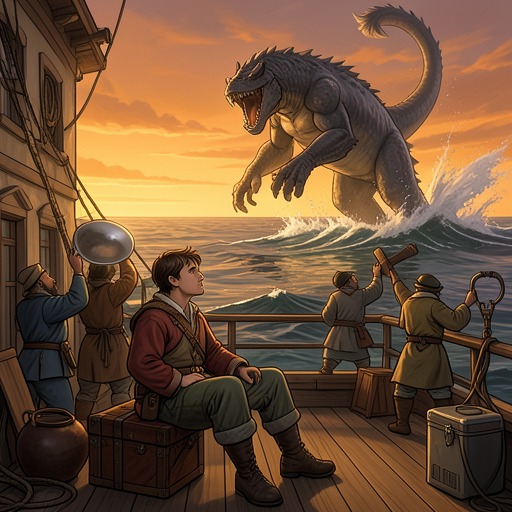
The same maritime world that reveals Queequeg’s courage also places him within a vast ecology of danger and dependence. The Pequod travels through brit, the minute yellow substance on which Right Whales feed, and encounters Sperm Whales gathering in immense caravans across the ocean. Around a captured whale, sharks gather in such numbers that the sea seems filled with voracious life. Queequeg’s work belongs to this network of species, tools, bodies, and commercial demands: he is not merely an exotic companion but a skilled participant in the labor that connects ships, whale grounds, ports, and markets across four oceans.
Illness, Coffin, and Recovery
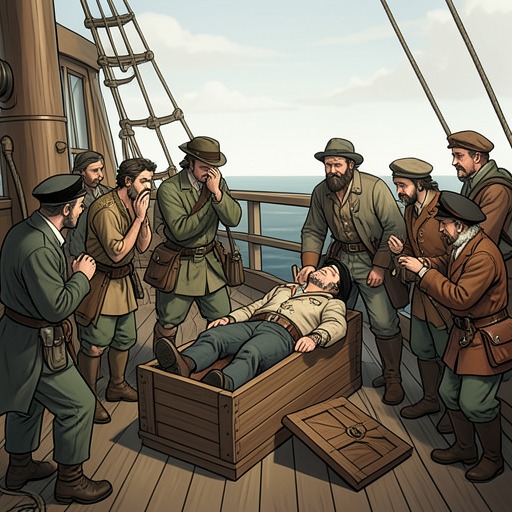
When Queequeg becomes gravely ill, he prepares for death by ordering a coffin that fits him. The crew treats the coffin as evidence that he has accepted his end, and Stubb theatrically imagines forming two ranks to make him a general, while contrasting his expected courageous death with Pip’s supposed cowardice. Queequeg lies with closed eyes as though in a dream, apparently having completed his preparations.
His recovery arrives as an act of will. After the coffin has proved a good fit, Queequeg suddenly rallies and explains that he has remembered a small duty ashore that he is leaving undone; therefore, he has changed his mind about dying. He insists that living or dying is a matter of his sovereign will and pleasure, arguing that once a man decides to live, sickness cannot kill him. Only a whale, a gale, or another violent, ungovernable destroyer can do so. The claim is comic in its confidence but also consistent with his character: Queequeg meets danger through decision, bodily action, and a refusal to surrender his agency to fear.
Once restored, he regains strength quickly, eats with a vigorous appetite, leaps to his feet, stretches, yawns, and returns to the head of his hoisted boat with a harpoon, declaring himself ready for a fight. His coffin then changes function. Rather than serving as a container for the dead, it becomes a sea-chest for his clothes, and he spends spare hours carving its lid with grotesque figures that echo the tattooing on his body. Those marks were made by a departed prophet and seer of his island and were said to form a complete theory of heaven and earth, along with a mystical treatise on attaining truth. Queequeg’s tattooed body is thus treated as a living riddle, a book whose mysteries even he cannot read and whose knowledge may disappear when the living parchment decays.
Narrative and Thematic Significance
Queequeg’s character gives the novel its most sustained argument against the easy opposition between civilized and savage. His background includes royal descent, pagan worship, and the frightening reputation of cannibalism, but his conduct repeatedly supplies the standards by which civilization should be judged. He offers hospitality to a frightened stranger, shares money without calculation, accepts religious reciprocity, risks his life for a greenhorn, and returns to dangerous labor without demanding recognition. The narrative does not make him culturally identical to Ishmael; it makes their difference the ground on which a more capacious fellowship becomes possible.
His life also reflects the global structure of nineteenth-century whaling. Queequeg leaves an uncharted island, enters a maritime economy shaped by Nantucket and Sag Harbor, and becomes part of a shipboard community that crosses the Atlantic, the Pacific, and the other oceans. Whaling is presented as a powerful international enterprise: American whalemen command a fleet of more than seven hundred vessels and eighteen thousand men, while whale ships explore uncharted seas, open routes toward colonies and island societies, and carry commercial and missionary traffic. Queequeg’s personal history therefore embodies the movement of people and knowledge through that oceanic system, even as his royal origin and indigenous identity resist being reduced to a mere laboring function.
The wider industry turns animals and their products into global commodities. Whale oil supplies lamps and candles around the world; ambergris, discovered in a whale and worth a gold guinea an ounce to a druggist, enters perfumery, candles, hair powders, cooking, and religious practice. English and American companies extend the hunt from the Atlantic around Cape Horn into the Pacific, while the whale ship becomes an instrument of exploration and imperial access. Queequeg stands inside this system as an expert harpooneer, yet the narrative’s attention to whales, sharks, brit, breeding, migration, and the refuge of whale-bone whales in Polar regions also shows that maritime labor is inseparable from the lives of other species.
Queequeg’s defining significance finally lies in the tension between his unknowability and his reliability. His island is absent from maps; his tattooing records a theology he cannot decipher; his language must be learned through broken phrases and signs; his customs initially provoke fear. Yet the more Ishmael encounters him, the more trustworthy his actions become. Queequeg cannot be fully translated into Ishmael’s categories, but he can be recognized through friendship, courage, and reciprocal care. In that sense, he is both a mystery and an answer: a figure whose difference remains intact while his humanity becomes impossible to deny.