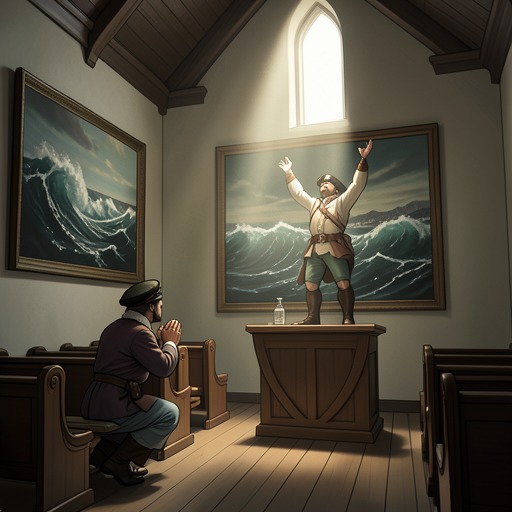
Father Mapple
Moby-DickFather Mapple is the celebrated chaplain of the Whalemen's Chapel and a former sailor and harpooner whose ministry remains marked by his maritime past. His appearance, movements, pulpit, prayer, and sermon all convert the chapel into a symbolic vessel: he does not merely preach to whalemen but addresses them as shipmates, interpreting Jonah's storm, punishment, repentance, and deliverance through the physical language of the ocean. His decisive significance lies in the way he joins religious authority to seafaring experience, making obedience to God both a spiritual command and a hard discipline of self-overcoming.
Identity and Maritime Background
Father Mapple is introduced as an old man of unusual vitality, standing in the “hardy winter of a healthy old age” while signs of renewed life appear among his wrinkles. The whalemen know him as a great favorite, and his authority does not arise from clerical office alone. In his youth he was a sailor and a harpooner; later he dedicated his life to the ministry. The combination explains why his religious language never becomes detached from labor, danger, navigation, or the bodily practices of sailors. Even before he speaks, his history makes him legible as a figure who has crossed from the violence of the whale fishery into the discipline of preaching without abandoning the knowledge acquired at sea.
His clothing preserves that history. He arrives through winter weather in a tarpaulin hat and a heavy pilot-cloth jacket saturated with sleet, carrying neither umbrella nor signs of a carriage. After removing the wet garments, he approaches the pulpit in respectable dress, but the transformation is not a rejection of the sailor. The soaked maritime clothing and the clerical suit together present two continuous aspects of the same life: the preacher has not escaped the sea but has brought its habits of endurance and command into the chapel.
The Pulpit as a Shipboard Space
The architecture of Father Mapple's pulpit makes his maritime identity physically visible. Because the chapel is too small for a long stairway, the pulpit has a perpendicular side ladder modeled on the means of boarding a ship from a boat at sea. A whaling captain's wife has supplied red worsted man-ropes, and Father Mapple climbs them hand over hand with sailor-like dexterity while retaining reverence. The ascent resembles mounting a vessel's main-top, turning the preacher's movement toward the pulpit into a ritual passage from the congregation's ordinary space to a precarious height.
Once he reaches the top, he pulls the ladder up after him, step by step, leaving himself enclosed and apparently impregnable in his elevated position. The pulpit becomes a small fortress or shipboard command post, but it also evokes isolation: the preacher separates himself from the congregation in order to speak with authority to it. His later wish to descend and sit among the listeners therefore carries structural force. He recognizes the distance created by the pulpit and imagines himself not only as the interpreter of Jonah but as another sinful sailor who must hear the lesson from below.
He also commands the congregation in nautical terms. When the people are scattered, he orders them to condense with directions for starboard, larboard, and midships gangways. The congregation is organized as a crew, and the chapel becomes a vessel whose passengers must respond to disciplined verbal signals. This does not make the religious gathering merely theatrical. It shows how Father Mapple translates communal worship into a form intelligible to whalemen, using the vocabulary of their work to create a temporary spiritual ship.
The Jonah Sermon
Father Mapple's sermon begins with the last verse of the first chapter of Jonah: God has prepared a great fish to swallow the prophet. He calls the Book of Jonah one of the smallest strands in the vast cable of Scripture, yet insists that its brevity contains profound depths of the soul. The metaphor of the cable joins biblical interpretation to maritime material culture. A short text can bear immense spiritual weight, just as a small strand contributes to the strength of a larger rope.
He identifies Jonah's story as a twofold lesson. For sinful people generally, it presents willful disobedience, fear, punishment, repentance, prayer, deliverance, and joy. For Father Mapple personally, it concerns the responsibility of a pilot of the living God. Jonah's sin is not simply that he makes a bad choice; it is that he refuses a difficult divine command. Father Mapple therefore defines obedience as a conflict between God and the self: to obey God, people must disobey themselves, and the hardness of obedience lies precisely in that surrender of self-will.
The sermon makes Jonah's sea ordeal vivid as both punishment and revelation. The mariners discover Jonah's guilt by casting lots during the storm. Jonah confesses that he fears the Lord who made the sea and dry land, then asks to be cast into the water because he knows the tempest has come for his sake. The sailors remain reluctant to sacrifice him and attempt other means of saving the ship, but the storm forces them to act. Father Mapple describes Jonah being dropped into the sea like an anchor, after which the gale ceases and the water becomes calm. The image makes divine judgment simultaneously terrible and ordered: Jonah's removal carries away the storm.
Within the whale, Jonah does not demand immediate rescue. Father Mapple emphasizes that he accepts the punishment as just and turns toward the holy temple despite his suffering. This becomes the sermon’s model of true repentance. Repentance is not a noisy claim to pardon but a recognition of guilt joined to gratitude for correction. Deliverance follows not because Jonah has negotiated it but because God hears him, commands the fish, and returns him to dry land. The whale is therefore both prison and instrument of restoration, a creature through which judgment becomes the route to renewed obedience.
Father Mapple's second lesson is directed at himself as a prophetic speaker. Jonah was commissioned to carry unwelcome truth to Nineveh, but fear of the hostility he would provoke drove him to flee from Joppa toward Tarshish. He never reaches that destination: God finds him in the whale and sends him back to fulfill the mission. Father Mapple presents this as the more awful lesson because it concerns the failure of a religious messenger. To preach truth to falsehood requires not only knowledge but the courage to withstand the social consequences of speaking it.
Religious Authority and Performance
Father Mapple's authority is enacted through his body as much as through his doctrine. During the prayer, he kneels with his large brown hands folded over his chest and appears to be praying at the bottom of the sea. The image places the congregation inside an imagined underwater depth, while his prayer links the physical extremity of the ocean with spiritual submission. His hymn begins in solemn tones like a bell tolling aboard a foundering ship in fog, then rises into exultant joy. The congregation joins him, and the singing swells above the storm outside, turning collective worship into a sound that contests the weather without denying its power.
As he recounts Jonah's storm, the preacher seems to undergo the storm himself. His chest heaves like a ground swell, his arms resemble warring elements, and his face and eyes produce in the listeners a fear unfamiliar to them. This performance does not merely decorate the sermon; it makes interpretation experiential. The congregation is asked to feel the danger of disobedience through the preacher's physical reenactment, just as sailors understand a storm through wind, water, motion, and command.
His final declaration is an act of humility within an otherwise commanding performance. Father Mapple says that God has laid one hand upon his listeners but both hands upon him, and confesses that he is a greater sinner than they are. He wishes he could come down from the pulpit and sit among them while another person reads the lesson meant for him. The statement reverses the apparent hierarchy of preacher and congregation: the religious authority is also the most exposed hearer, burdened by the obligations of a pilot-prophet.
The sermon closes in a theology of steadfastness. Father Mapple celebrates the joy of the person who stands against the proud powers of the world, gives no quarter to sin, and acknowledges no ultimate lord but God. He imagines a final deathbed confession in which a person can say that he has tried to belong to God rather than to the world or to himself. After speaking, he gives a benediction, covers his face with his hands, and remains kneeling until everyone has left. His ending gesture completes the contrast between public force and private submission: the preacher who commands the room finally withdraws into solitary prayer.
Narrative and Thematic Significance
Father Mapple provides an early religious grammar for the novel's maritime world. His sermon makes the whale, the storm, the ship, the anchor, the sounding depths, and the act of navigation into instruments of theological thought. Later reflections on whaling's antiquity and honor likewise place the whale within a vast archive of sacred and mythic traditions, including Jonah, Perseus, St. George, Hercules, and Vishnoo. In that broader pattern, Father Mapple's sermon establishes the interpretive habit of reading marine life and seafaring action through biblical, legendary, and comparative religious forms.
His treatment of Jonah also introduces a central tension between vocation and self-will. The prophet's task is not simply to survive a disaster but to accept an unwelcome mission and speak truth despite hostility. Father Mapple's emphasis on obedience, repentance, and prophetic responsibility gives the sea a moral dimension without reducing it to safety or comfort. The ocean is the place where human evasion is exposed, punishment becomes unavoidable, and deliverance remains dependent on a power beyond human control.
For Ishmael, Father Mapple is among the first figures to show how a sailor's life can become a form of knowledge rather than a disreputable occupation. The later defense of whaling presents the whale-ship as an explorer of unknown seas, a mediator between distant peoples, and a force in global history. Father Mapple's chapel scene prepares that defense by demonstrating that maritime labor possesses its own ritual language, heroic memory, and moral seriousness. The former harpooner does not romanticize danger away; he turns its terror into a discipline of attention, repentance, and truth-telling.