Stubb
Moby-DickStubb is the Pequod’s second mate, a native of Cape Cod whose professional calm turns the violence of whaling into something almost domestic. Neither notably cowardly nor conventionally heroic, he meets danger with an indifferent cheerfulness, working through the most desperate chase as steadily as a journeyman joiner at his trade. His humor, pipes, and fatalistic habits make him seem nearly immune to fear, yet his conduct repeatedly shows the practical courage and disciplined competence on which the ship depends.
Identity and Temperament
Stubb presides over his whale-boat as though a deadly encounter were an ordinary meal to which his crew had been invited. He arranges his place in the boat with the care of an old stage-driver securing his box, then handles his lance beside an enraged whale as coolly as a whistling tinker handles a hammer. He may hum old rigadig tunes while the monster thrashes within reach. Long familiarity has made the jaws of death feel to him like an easy chair, and death itself, if he thinks of it at all, resembles merely a call to another watch whose purpose will become clear only after he obeys it.
His pipe is the concrete emblem of this disposition. The short black pipe is as constant a feature of his face as his nose, and he keeps a whole row of loaded pipes in a rack near his hand. When he turns in, he smokes them successively, lighting each from the preceding one, then reloads them for the next round. When dressing, he puts the pipe into his mouth before putting his legs into his trousers. The narrative treats the tobacco smoke as a possible disinfectant against the miseries carried in the earthly air, giving Stubb’s habit both comic specificity and a material explanation for his apparently inexhaustible good humor.
Position aboard the Pequod
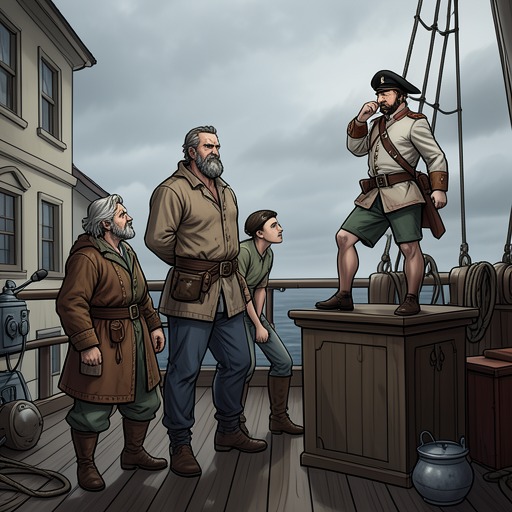
As second mate, Stubb occupies a formal place in the Pequod’s command structure beneath Captain Ahab and the first mate, Starbuck, while Flask serves as third mate. The officers’ duties are defined by strict quarter-deck customs even when the voyage’s shared risks and profits encourage a more familial life among the crew. Captain Ahab demands implicit and instantaneous obedience rather than ceremonial homage, but he remains attentive to maritime forms, and those forms help turn his private authority into an effective dictatorship.
Stubb’s relation to that authority is marked by a revealing mixture of boldness and submission. During one night watch, Ahab paces the deck on his ivory leg, and Stubb cautiously suggests muffling the noise with tow inserted around the heel. The attempt at humorous practical advice collapses when Ahab answers with contempt and orders him below to his nightly grave. Stubb is momentarily speechless and protests that he is not accustomed to being spoken to in that way. Yet the exchange does not produce open defiance. Like the other officers, he can carry himself more freely in the open air of the deck, but the ship’s social and official rituals make him deferential in Ahab’s cabin.
At dinner, Stubb participates in this transformation. Ahab presides at the ivory-inlaid table, and the officers wait upon his movements with the silent attention of children before an imposing parent. When Ahab’s knife moves Starbuck’s plate toward him with a slice of beef, the mate receives the meat almost as alms. Stubb’s own conduct is shaped by the same social enchantment: the ship’s commander is not merely an officer but the temporary sovereign of the private table. The contrast reveals how obedience is produced not only by commands and punishments but also by ceremony, habit, and the concentrated power of a closed community.
Work, Whaling, and Comic Courage
Stubb’s competence is clearest in the whale-boat, where humor becomes a method of mastering fear. He does not romanticize the whale or pause before its majesty; instead, he converts danger into routine, rhythm, and bodily procedure. His calm is therefore not the absence of peril but a practiced response to it. The same temperament helps the Pequod continue functioning when the sea turns labor into exhaustion and violence.
Stubb’s presence also belongs to the book’s wider account of whaling as an ecological and material system. He takes part in the work surrounding captured whales, including the difficult handling of a Sperm Whale’s enormous head hanging alongside the Pequod. When the ship encounters a sea marked by patches of brit, the crew unexpectedly decides to lower a boat for a Right Whale, although the Pequod normally disdains that quarry and was not commissioned to cruise for it. Stubb and Flask then kill a Right Whale, an episode that places Stubb’s practical appetite within a world of competing species, feeding grounds, hunting customs, and commercial priorities.
The surrounding ocean repeatedly complicates the human confidence that Stubb’s humor seems to embody. A Sperm Whale herd may appear after weeks or months without a single spout, gathering into immense caravans rather than the smaller pods remembered by earlier whalemen. Within such a host, whales can remain peaceful at the center even while boats wage violence around the outer circles. The contrast between Stubb’s easy handling of danger and the whales’ own social life makes his courage look both impressive and limited: he is masterful at his task, but the task itself belongs to a larger, only partly understood world.
Relationships and Conflict with Ahab
Stubb’s relationship with Ahab is neither intimate alliance nor sustained rebellion. It is a working relationship strained by unequal power. Stubb can joke, advise, and display personal independence, but Ahab’s authority repeatedly absorbs those gestures. The captain’s private obsession is converted into the ship’s collective mission through orders, assemblies, rituals, and the expectation that every officer will become one of the men who have vowed the same vow.
When Ahab summons the entire company aft, Stubb initially treats the strange command with comic suspicion, whispering to Flask that the captain may have gathered them to witness a pedestrian feat. The joke lasts only until Ahab confronts the assembled sailors and asks what they do when they see a whale. The answer, shouted by many voices, begins the ritual through which the crew is drawn into Ahab’s pursuit. Stubb is therefore both observer and participant: his humor registers the absurdity of the scene, while his position and obedience help make the scene effective.
Later, when a fair wind sends the Pequod onward, Starbuck approaches Ahab’s cabin and finds himself contemplating the loaded muskets kept there. Starbuck remembers that Ahab once pointed one at him and concludes that the captain may drag more than thirty men toward death. Stubb is not the center of this crisis, but his place in the command chain gives the crisis its practical meaning: the officers know the danger, yet the ship’s forms and obedience prevent them from converting knowledge into resistance. Stubb’s habitual good humor thus exists beside, and sometimes masks, a structure capable of carrying everyone toward catastrophe.
The Final Chase and Narrative Role
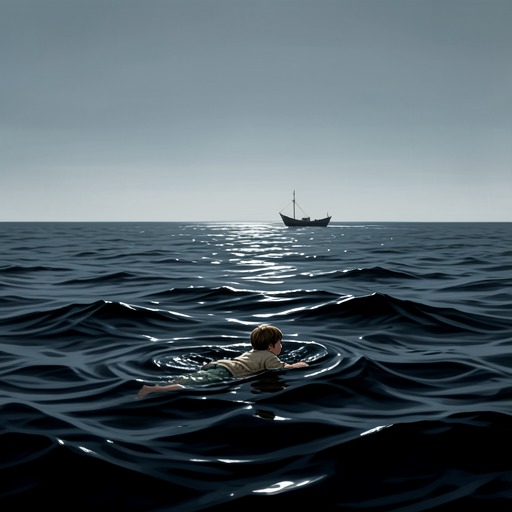
During the final chase, Stubb’s courage becomes grotesque rather than merely comic. When Moby Dick turns toward the boats, he confronts the whale with a grin and declares that only his own unwinking eye has kept him awake. He imagines death as a bed, wishes the mattress were stuffed with brushwood, and asks Flask for one red cherry before they die. The speech moves rapidly from bravado to bodily vulnerability, from jokes about drinking to the recognition that the voyage may be ending and that even a sailor’s pay may matter to the family left behind.
Stubb’s humor cannot stop the whale. Moby Dick smashes the Pequod’s starboard bow, and the men and timbers reel as water pours through the breach. Afterward, when Stubb sees the wrecked boat on the quarter-deck, he tries to maintain his customary fortitude by joking that the thistle had pricked the mouth of the ass that refused it. Ahab rebukes him for laughing before a wreck, insisting that no groan or laugh should be heard at such a sight. The exchange exposes the limit of Stubb’s comic philosophy: humor can steady a man amid immediate danger, but it cannot make destruction harmless.
Stubb’s final significance lies in this tension. He is a comparatively flat, instantly recognizable figure in his pipe-smoking, fatalistic cheerfulness, yet the last chase gives that recognizable manner a darker range. His jokes are not evidence that he feels nothing; they are the form his courage takes when fear, duty, comradeship, and impending death cannot be separated. Against Ahab’s monomania and Starbuck’s troubled conscience, Stubb represents the working sailor’s adaptation to danger: neither a prophet nor a rebel, but a skilled man who keeps laughing while the ship’s command structure turns private obsession into collective ruin.