Captain Ahab
Moby-DickCaptain Ahab is the commanding officer of the Pequod and the decisive force behind its fatal voyage. He is presented as a man of extraordinary authority, learning, will, and imaginative intensity, but also as a captain whose private wound has hardened into a public command. After Moby Dick tears away his leg, Ahab identifies the whale with every form of personal, intellectual, and spiritual malignancy, and makes the pursuit of that single animal the governing purpose of ship, crew, and life. His greatness and his ruin arise from the same source: an intelligence powerful enough to give cosmic meaning to suffering, yet too concentrated to accept any meaning that does not end in revenge.
Identity and First Appearance
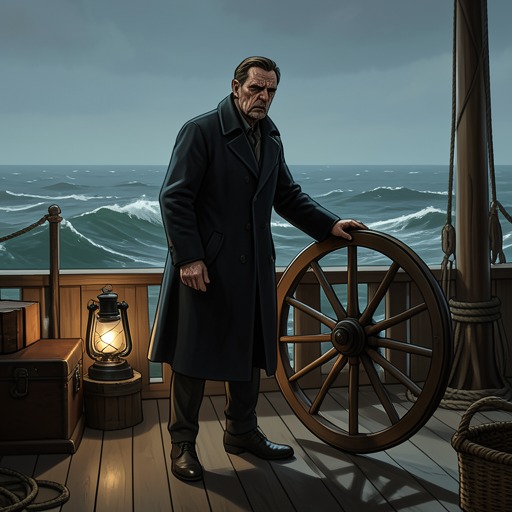
Captain Ahab is initially known through absence. For several days after the Pequod leaves Nantucket, he remains hidden below deck, while Starbuck, Stubb, and Flask appear to command the ship. Their orders, however, emerge from the cabin with such suddenness and force that the crew gradually understands that the visible officers are exercising authority only vicariously. Ahab is already the ship's “supreme lord and dictator,” though no one outside his secluded retreat has yet been permitted to see him.
Ishmael's uneasiness grows around this concealed presence, intensified by the earlier warnings of Elijah, while the ship's heterogeneous crew waits for the unseen captain to become visible. Captain Peleg describes him as a “grand, ungodly, god-like man”: quiet, educated in colleges and experienced among cannibals, accustomed to “deeper wonders than the waves,” and practiced in confronting foes more strange and formidable than whales. The description joins contradiction to distinction. Ahab is not merely a professional commander, nor is he simply a villainous king recalled from biblical history; he is a figure who seems to exceed ordinary categories of civilization, savagery, piety, and impiety.
His name evokes an ancient crowned ruler, but the comparison also carries the memory of wickedness and violent power.
Authority and the Pequod's Social Order
Ahab's authority depends not only on his personality but on the formal rituals of the ship. The quarter-deck preserves its “punctilious externals,” even aboard a whaler whose long voyages, shared profits, dangers, and communal labor might otherwise loosen discipline. Ahab is less interested than many captains in shallow displays of rank, and the only homage he openly demands is immediate, implicit obedience. Yet he understands that maritime forms can serve private purposes. Behind the customs of command, the narrative observes, Ahab masks himself; the external structure of the ship turns the “sultanism” of his mind into an irresistible dictatorship. His intellectual superiority becomes practically effective through ceremony, hierarchy, and the obedience attached to his office.
The cabin makes this power intimate as well as official. At dinner, the officers who might show courage or defiance on deck become subdued and deferential before Ahab at the head of the ivory-inlaid table. His silence, gestures, and knife possess the force of commands. Starbuck receives a slice of beef as though receiving alms, and the officers refrain even from neutral conversation while Ahab carves. The scene shows how power is reproduced through ordinary ritual: the captain need not shout because the social atmosphere of the cabin has already converted his presence into an order. When Ahab summons the entire company aft, the crew sees a figure whose appearance resembles a storm-bearing horizon.
He paces without explanation, ignores the men's whispers, and then abruptly tests their readiness by asking what they do when they see a whale. The gathering is not a routine briefing but a theatrical reorganization of the ship's collective attention.
The Oath Against Moby Dick
Ahab transforms the crew's ordinary hunting practice into a personal crusade by offering a sixteen-dollar gold coin for the sighting of a particular white whale. He identifies the target with exact physical signs: a white head, a wrinkled brow, a crooked jaw, and three holes punctured in the starboard fluke. Taking a top-maul from Starbuck, he nails the coin to the mast so that the reward becomes a permanent public emblem of the chase. The act converts money into ritual and information into prophecy. Every sailor is ordered to watch for white water and to report even a bubble, while the whale's exceptional color and markings make it not merely quarry but an object of collective fixation. Ahab then arranges the harpooneers, the mates with their lances, and the rest of the company around the capstan.
He orders the crew to drink together, reviving what he calls a noble custom of his fishing ancestors. The shared liquor, weapons, circle, and speech create a temporary brotherhood organized around his will. The ceremony makes the crew's bodily unity appear to confirm the unity of his purpose, even as the ominous atmosphere suggests that they are being drawn into a trap. Captain Ahab's oath therefore has both political and psychological force. It binds men through reward, spectacle, hierarchy, and shared excitement, while concealing the extent to which the voyage has ceased to be a common commercial enterprise.
The Wound and the Monomania
The decisive cause of Ahab's obsession is his earlier encounter with Moby Dick. During that attack, three of his boats are stove, men and oars whirl in the eddies, and Ahab himself rushes at the whale with a line-knife. Moby Dick's sickle-shaped lower jaw sweeps beneath him and removes his leg. The injury is physical, but its consequences are metaphysical. Ahab comes to associate the whale not only with his bodily pain but with every intellectual and spiritual frustration that torments him. Moby Dick becomes, in his vision, the visible incarnation of a general malignity: the accumulated rage, hatred, cruelty, and contradiction that human beings experience but cannot grasp. Rather than treating the whale as an unintelligent animal, Ahab projects onto it the total burden of evil and makes that projection practically actionable.
The result is a war against an enemy who can be attacked, harpooned, and pursued, even though the meaning Ahab has assigned to him is far larger than any animal could contain. His monomania thus converts an injury into a universal theory. The white whale is no longer only the creature that mutilated him; it is the chosen surface upon which he places “all that most maddens and torments.” The pursuit promises him an answer because it gives hatred a body, a direction, and a target.
Strategy, Defiance, and the Cost to the Crew
Ahab's fixation governs the Pequod's geography. As the ship approaches the Straits of Sunda, he plans to pass into the Javan sea, cruise northward through waters frequented by the Sperm Whale, sweep by the Philippine Islands, reach the coast of Japan during its principal whaling season, and then descend toward the Line in the Pacific. The route is designed to cover nearly all known Sperm Whale grounds before Ahab finally confronts Moby Dick in waters where the whale is most likely to appear. The plan makes the ship a moving instrument of pursuit rather than a vessel with an ordinary commercial destination. Its self-sufficiency intensifies the isolation: the whale-ship carries its own crew, weapons, provisions, and years of water, and may pass for long periods without sighting land or meeting anyone except other seamen.
Ahab exploits this enclosed world, where his crew cannot easily leave and where every calculation of wind, season, and location can be subordinated to the chase. Starbuck recognizes the danger more clearly than most. Near Ahab's cabin, seeing the loaded muskets, he recalls that Ahab once pointed one at him and considers whether the captain should be removed before he drags more than thirty men to their deaths. Starbuck understands that argument, remonstrance, and entreaty have failed, because Ahab demands obedience to his own commands and insists that the crew has joined his vow. Yet Starbuck cannot act. The hierarchy that protects the ship's order also prevents resistance to the man who is destroying it.
Ahab's power is therefore shown as organizationally produced: his private will becomes fatal because the ship's command structure, rituals, weapons, and collective discipline carry it outward.
Final Chase and Death
During the final pursuit, Ahab refuses to interpret disaster as a reason to stop. After two days of chase, the boats have twice been smashed, his damaged leg has again been endangered, and warnings have accumulated around him. Starbuck calls the pursuit impious and asks whether the crew should continue until the whale swamps the last man. Ahab answers that his act has been immutably decreed, that he is the Fates' lieutenant, and that his purpose remains taut like a hawser towing a dismasted frigate. He describes himself as physically reduced to a stump, leaning on a broken lance and supported by one lonely foot, yet claims that his soul moves on a hundred legs. The image captures both mutilation and persistence: the body has been diminished, but the will has multiplied its means of continuation.
When the whale strikes the Pequod's starboard bow, the ship's timbers reel and water pours through the breach. From his boat, Ahab recognizes the vessel as a hearse and mourns the possibility that it will perish without him. His grief briefly reveals that the ship is not merely a tool; it is his last pride, the material extension of his command and identity. Even at this moment, however, grief intensifies rather than interrupts the chase. He turns toward Moby Dick and attacks him with the language of final hatred, casting himself as a man who will remain tied to the whale until both are destroyed. The fatal mechanism is brutally literal. Ahab throws the harpoon, the whale surges forward, and the line runs through its groove.
After stooping to clear a foul turn, Ahab is caught around the neck by the flying rope and shot out of the boat before the crew understands what has happened. His death is therefore produced by the very technology of pursuit that he has mastered and exalted. The whale does not need to strike him directly; Ahab's own line, set in motion by his attack, becomes the instrument of execution. Immediately afterward, Moby Dick smashes the Pequod. Men and timbers reel, water floods through the breach, and the ship sinks while the harpooneers remain at their posts. Ahab's personal death and the vessel's destruction occur as one catastrophe: the captain is not simply killed during the voyage, but is inseparable from the command system and collective destiny he has bent toward revenge.
His final significance lies in that fusion of heroic endurance and catastrophic error. Captain Ahab possesses courage, knowledge, authority, and the power to bind strangers into a common action; but he cannot distinguish perseverance from compulsion, fate from self-authorization, or justice from revenge. His pursuit gives the Pequod its direction and its meaning, yet it also makes the ship unable to survive the man who commands it.