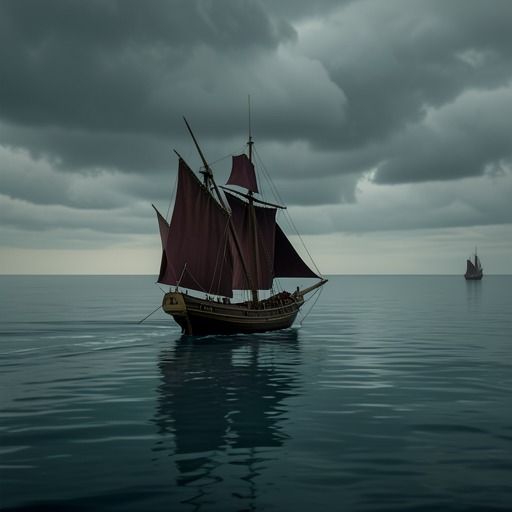
Derick De Deer
Moby-DickDerick De Deer, master of the German whaler Jungfrau, appears in the encounter between the Jungfrau and the Pequod as a practical, energetic, and intensely competitive captain. His immediate need for lamp oil brings the vessels into temporary fellowship; the sudden appearance of whales transforms that fellowship into a furious contest. Through him, the narrative presents the whale-ground as an international arena in which aid, rivalry, profit, and danger exist within the same few minutes.
Identity and Introduction
Derick De Deer is identified as the master of the Jungfrau, a Bremen ship met by the Pequod in the Pacific. The meeting carries a historical irony: Dutch and German whalers had once ranked among the greatest whaling peoples, but by this period their flags appeared only intermittently across the Pacific. Derick therefore represents both an established European maritime tradition and one of its diminished remnants.
The Jungfrau seems eager to approach the Pequod. Derick rounds toward the ship, lowers a boat, and stands impatiently in its bows rather than waiting at the stern. His haste initially makes the object in his hand difficult to identify. Starbuck mistakes it for a lamp-feeder, Stubb jokes that it is a coffee-pot accompanied by boiling water, and Flask assumes that Derick has come begging for oil. The comic uncertainty gives way to a precise explanation: Derick is carrying a lamp-feeder and an oil-can because his ship has exhausted its Bremen oil.
Need and Assistance
Derick's predicament is especially pointed because the Jungfrau is an oil-ship asking for oil on the whale-ground. The request seems to reverse the familiar logic of maritime commerce, yet the narrative insists that such a need can genuinely arise. Derick explains that his ship must turn into its hammock at night in profound darkness, since its last drop of Bremen oil is gone and no flying-fish has yet been caught to replace it. The Jungfrau is also described as a clean ship in the technical language of the Fishery: she is empty, and her name, meaning virgin, becomes an apt joke about her lack of a catch.
Ahab supplies what Derick needs, although the assistance is not presented as a sentimental exchange. Ahab abruptly addresses him without first attending to the object he carries, while Derick's broken language and immediate concern with oil emphasize the practical, multilingual world of the whale fishery. The encounter briefly confirms the shared necessities of whalemen: ships separated by nationality can still depend upon one another for the means to continue working at sea.
The Race for the Whale
Derick has scarcely reached the side of the Jungfrau when whales are raised from the mastheads of both vessels. His eagerness to resume the chase is so great that he does not pause to put the oil-can and lamp-feeder aboard. He turns his boat toward the whales and is soon followed by three other German boats. The Pequod's boats join the pursuit, but Derick's boat has the advantage of an earlier start.
Eight whales form the principal pod, yet the competing crews fix their attention on a huge, elderly bull traveling behind them. He is the largest and therefore the most valuable whale, and his position makes him the nearest attainable prize. The German boat initially leads, while Starbuck, Stubb, and Flask urge their crews forward. Derick periodically shakes the lamp-feeder at the rival boats, turning the very instrument for which he had just required assistance into a taunting emblem of his lead.
The Pequod's officers interpret the gesture as an insult. Starbuck sees the lamp-feeder as the poor-box he had filled for Derick only minutes earlier, while Stubb calls Derick a villain and offers a hogshead of brandy as a prize to the strongest rower. Their taunts make the chase both commercial and personal: the whale is worth money, but Derick's mockery gives the competition the emotional force of an affront to honor. Tashtego answers the provocation with a renewed effort, and the three Pequod boats draw nearly abreast of the German boat.
Derick escalates the contest by throwing both the lamp-feeder and the oil-can toward the advancing boats. The gesture may retard his rivals and, through the backward toss, momentarily help his own boat's movement. It is an act of improvised tactics as well as theatrical defiance: the objects that marked his dependence are discarded once the chase becomes paramount. The boats race on with the whale's foaming wake stretching around them, while the wounded animal struggles ahead with one fin beating its side and its breath issuing in a tormented jet.
Reversal and Defeat
Derick's original advantage is so substantial that he would probably have won the race despite the Pequod crews' determination. The decisive reversal comes not from superior rowing by the Pequod alone but from an accident in Derick's boat. A crab catches the blade of his midship oarsman, and the effort to free the oar brings the boat close to capsizing. Derick responds by thundering angrily at his men, but the interruption gives Starbuck, Stubb, and Flask the opening they need.
The Pequod's boats take a mortal lead and range up on the German boat's quarter. The four boats then enter the whale's immediate wake, pursuing the great animal in a shared diagonal formation. Derick's defeat is therefore caused by the instability of the chase itself: speed, oars, water, wounded prey, and chance combine to overturn the advantage that had seemed nearly decisive. His encounter with the Pequod ends not with a formal reconciliation or a completed kill, but with his being overtaken in the race.
Narrative Function and Significance
Derick De Deer is a small but sharply drawn figure in the larger international world of whaling. His nationality, his Bremen oil, his empty Jungfrau, and his rivalry with the American boats show that the fishery is not a single national enterprise. It joins European and American ships across the Pacific, circulating supplies, labor, knowledge, and competition through waters that the narrative also connects with Java, the Sunda passage, the Philippine Islands, and the Japanese whaling grounds.
His episode also embodies the contradictory ethics of the whale-ground. Derick receives assistance because the work requires mutual dependence, then immediately competes with the men who assisted him. The same lamp-feeder functions first as a sign of need, then as a teasing banner, and finally as a projectile. That transformation condenses the unstable social logic of whaling: cooperation makes the chase possible, but value and scarcity turn fellow hunters into rivals.
The wounded bull intensifies the moral and ecological dimension of the scene. The crews pursue the largest and most valuable animal while the narration emphasizes its terror, bodily infirmity, and inability to voice its fear. Derick's brisk, tactical energy belongs to the human economy of the hunt, whereas the whale's broken flight exposes the cost of that economy. His characterization is consequently inseparable from the larger tension between the whaleman's claimed dignity and the violence through which that dignity is materially sustained.