Captain Gardiner
Moby-DickCaptain Gardiner is the commander of the Rachel and a Nantucketer known to Captain Ahab. He enters the narrative during the Rachel’s desperate encounter with the Pequod, carrying news of a missing whale-boat and asking Ahab to suspend the pursuit of Moby Dick so that the two ships can search together. His decisive significance lies in the moral pressure of his request: as a father searching for his own son, he presents an ordinary human obligation that Ahab recognizes but ultimately refuses.
Identity and Introduction
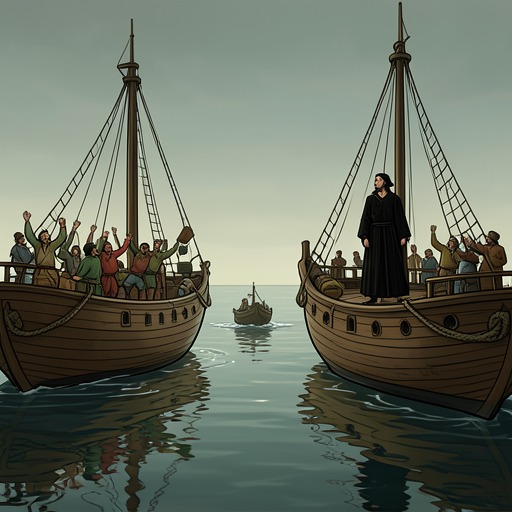
Captain Gardiner is introduced as the commander of the Rachel, a large whaling ship whose spars are crowded with men as it bears down upon the Pequod. The Rachel is moving with apparent speed, but as it approaches, its sails collapse and the animation of the hull seems to drain away. The change makes the ship’s approach a movement from force to grief before Gardiner has even spoken. He is recognized by Ahab as a Nantucketer whom Ahab already knows, yet their meeting is stripped of formal courtesy because the immediate issue is urgent: the Rachel has lost a whale-boat.
Gardiner’s first words to Ahab are not a conventional greeting but a question about the White Whale. Ahab immediately asks whether Gardiner has seen Moby Dick, revealing that even an encounter with another ship is first interpreted through his private hunt. Gardiner answers that he saw the White Whale the previous day, then turns the exchange toward the missing boat by asking whether the Pequod has seen it adrift. The juxtaposition establishes the difference between the two captains’ concerns: Ahab hears the possibility of renewed pursuit, while Gardiner is searching for people.
The Search for the Missing Boat
Gardiner boards the Pequod to ask for cooperation in a systematic search. He proposes that the two vessels sail several miles apart on parallel lines, sweeping a double horizon across the sea. His request is practical rather than theatrical: the ships would enlarge the field of observation and increase the chance of finding the missing boat. The Rachel has already spent the night trying to recover it, picking up her other boats, lighting the try-pots as a beacon, placing men aloft, lowering spare boats, and repeatedly searching the presumed location without seeing even a glimpse of the absent keel.
The urgency of Gardiner’s appeal is initially misunderstood. Stubb speculates that the captain may be anxious to recover a coat or watch, and only then realizes that something more serious is involved. Gardiner reveals that his own son is among the missing men. The boy is twelve years old, and his father had allowed him to begin a whaleman’s career aboard another ship, a practice associated with Nantucket captains who wished a son’s first experience at sea to be independent of paternal favoritism. The detail makes the search both a maritime emergency and a parental ordeal: Gardiner is not merely responsible for a crewman but is seeking his child in a hostile ocean.
Appeal to Ahab and Refusal
Gardiner asks Ahab to let the Pequod join the search, offering to pay for the ship’s use for forty-eight hours if necessary. His appeal becomes explicitly reciprocal and ethical when he reminds Ahab that Ahab too has a son, though that child is safely at home. Gardiner asks Ahab to act toward him as Ahab would wish another captain to act in the same situation. The request reaches beyond professional cooperation; it invokes shared fatherhood as a basis for obligation.
Ahab appears, for a moment, to be yielding. Gardiner interprets his expression as consent and tells the men to prepare the yards. Ahab then stops them. He refuses in measured, prolonged words, instructs Starbuck to warn off the Rachel within three minutes, and orders the Pequod to resume its course. He gives no practical argument against the search. His reason is the loss of time, and that reason exposes the absolute priority of his pursuit. The possibility of a living child in a drifting boat cannot outweigh the schedule of the hunt.
Gardiner’s response is silent shock. He descends to his boat and returns to the Rachel, while the Pequod and the other vessel separate along diverging wakes. The Rachel’s subsequent movement—halting, yawing, tacking, and turning toward every dark spot on the water—becomes a visible continuation of Gardiner’s grief and hope. The ship does not simply sail away; it keeps searching, its course made irregular by the missing men. The narrator presents it as Rachel grieving for her children, transforming the captain’s personal loss into the ship’s governing image.
Contrast with the Pequod’s Voyage
Gardiner’s brief appearance gains force from the larger structure of Ahab’s pursuit. Ahab has spent night after night studying charts of all four oceans, consulting old log-books, calculating currents, feeding grounds, migration routes, and the Season-on-the-Line in order to make a meeting with Moby Dick as probable as possible. He treats the ocean as a space that can be methodically organized around the whale’s movements. Gardiner’s search exposes the limit of that system: a missing boat and a child’s life cannot be reduced to the timetable of a planned chase.
The contrast becomes even sharper because Ahab has already rejected reliance on the quadrant. After using it to calculate the Pequod’s latitude, he condemns the instrument for telling him where he is without telling him where Moby Dick is, smashes it, and turns instead to the level compass, dead-reckoning, log, and line. The episode with Gardiner similarly places human judgment before him, but Ahab refuses the moral bearing that Gardiner offers. Gardiner’s appeal is a form of navigation toward another person’s need; Ahab remains oriented toward the White Whale.
Narrative and Thematic Significance
Captain Gardiner functions as a moral counterpoint to Ahab rather than as a rival hunter. His objective is limited, concrete, and communal: find the missing boat. He is willing to surrender time and pay for assistance, and his search continues after Ahab’s refusal. Ahab’s objective is expansive in distance but narrow in value, requiring the entire voyage to serve one grievance. Their encounter therefore makes Ahab’s monomania legible not through abstract diagnosis but through a choice between two immediate claims: the pursuit of Moby Dick and the rescue of a captain’s son.
Gardiner’s presence also reverses the usual hierarchy of the chase narrative. Ahab asks first about the White Whale, as if the whale were the only event that mattered; Gardiner restores the lost human beings to the center of attention. The Rachel’s name and grieving course widen the episode beyond one father, suggesting a vessel whose purpose is defined by the search for its missing children. Against Ahab’s charted routes, seasons, and calculated probabilities, Gardiner embodies uncertainty joined to responsibility: he cannot know whether the men survive, but he searches because not knowing is precisely why he must continue.
His encounter with Ahab ends without rescue, reconciliation, or confirmed news of the missing boat. Gardiner departs with the Rachel still turning across the sea, while the Pequod proceeds toward its appointed pursuit. That unresolved separation preserves the ethical wound of the scene. Captain Gardiner cannot alter Ahab’s course, but his plea reveals what Ahab sacrifices when the hunt becomes the sole measure of action: not merely time, opportunity, or safety, but the obligation to answer another human being in distress.