Flask
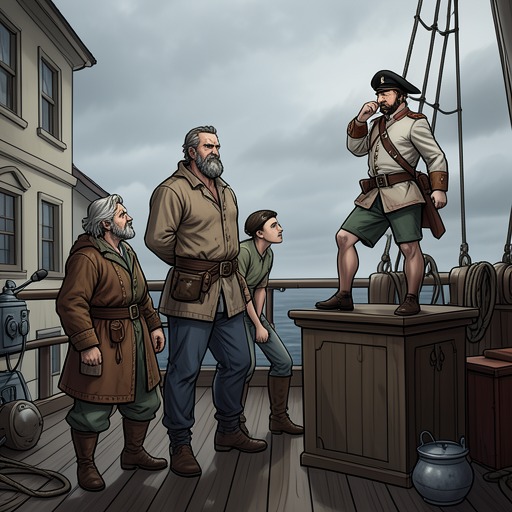
Moby-DickFlask, called King-Post aboard the Pequod, is the third mate and one of the three officers entrusted with command of the ship’s boats. A short, stout, ruddy young man from Tisbury on Martha’s Vineyard, he is defined by an aggressive intimacy with danger: whales seem to him not sublime leviathans but oversized mice or water-rats, creatures that require only persistence and a little ingenuity to kill and boil. His comic confidence is therefore also a form of blindness. Flask does not merely tolerate the hazards of whaling; he treats them as part of the amusement, and the voyage itself as an extended joke whose violence he refuses to dignify with fear or reverence.
Identity and Temperament
Flask’s hostility toward whales is presented as personal and hereditary, as though the great animals had insulted his family across generations. That imagined grievance becomes a point of honor: whenever a whale appears, Flask feels obliged to destroy it. He follows whales for the fun of the pursuit, not because he recognizes their grandeur or because the hunt reveals some solemn truth. The narrative emphasizes that he is “utterly lost to all sense of reverence” for their bulk and mysterious ways, and equally incapable of apprehending the danger involved in confronting them. His courage is thus described as ignorant and unconscious rather than disciplined or reflective. The result is a character whose energy is lively, even waggish, but whose liveliness depends upon refusing to see the beings and forces before him in their full scale.
Flask’s body reinforces this impression. He is compact and square, “made to clinch tight and last long,” like a wrought nail rather than a cut one. The nickname King-Post comes from the short, square timber used in Arctic whalers to brace a ship against battering ice. The image gives his physical presence an architectural function: Flask is imagined as a piece of durable reinforcement, a stocky human brace built to withstand impact and to deliver it.
Rank and Function aboard the Pequod
Flask’s position as third mate places him within the Pequod’s central command structure. He stands beside Starbuck and Stubb as one of the three “momentous men” who command the ship’s boats as headsmen. In the narrator’s military comparison, Captain Ahab’s three mates resemble captains of companies, while their harpooneers function as lancers or javelin throwers. Flask therefore occupies both an administrative and combat role. He is an officer of the quarter-deck, but his authority is made most visible when a boat is lowered and the ship’s abstract hierarchy becomes an immediate machinery of pursuit, oars, harpoons, lances, and coordinated risk.
Each mate is paired with a boat-steerer or harpooneer, a relationship founded not only on command but also on practical intimacy. The boat depends upon the headsman’s judgment and upon the harpooneer’s ability to supply a fresh lance when the first weapon has been twisted or bent in the assault. Flask’s authority consequently exists within a network of mutual dependence: he directs the attack, but the attack can succeed only through the synchronized labor of men whose lives are placed in one another’s hands. His rank does not make him independent of the crew; it makes him responsible for concentrating their danger. Flask’s conduct also reveals the difference between public maritime authority and private submission aboard the Pequod.
On the open deck, officers may appear bold toward their commander, yet the ship’s artificial usages quickly transform them when they enter Ahab’s cabin. Flask’s own comic independence—elsewhere figured through his playful, rollicking manner—does not cancel the formal power of the shipmaster. At dinner, the officers become deferential before Ahab, and the quarter-deck’s rituals turn authority into a social force as well as a chain of command.
Whaling Practice and Reckless Judgment
When Ishmael asks Flask whether it is an unalterable law of the fishery for an oarsman to pull backward into the jaws of death, Flask answers that it is indeed the law, while joking that he would like to see a boat crew back toward a whale face-first. The exchange captures his characteristic mixture of practical knowledge and levity. He understands the mechanics of the hunt, including the necessity of exposing the boat to the whale while withdrawing from it, but he treats the lethal arrangement as an occasion for humor rather than as a reason for hesitation. His experience includes lowering for whales from a leaking ship in a gale off Cape Horn, a feat that confirms how easily he accepts conditions others would regard as prohibitive.
His confidence is not simply personal bravado; it is embedded in the institutional logic of whaling, where boat crews must trust the headsman at precisely the moment when a small error can become capsizing, entanglement, or death. Flask’s attitude also helps explain the Pequod’s readiness to expand its violence beyond its stated purpose. When a captured Sperm Whale’s head hangs alongside the ship and patches of brit suggest the presence of Right Whales near the Crozetts, the crew is ordered to pursue a Right Whale even though the Pequod is not commissioned to cruise for that species and the men ordinarily disdain its capture. Flask participates in a culture that turns opportunity into obligation: if a whale can be hunted, the fact that it is available becomes sufficient justification for hunting it.
In the attack on the old Right Whale, Flask sees a vulnerable place and asks to prick it. Starbuck objects that there is no need, but Flask acts before the warning can restrain him. The wound produces an ulcerous jet; the whale, driven into agony, charges blindly, showers the boats and crews with blood, capsizes Flask’s boat, and damages its bows. The injury becomes the death stroke, but it also exposes the cost of Flask’s appetite for tactical advantage. The whale dies after a violent final convulsion, while Flask’s own boat is wrecked by the suffering his intervention intensified. The scene makes his character legible through action rather than reflection: he is brave enough to approach the animal, but not humane enough to leave a cruel opening untouched.
Relation to Ahab’s Pursuit
Flask is one of the officers through whom Ahab’s private obsession is converted into collective action. When Ahab assembles the entire ship’s company, Flask stands among the officers and harpooneers arranged around the capstan. The crew’s weapons are produced, the harpoons are displayed, and the men are organized into a ceremonial circle that turns ordinary whaling equipment into the signs of a common campaign. Flask’s presence in this formation matters because his natural aggression toward whales already aligns with Ahab’s demand for pursuit. Unlike Starbuck, whose prudence repeatedly registers the moral and practical danger of Ahab’s command, Flask is temperamentally suited to the captain’s escalation.
The whale is already a personal enemy in Flask’s imagination; Ahab merely enlarges that hostility into a governing purpose. Yet Flask’s alignment with Ahab does not make him the master of his own situation. In the final pursuit, after the chase has already cost the boats and men dearly, he is still caught inside a purpose defined by Ahab. Ahab insists that the whole act has been immutably decreed and commands the men to continue. Flask responds as part of the crew’s collective fearlessness, but the words expose the narrowing of his agency: his boldness has helped build the atmosphere in which refusal becomes nearly impossible.
Final Crisis and Significance
During the last attack, Flask is among the men suspended between labor and paralysis as Moby Dick bears down upon the ship. The crew hold hammers, planks, lances, and harpoons mechanically, their attention fixed upon the whale’s advancing head. When the white forehead smashes the Pequod’s starboard bow and water pours through the breach, Flask’s personal fate is absorbed into the catastrophe of the vessel. His earlier jokes about danger now acquire a grim aftertaste. He had treated a three-year voyage as a “jolly joke,” had found amusement in the pursuit, and had accepted the fishery’s deadly procedures as ordinary law; the final collision reveals the scale that his humor had concealed. The last exchange associated with Flask is strikingly domestic amid the impending destruction.
He wishes that the crew were where cherries grow, while Stubb imagines a final drink and worries that his mother may not have received his part-pay. Flask answers that he hopes Stubb’s mother has drawn it, otherwise only a few coppers will reach her because the voyage is over. The line gives Flask a brief awareness of consequence beyond the chase: wages, family, and the material aftermath of death intrude upon the heroic language of vengeance. Even at the end, however, he remains within the collective fate of the Pequod. Flask is not granted a separate conversion or a private escape. His fixed disposition—compact, durable, amused by peril, and contemptuous of the whale’s majesty—helps sustain the ship’s violent momentum, but that same disposition leaves him unable to stand outside it.
As King-Post, he is both a brace within the ship and an emblem of its rigidity: useful for meeting impact, incapable of changing direction before impact arrives.