Radney
Moby-DickRadney is the mate of the Town-Ho, a Vineyarder whose authority is marked by physical courage, stubbornness, malice, and a destructive need to subordinate a man who appears his equal or superior in pride. His treatment of Steelkilt converts a manageable maritime emergency into a chain of violence: the mate’s coercion provokes Steelkilt’s resistance, the resulting mutiny fractures the ship’s company, and Radney’s later insistence on pursuing the conflict carries him directly into the jaws of Moby Dick.
Position and Character
Radney serves as chief mate aboard the Town-Ho, a Sperm Whaler of Nantucket cruising in the Pacific. When the ship begins making more water than usual, he shows unusual concern for her safety and orders the sails hoisted and expanded, although the narrative emphasizes that he is ordinarily neither cowardly nor nervous about his own person. Some sailors attribute his solicitude to his being part owner of the ship, but his conduct also reveals a more personal investment in command: he cannot tolerate the presence of a subordinate whose independence and physical stature challenge his authority.
The contrast between Radney and Steelkilt is presented in deliberately severe terms. Steelkilt is described as tall, noble, physically powerful, and richly endowed with pride, intelligence, heart, and soul; Radney, by contrast, is called ugly as a mule, yet equally hardy, stubborn, and malicious. The opposition is therefore not between courage and cowardice in any simple sense. Both men possess force, but Steelkilt’s force appears commanding and self-possessed, while Radney’s becomes punitive. His authority depends less on competence than on breaking the man who refuses to be made small.
The Pumping Dispute
The immediate conflict begins while the Town-Ho’s crew is laboring at the pumps. The leak has worsened, and Radney’s anxiety about the vessel’s safety becomes visible to the men. They quietly joke about it while clear water ripples across the deck from the pumping. Steelkilt, the strongest seaman aboard, has been assigned captain of one of the pumping gangs; he is exhausted by strenuous labor and has performed the duty expected of him.
At that moment Radney orders Steelkilt to fetch a broom and sweep the deck, then to use a shovel to remove the offensive matter left by a pig allowed to run at large. The command is deliberately humiliating as well as badly timed. Sweeping the deck is ordinary sea routine, but it is customarily the boys’ work when boys are aboard, and Steelkilt’s position as captain of a powerful pumping gang should have freed him from such a trivial task. The narrative supplies these details to make clear that Radney is not merely enforcing an impersonal shipboard rule; he is singling out a physically spent subordinate for degradation.
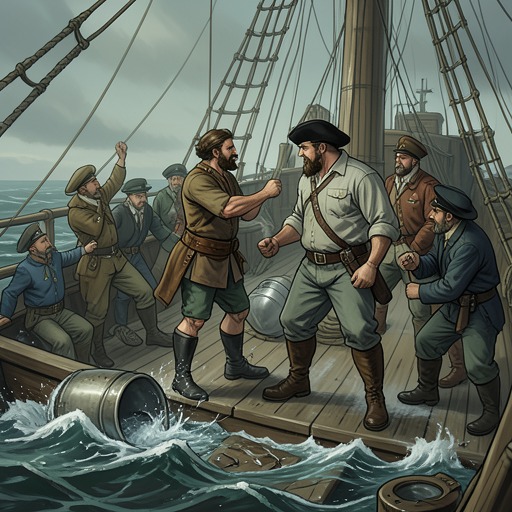
Steelkilt initially refuses in silence, remaining seated while he tries to contain his anger. Radney then advances with a hammer, shaking it within inches of Steelkilt’s face and continuing his abuse. Steelkilt retreats slowly around the windlass, warning Radney away, but the mate follows until retreat can no longer preserve restraint. Steelkilt finally states that he will not obey and warns Radney to remove the hammer or look to himself. When the hammer touches his cheek, Steelkilt strikes: Radney’s lower jaw is stove in, and he falls onto the hatch spouting blood.
Mutiny and the Mate’s Return
The blow immediately transforms a personal quarrel into a shipboard crisis. Steelkilt seizes a backstay and signals two comrades stationed aloft, while the authority of the officers begins to collapse. The captain’s attempt to punish the men is complicated by Steelkilt’s inaudible threat. The captain first commands that Steelkilt and the others be hanged, then abruptly withdraws the order and tells the crew to let them go. The hesitation exposes the instability beneath formal command: the captain possesses office, but not the unqualified power to make his threat effective.
Radney nevertheless refuses to let the matter end. Though he has lain in his berth since the blow and now has a bandaged head and a damaged mouth that makes speech difficult, he emerges when he hears the tumult on deck. He claims that he is willing and able to do what the captain dared not attempt, takes the rope, and advances against the restrained Steelkilt. Steelkilt calls him a coward; Radney admits the charge and strikes anyway, despite the warning that doing so will cost him his life. The three men are eventually cut down, and the crew returns sullenly to the pumps, but the injury has not been repaired. Radney’s insistence on personal retaliation has converted discipline into resentment.
Moby Dick and Radney’s Death
The Town-Ho’s internal rupture meets its fatal external counterpart when Moby Dick suddenly appears within fifty yards of the ship. The crew had formed a compact concerning the White Whale, but excitement breaks it. Captain, mates, and harpooneers cry out for the famous creature, while the resentful seamen regard the whale with curses and apprehension. The white whale’s arrival appears to fulfill a design already latent in the quarrel, joining Radney and Steelkilt once more in the same boat and in the same hunt.
Steelkilt is assigned the position of Radney’s bowsman, so that the mutineer must sit beside the mate while Radney stands in the prow with his lance. When the boats are lowered, Radney’s boat gains the start, and Steelkilt rows with conspicuous fury. Their harpooneer fastens to Moby Dick, and Radney orders Steelkilt to haul him up the whale’s back through the foam. The boat strikes as though against a submerged ledge and spills Radney onto the whale’s slippery body. He is thrown into the sea on the opposite side, where he briefly struggles to escape Moby Dick’s sight.
The whale turns in a sudden maelstrom, catches Radney between its jaws, rises with him, and plunges beneath the surface. Steelkilt, meanwhile, has slackened the line to let the boat fall astern from the whirlpool; when the boat is dragged downward, he cuts the line and frees the whale. Moby Dick later resurfaces with fragments of Radney’s red woolen shirt caught in the teeth that destroyed him. The four boats pursue the whale, but it eludes them and disappears. Radney’s death is thus both an act of animal violence and the culmination of a human conflict that he repeatedly chose to intensify.
Aftermath and Significance
When the Town-Ho reaches a savage, solitary port, Steelkilt leads nearly all the foremastmen in deserting. The deserters eventually seize a large double war-canoe and sail toward another harbor. Radney’s conduct has therefore produced consequences beyond his own death: his abuse damages the ship’s cohesion, the captain’s authority is compromised, and a substantial part of the crew abandons the vessel. The leak that first threatened the Town-Ho might have been survived; the social violence created by Radney proves less containable.
Radney’s story is recounted within a larger account of whaling, a world in which routine labor, maritime hierarchy, and pursuit of the Sperm Whale constantly expose men to forces they cannot fully command. His fate gives that structure a concentrated dramatic form. He begins by treating authority as the right to humiliate, answers resistance with escalating violence, and then carries the same antagonism into the hunt. Moby Dick does not simply interrupt the quarrel; the whale becomes the final power before which Radney’s rank, courage, and grievance are all meaningless. The character consequently embodies the collision between institutional command and personal pride, while his death shows how a local act of domination can become part of the vast, fatal machinery of the sea.