Steelkilt
Moby-DickSteelkilt is the Lakeman from Buffalo whose conflict with Radney, the mate of the Town-Ho, drives the ship’s crisis from simmering humiliation into mutiny. A powerful, self-possessed sailor with exceptional pride, he refuses to accept arbitrary violence as the natural right of command. His resistance is both political and personal: he defends the dignity of the subordinate against an officer determined to “pull down and pulverize” any man who appears superior in manhood. Yet his defiance also carries him toward retaliation, conspiracy, and abandonment, making him neither a simple hero nor merely a criminal within the story’s unstable moral world.
Identity and Character
Steelkilt is identified as a Lakeman, a sailor formed in the inland maritime culture around Lake Erie and the other Great Lakes. The narrative treats that background not as a mark of provincial weakness but as a source of oceanic toughness. The Great Lakes possess expansiveness, islands, changing climates, and maritime races, so their sailors can enter the deep-sea world already habituated to danger and freedom. Steelkilt therefore embodies the strange passage between agrarian America, canal labor, freshwater navigation, and the “most barbaric seas.” His identity links the whaling ship to a broader American geography rather than confining him to the ocean alone.
He is presented as physically striking and inwardly formidable: tall, noble in bearing, Roman-headed, and marked by a flowing golden beard. More important than his appearance are the brain, heart, and soul attributed to him. The narrator imagines that, under different hereditary circumstances, Steelkilt might have become a Charlemagne. This extravagant comparison establishes the scale of his latent authority while also explaining why Radney experiences him as a threat. Steelkilt possesses the command presence of a leader without holding the official rank that would legitimize it.
Conflict with Radney
The Town-Ho’s immediate danger begins with a leak that gradually worsens while the crew works the pumps. The captain delays departure because he expects good luck in those latitudes, but the ship eventually turns toward an island harbor for repairs. Radney becomes especially anxious about the vessel’s safety, perhaps because he is a part owner, and the sailors mock his solicitude while laboring in water that runs across the deck. Beneath this rough humor lies the real antagonism: Radney dislikes Steelkilt, and Steelkilt knows it.
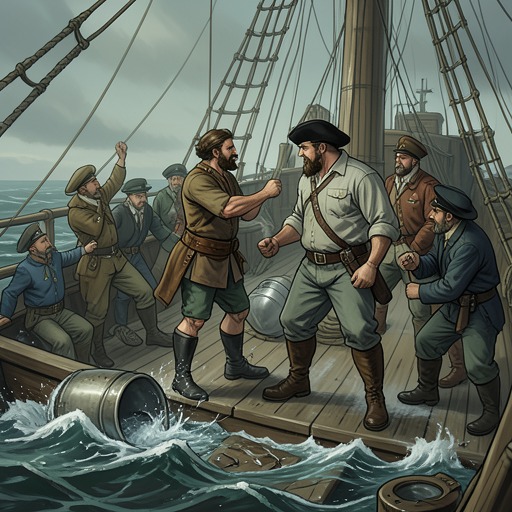
Radney’s authority becomes oppressive when he approaches Steelkilt during the pumping and commands him to perform a task. Steelkilt initially suppresses his anger and remains seated, even while Radney’s menacing hammer and abuse intensify the confrontation. He then retreats slowly around the windlass, refusing to obey but still allowing the officer opportunities to stop. Once Radney presses the hammer within an inch of his teeth, Steelkilt warns him that he will murder him if it touches his cheek. Radney ignores the warning; the hammer grazes him, and Steelkilt immediately smashes the mate’s lower jaw, sending him onto the hatch spouting blood.
This moment changes the ship’s value structure at once. Radney’s official power is exposed as dependent on physical intimidation, while Steelkilt’s resistance becomes an alternative form of authority grounded in self-possession. The scene does not erase violence; it transfers violence from officer to sailor. Steelkilt’s dignity is defended, but the defense creates the conditions for a wider struggle between the crew and the command.
Mutiny and Betrayal
After striking Radney, Steelkilt seizes a backstay and signals two comrades stationed high aloft. The three Canallers descend into the turmoil, and other sailors join their attempt to pull him toward the forecastle. The captain dances about with a whale-pike, urging the officers to overpower the “atrocious scoundrel,” but Steelkilt and his supporters force their way forward and barricade themselves behind several large casks near the windlass. The physical arrangement makes the conflict resemble a miniature siege: command holds the open deck, while the rebels convert the forecastle into a defensive stronghold.
Steelkilt does not immediately seek indiscriminate bloodshed. He tells the captain that he and his men will not attack unless attacked, but they will perform no work until the threat of flogging is withdrawn. When most of the rebels resist the captain’s order to descend into the forecastle, Steelkilt eventually directs them to comply. Ten men are locked below, while more than twenty sailors remain neutral. Officers keep an armed watch through the night, fearing that the prisoners may break through the bulkhead while the rest of the crew continues pumping to keep the leaking vessel afloat.
Confinement turns resistance into a struggle for survival and leadership. Maddened by darkness, entombment, and the defection of seven former associates, Steelkilt proposes that he and the two Canallers break out with crescent-shaped mincing knives, seize the ship, and run amok from bowsprit to taffrail if necessary. The plan is not simply escape; it is a desperate bid to reverse the ship’s hierarchy by force. The two allies agree, but each insists on being first onto the deck. Steelkilt refuses to surrender that position, claiming leadership even at the edge of collective ruin.
The alliance collapses through calculated treachery. The two Canallers realize that the first man out might also be the first of the three to surrender and thereby secure a chance of pardon. While Steelkilt sleeps, they bind and gag him, then call for the captain. The officers drag all three men onto the deck and seize them in the mizzen rigging until morning. At sunrise the captain separates the mutineers from the neutral sailors and chooses reprimand over flogging because of their timely surrender. Steelkilt’s rebellion thus wins neither institutional reform nor personal triumph; it ends in confinement, exposure, and betrayal by the very men who had accepted his leadership.
Revenge and the Death of Radney
Even after the mutiny has been contained, Steelkilt’s conflict with Radney remains active. He asks the mate for twine to mend his hammock, arguing that Radney will help himself in the end by assisting the ship. The request appears ordinary and even practical, but Steelkilt uses the twine to construct an iron ball closely netted in his monkey jacket. The weapon is discovered only when it partly rolls from his pocket as he tucks the coat into his hammock for a pillow.
Steelkilt’s intended revenge is timed for his turn at the silent helm, when he would be stationed near Radney, a man described as liable to doze beside the grave already prepared for every sailor. In Steelkilt’s imagination Radney is already a corpse, his forehead crushed in. The plan shows the movement from spontaneous self-defense to premeditated vengeance: once the immediate threat has passed, the injury continues to govern Steelkilt’s conduct.
The planned murder never occurs because another force intervenes. At daybreak on the second day, a sailor washing the decks sees Moby Dick. During the ensuing chase, Steelkilt serves as Radney’s bowsman. When their boat strikes the whale and Radney is thrown onto Moby Dick’s back, the mate falls into the sea and is seized between the whale’s jaws. As the whale submerges, Steelkilt cuts the line, freeing Moby Dick; the whale later rises with tatters of Radney’s red woollen shirt caught in its teeth.
The result is a grim displacement of agency. Steelkilt does not deliver the blow he had prepared, yet Radney dies in a manner that fulfills the substance of his revenge. The narrative presents this as a mysterious fatality, as though Heaven or destiny removes the murderous deed from Steelkilt’s hands and completes it through Moby Dick. His vengeance is therefore both achieved and denied: Radney is dead, but Steelkilt must live with the knowledge that his desire was realized by an impersonal power beyond human control.
Desertion and Narrative Significance
After the Town-Ho reaches a remote port, Steelkilt leads nearly all the foremastmen, except five or six, in deserting the ship. The deserters eventually seize a large double war-canoe and sail toward another harbor. Their flight completes Steelkilt’s rejection of the ship’s authority. He does not return to ordinary service after the mutiny, nor does he accept reconciliation with the captain or Radney’s surviving order; he carries his resistance outward into escape.
His departure also has material consequences for the Town-Ho. With the company reduced to a handful, the captain must enlist Islanders to help heave down the vessel and repair the leak. The remaining whites must maintain constant vigilance over their dangerous allies, and the exhausting labor leaves them too weak to put to sea in so heavy a ship. The captain finally anchors offshore, arms the ship’s two cannon, stacks muskets on the poop, warns the Islanders away, and sails for Tahiti in a whale-boat with one companion. Steelkilt’s rebellion therefore contributes indirectly to the ship’s vulnerability long after the personal quarrel has ended.
As a character, Steelkilt belongs to the novel’s recurring world of unstable rank, where formal command can be brutal, subordinate pride can become heroic, and resistance can slide into violence. His body, intelligence, and leadership make him larger than the mutiny’s official label, but his secret weapon and planned murder prevent an uncomplicated moral elevation. He is at once a defender of dignity, a mutinous insurgent, a betrayed leader, and a would-be avenger whose revenge is completed by Moby Dick. Through him, the Town-Ho episode turns a labor dispute into a meditation on coercive power, masculine pride, collective loyalty, and the possibility that human intentions are repeatedly overtaken by forces they believe they control.