Ishmael
Moby-DickIshmael is the narrator and central surviving consciousness of the voyage aboard the Pequod. He enters the story as a man seeking relief from melancholy through the sea, becomes a whaleman whose observations range from intimate shipboard life to the worldwide history of whaling, and ends as the sole survivor of the Pequod’s destruction. His decisive significance lies in the transformation of catastrophe into narrative: because Ishmael lives, the lost ship, its crew, and Captain Ahab’s fatal pursuit can be remembered and interpreted rather than disappearing without a witness.
Identity and Departure
Ishmael introduces himself as a man with little money, no compelling attachment to life ashore, and a recurring tendency toward depression. When his spirits darken, he turns to the sea as a practical form of self-preservation, preferring the ship to the pistol or sword. This motive makes his departure more than an adventure chosen for profit. Sailing is his way of regulating his inward condition, and the ocean appears to him as a common human attraction rather than a private eccentricity.
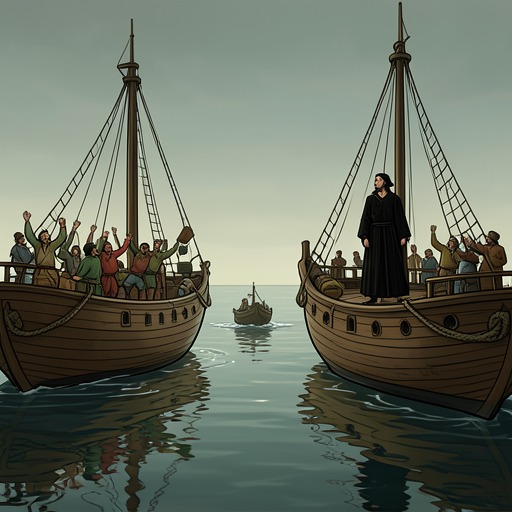
His shoreward point of departure is the insular city of the Manhattoes, whose streets and commerce direct crowds toward the water. The city’s wharves and water-gazers establish the sea as both public spectacle and threshold. Ishmael stands among those drawn toward it, but he does not remain a spectator. He crosses from land into the working world of ships and becomes part of the maritime circulation that joins ports, crews, commodities, and distant waters.
Friendship and Entry into Whaling
Before choosing a vessel, Ishmael makes his plans with Queequeg. Queequeg consults Yojo, his black little god, and accepts Yojo’s command that Ishmael alone should select their ship, even though the choice is supposed to serve both men. Ishmael initially distrusts this arrangement because he has relied on Queequeg’s practical judgment, yet he finally acquiesces. The episode establishes their friendship as a partnership capable of accommodating radically different religious assumptions, habits, and forms of knowledge.
Ishmael and Queequeg consequently enter the whaling world together, though Ishmael’s account repeatedly preserves the distance between an observer and the customs he is learning. Queequeg’s fasting and worship remain partly unintelligible to him, including the rituals he associates with Lent or Ramadan. Rather than treating this difference as a reason for separation, Ishmael incorporates it into the developing relation between them. His narrative makes shared dependence more important than cultural uniformity.
Whaling as a Global World
Once embarked, Ishmael becomes an advocate for whaling as a profession and a historical force. He acknowledges that landsmen regard whale hunters as disreputable, unpoetic butchers, then contests that judgment by comparing the dangers of whaling with those of military combat. In his account, the sperm whale’s power makes the whaleman’s peril at least as formidable as the battlefield dangers honored by society. The argument also gives Ishmael a public voice: he is not merely recording what happens aboard ship but defending the dignity of the labor that makes his narrative possible.
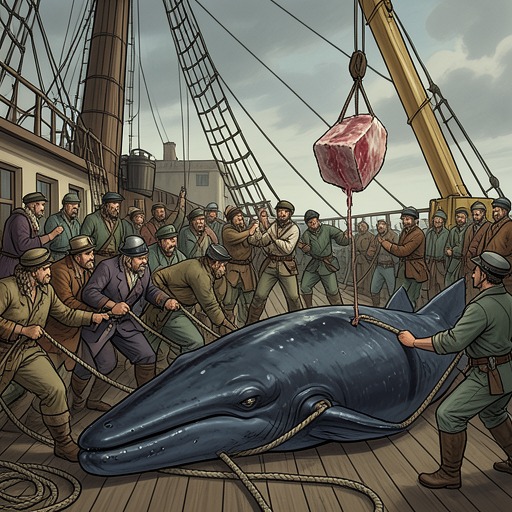
Ishmael presents whaling as an industry of immense scale. American whalemen command a fleet of more than seven hundred vessels and eighteen thousand men, consume millions of dollars yearly, and return with products worth millions more. The lamps, candles, and other forms of illumination used around the world depend upon whale products, so an occupation dismissed as filthy unknowingly receives the world’s practical homage. His defense therefore moves from personal pride to an account of economic interdependence.
He also describes the whale-ship as a pioneer of exploration and communication. Whalers enter uncharted seas and archipelagoes, reach harbors before naval expeditions, and open routes later used by warships, merchants, and missionaries. Ishmael attributes to whalers a role in breaking the Spanish colonial monopoly around the Pacific coast and connects their movements with the eventual liberation of Peru, Chili, and Bolivia. He likewise presents the whale-ship as the true formative force behind Australia’s later colonial importance, recalling that whale-ships sometimes supplied early settlers with food when they faced starvation. In this vision, Ishmael’s voyage belongs to a planetary network of labor, empire, commerce, exploration, and cultural contact.
The Pequod’s route makes that network concrete. Captain Ahab plans to pass through the Sunda Strait into the Javan sea, continue toward the Philippine Islands and the coast of Japan, cross the principal sperm-whale grounds, and descend into the Pacific where Moby Dick is most likely to be found. Ishmael emphasizes the exceptional self-sufficiency of the whale-ship: unlike merchant vessels that carry cargo between ports, it can carry its own crew, weapons, provisions, and years of water while seeing no land and encountering almost no people except other seamen. His narrative thus treats the ocean not as empty space between nations but as a mobile world with its own routes, economies, dangers, and forms of knowledge.
The Observer and Interpreter
Ishmael’s role expands beyond that of an ordinary crewman. He records the technical and commercial life of whaling, but he also pauses over its materials and species. The discovery of ambergris, for example, becomes an occasion to explain a valuable maritime substance: soft, waxy, fragrant, and used in perfume, candles, hair powder, cooking, and wine. The object links the physical labor of the boat crew to distant markets and unfamiliar customs, turning a small find at sea into evidence of the wide circulation of marine commodities.
His attention also extends to the nonhuman life surrounding the ship. The chapter on Brit describes vast fields of the yellow food on which Right Whales feed, while the Pequod moves through waters where those whales can graze beyond the immediate danger posed by a sperm whaler. The later account of the squid presents the sea as a realm whose creatures are beautiful, concealed, predatory, and locked in perpetual conflict. Ishmael turns these observations into a meditation on human inwardness: the calm island of peace within the soul is surrounded by the horrors of only partly known life. The sea is therefore simultaneously ecological environment, philosophical image, and challenge to the confidence with which humans classify or master the world.
Ishmael’s interpretive method is expansive and unstable in a productive way. He can move from a ship’s commercial history to theology, from a whale’s feeding to the structure of the human soul, and from a local maritime custom to global political consequence. His knowledge is not presented as complete mastery. It grows through testimony, speculation, documents, remembered scenes, and the visible remains of things that cannot be fully possessed. The result is a narrator who continually enlarges the meaning of what he sees without reducing the sea to a single explanation.
Catastrophe and Survival
The Pequod’s voyage ends in the destruction of the ship and the death of its pursuing company. After the Parsee disappears and the final men are cast from the rocking boat, Ishmael is drawn toward the vortex left by the sinking vessel. He is not rescued by strength, command, or deliberate strategy. Instead, the pressure of the wreck releases the coffin life-buoy made from Queequeg’s coffin, whose buoyancy brings it to the surface beside him.
Ishmael floats on that coffin for almost a whole day and night. The sharks pass without harming him, and sea-hawks move above the water without attacking. These altered relations with animals create a suspended interval between death and rescue, while the coffin becomes the material instrument of continued life. The object once designed for Queequeg’s burial is transformed into Ishmael’s means of survival, binding the narrator’s final existence to the friendship that began his maritime passage.
On the second day, the Rachel approaches and picks Ishmael up while searching for its own missing crew. The ship’s rescue of another orphan gives the ending a sharp moral reversal: the Pequod’s obsessive pursuit has produced only wreckage, while a vessel engaged in searching for the lost becomes the agent of Ishmael’s preservation. His survival is therefore not a triumph over the catastrophe but its condition of remembrance. He alone can say that one escaped to tell what happened, and his testimony keeps the vanished ship and its dead within the world of language.
Narrative Role and Significance
Ishmael combines participant, witness, historian, advocate, and philosophical interpreter. His personal reasons for going to sea remain intertwined with the wider structures he uncovers: the whaling industry’s wealth, its dangerous labor, its imperial routes, and its traffic in knowledge and commodities. Because he is neither the ship’s commander nor the object of its monomania, he can observe Captain Ahab’s pursuit while also sharing the crew’s exposure to it.
His voice holds together incompatible scales. The narrator can describe a crewman’s immediate labor, the whale’s feeding ground, the commercial value of ambergris, the expansion of maritime routes, and the metaphysical darkness surrounding human life. The movement between these scales is not decorative; it is the form through which Ishmael makes the Pequod’s disaster intelligible. A shipwreck becomes an account of friendship, work, empire, species, mortality, and the precarious possibility of knowledge.
The final image fixes Ishmael’s narrative identity. He survives not by escaping the sea but by remaining afloat within its aftermath, supported by the emblem of a dead friend and finally recovered by a ship searching for others. Ishmael is thus both castaway and chronicler: the solitary remnant of a collective world, carrying its voices, histories, contradictions, and unanswered questions into the story that follows.