Liminality and Female Space
PossessionLiminality and Female Space names the contradiction Maud Bailey identifies in Victorian women’s imaginative treatment of space: a longing to cross into open, unconfined territory can coexist with a longing for enclosure so complete that it protects the self from contact. In Maud’s account, thresholds are not merely boundaries to pass over. They are charged positions between exposure and safety, freedom and confinement, where women’s relation to space becomes a way of imagining agency and vulnerability.
The concept and Maud’s argument
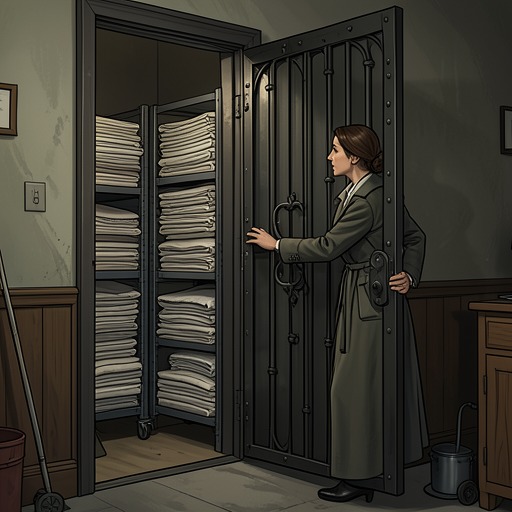
Maud develops the idea in a paper titled “Marginal Beings and Liminal Poetry.” She describes a paradoxical desire to be released into wild moorland and open ground while also wanting to be shut into increasingly tight, impenetrable spaces. Her examples include Emily Dickinson’s voluntary confinement and the Sibyl enclosed in a jar. The pairing matters: the open landscape promises escape from restriction, while the small sealed space promises protection from intrusion. Neither pole resolves the conflict; each offers a different imagined defense against a world in which a woman may be exposed or constrained.
Maud connects the paper to her earlier response to a poem about the Sibyl. Its image stayed with her and returned when she began working on thresholds. In retrospect, the remembered figure becomes more than a literary ornament: the Sibyl’s enclosure makes visible the tension between wanting to disappear from reach and wanting release. Maud’s account treats such images as a recurring imaginative structure, not as a simple preference for either solitude or freedom.
The Sibyl, enclosure, and interpretation
The Sibyl’s jar supplies the concept with a particularly concentrated image. The figure is protected because she is sealed away, yet that safety is inseparable from confinement and a wish to die. The jar therefore gives physical form to liminality: a boundary that shields also imprisons, and a retreat from the world may be both self-preservation and a limit on life. Maud’s critical attention begins with the image’s return to memory and follows it into a broader argument about women’s imaginative spaces.
Maud also compares the Sibyl with the Sorceress in Randolph Henry Ash’s “In-Pace,” but resists reading Ash’s poem as simply endorsing the punishment of a beautiful, supposedly wicked woman. Her interpretation is that the poem addresses those who believed the Sorceress ought to be punished, including the woman herself insofar as she has accepted that judgment. Ash, in Maud’s reading, does not ratify the sentence; he leaves its implications to the reader’s intelligence. This distinction keeps the image open to interpretation without making every reading equally persuasive: the poem’s treatment of judgment, rather than an assumed authorial condemnation, sets a limit on what the image can mean.
Desire and the remembered room
The concept’s concern with opposing spatial desires has a personal counterpart in Maud’s recollection of Fergus Wolff. As she stands under the shower, she remembers an unmade, stained, rumpled bed, its sheets raised into peaks like whipped egg-white. The bed appears to her as an empty battlefield. Around it gather other signs of disorder: used coffee cups, abandoned clothes, dusty papers marked by wineglasses, dust and ashes, and the smell of socks. This scene does not merely describe a room; it gives form to the repugnance that now accompanies the memory of desire.
Maud recalls meeting Fergus at a Paris conference on “Gender and the Autonomous Text.” She had spoken about thresholds; he delivered a paper titled “The Potent Castrato: The phallogocentric structuration of Balzac’s hermaphrodite hero/ines.” His argument seemed feminist, yet his presentation also felt mocking and subversive, with an element of self-parody. He flirted with Maud, praised her intelligence and beauty, and insisted that his desire for her was irresistible. Maud cannot rationally explain why the attraction had been irresistible, but acknowledges that he had been right about its force. The arguments came afterward, leaving the relationship in memory as a sequence in which attraction and conflict are joined rather than neatly separated.
Significance and limits
Maud’s remembered bed echoes the larger idea without duplicating it. Her paper sets open moorland against sealed enclosure; her recollection sets past attraction against present repugnance. In both, opposed responses coexist, and neither can simply be discarded as false. The empty bed is an image of aftermath, while the Sibyl’s jar is an image of enclosure; together, they show how spaces can hold meanings that change with the observer’s position and experience.
Liminality and Female Space thus links literary interpretation, gender, and the bodily memory of intimacy. Maud’s argument attends to the way women’s imagined spaces can register both a desire to withdraw from scrutiny and a desire to escape restriction. Her reading of Ash also insists on interpretive responsibility: a poem may expose the social judgment that condemns a woman without itself repeating that judgment. The concept remains valuable precisely because its central images resist a single solution. A threshold may lead outward or mark the edge of refuge; enclosure may protect and confine; desire may persist in memory alongside the repugnance that follows it.