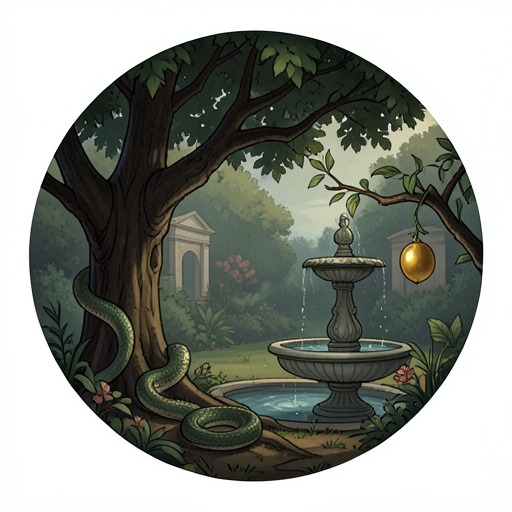
The Mythic Garden
PossessionThe Mythic Garden is a recurring poetic landscape assembled from the garden and tree, the serpent, golden fruit, running water, grass, and a woman in the shade. In Randolph Henry Ash’s The Golden Apples, it is not merely a setting borrowed from old stories: the poem asks how names and metaphors make a world visible, and whether different mythic places are versions of one place. The garden thus becomes an image of poetry itself, where inherited materials are reshaped and recognition arrives through reading.
The Garden’s Recurrent Images
The poem first presents these things as already present: garden and tree, serpent at the root, golden fruit, a woman beneath the branches, running water, and a grassy space. It insists that they are and were there, placing the garden at the old world’s edge in the Hesperidean grove, where golden fruit glows on enduring boughs. This language gives the scene the quality of a remembered or primordial landscape, but does not confine it to a single myth or moment.
The tree also appears as the World Ash, rising from darkness and thrusting its roots into the cavern where Nidhogg coils. The image joins an axis of life and shelter to an underworld of danger: the tree links realms, while the serpent at its root makes that connection uneasy. The poem’s garden is consequently both fertile and exposed to threat, a place where creation and danger occupy the same symbolic ground.
The golden fruit, the tree, and the water recur in more than one mythic register. Their repetitions invite the question of whether the separate places are shadows of one Place, and whether the several trees are instances of one Tree. The poem raises that possibility without reducing its different mythic settings to a simple, settled equivalence. It keeps the reader between plurality and unity: each image belongs to a particular story, yet echoes beyond it.
Naming and Making
The poem connects the garden to the first act of naming. The first people named the place and the world, making words for garden and tree, dragon or snake, woman, grass, and gold. It then describes a further imaginative act: names are mixed to make metaphor, or what the poem calls visible truth, such as apples of gold. Language does not simply label a completed world; poetic combination makes familiar things newly perceivable.
That account gives the garden a double status. It is described as something there before the act of naming, yet its forms become intelligible through the words and stories that people make. When Ash writes that people see the place and make it, the poem holds both sides together: the world offers material for perception, while imagination composes that material into a meaningful scene. Its myths are neither bare records of an untouched reality nor arbitrary inventions detached from it.
The same principle informs the poem’s treatment of things that cross between forms and stories. A tree can be the World Ash; golden fruit can belong to a Hesperidean grove; and the garden can gather creatures and figures from the mind, including lamias, dryads, and mélusines. These figures do not erase one another. Their accumulation shows how poetic language builds consequential stories around recurring forms, giving the garden its power to connect traditions while preserving their differences.
Reading as Recognition
The Mythic Garden becomes an interpretive event when Roland Michell reads or rereads The Golden Apples. He sees the tree, fruit, fountain, woman, grass, and serpent as single and multiple in form. He hears Ash’s distinctive voice, but also hears language moving beyond the reach of any one writer or reader. The scene makes reading an encounter with a work that bears an author’s particular sound and meanings no individual can entirely possess.
Roland’s recognition also brings Giambattista Vico’s account of the first poets and their names, which were also things, into contact with the poem’s own meditation on naming. The lists Roland had made in Lincoln, previously strange and apparently meaningless to him, acquire a place in this wider pattern. The garden’s images have helped him understand not only Ash’s poem but also the work of interpretation through which fragments begin to cohere.
That recognition does not end by assigning Christabel LaMotte one fixed mythical identity. Roland sees that she is the Muse and Proserpina, and that she is not; the contradiction strikes him as apt, and he laughs aloud. The garden’s method is one of correspondence without confinement: a person or image may illuminate a mythic role without being exhausted by it. Ash began Roland’s quest, and this reading returns him to the clue with which it began, even as the letter, the letters, Vico, the apples, and his list fall away as separate objects of pursuit.
Gifts, Inheritance, and the Life of Things
The garden’s imaginative transformation has a material counterpart in Ash’s account of jet. During his Yorkshire visit, he sends Ellen a piece of the local material with a poem, praising the craftsmanship that turns ancient ammonites and fossil remains into ornaments and polished surfaces. Long-dead forms are not simply recovered intact: they acquire new uses and shapes, while still carrying traces of their former life. Ash identifies this persistent shape-shifting of what is dead but not vanished as a subject of his own writing, joining geological time to poetic making.
His concern with transmission also appears in a small, personal exchange with Sophia, a child who has sent him drawings of ducks. Ash reciprocates with a drawing of the ash tree and explains its mythic association with holding the world together, from underworld roots to Heaven. He addresses her as a dear friend, while distinguishing her present time of play and delight from the wisdom she may grow into. The letter turns the tree into an object of instruction and affection, passed from an older poet to a child through words and a drawing.
The circulation of letters makes that continuity a question of custody as well as imagination. Mrs Wapshott explains that her husband inherited Ash’s tree letters and intended them for their daughter Katy, who had taught English and expressed interest in them. She calls them Grummer’s tree letters and regards them as Katy’s in a kind of trust, refusing to hand them over without consulting her. Mortimer Cropper, seeking to complete his collection of Ash’s correspondence, instead presents the letters as details that would restore the poet to life and offers the Stant Collection’s controlled preservation and restricted scholarly access. The contrast makes the garden’s transmission concrete: texts pass between generations and institutions, but what it means to preserve them depends on who receives, owns, and reads them.
A related chain of inheritance appears in Maud Bailey’s account of Christabel’s papers. After Christabel’s death in 1890, her sister Sophia sent papers and poems to her daughter May, Maud’s great-great-grandmother. The accompanying explanation, as Maud recalls it, was that Christabel had wished her papers to pass through the female line and that she deserved recognition as a better poet than she had yet been acknowledged to be. The account makes the transmission of women’s writing part of the garden’s larger pattern: poems and papers survive through acts of handing on, while their value and meaning remain subject to later readers and institutions.
The motif consequently joins poetic creation to material survival and scholarly discovery. In the garden, old names and stories are rearranged into newly visible forms; in Ash’s letters and the papers passed down through Sophia and May, writing itself is carried forward by particular people making decisions about its custody. Roland’s fellowship offer on Ash, made possible by funding from a philanthropic trust after his own critical work, extends that history into the academic present. The garden is not a single hidden answer waiting to be recovered, but a model of how forms endure: they recur, change their relations, and become newly legible when readers bring them together.