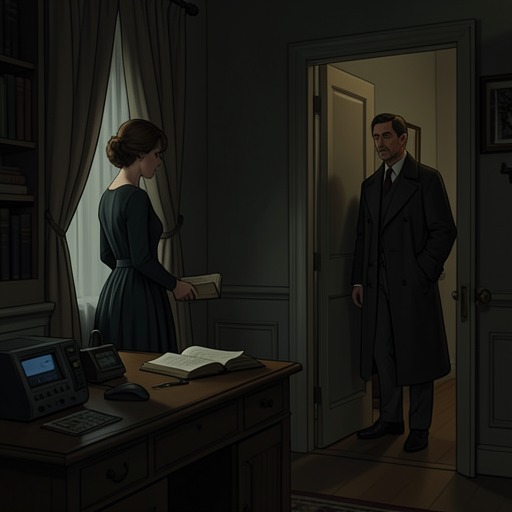
The Unbroken Egg
PossessionThe Unbroken Egg is Christabel LaMotte’s image for a self-contained life: solitude and self-possession held within a boundary that intimacy may break. The image gathers together a question she cannot finally resolve—whether love diminished her independence or enlarged her—and becomes a point of recognition for Maud Bailey, who also understands self-protection as necessary to her work.
The Egg as Solitude and Self-Possession
In her letter to Randolph Henry Ash, Christabel recalls “the riddle of the egg” as an image of her solitude and self-possession. Its shell suggests a closed, defended life, one she associates with the possibility of becoming a great poet. She wonders whether she might have achieved that distinction had she remained within her “closed castle,” protected by “motte-and-bailey defences.” The image therefore refers not simply to isolation, but to a form of autonomy that can shelter creative work.
Yet the egg is not presented as an uncomplicated ideal. Christabel says Ash threatened it, whether he intended to or not, and destroyed it while meaning her well. The paradox is central: what she experienced as a breach of her boundaries may also have been an act of generosity. Her metaphor keeps both possibilities alive rather than reducing their relationship to either injury or emancipation.
Love, Art, and Unresolved Change
Looking back, Christabel asks whether Ash’s spirit rebuked hers, as Caesar’s was rebuked by Antony, or whether she was enlarged by his generosity. The alternatives remain entangled. She says the matters are “all mixed and mingled,” and links their love to Maia, who rejects her “strange name” in favour of the plain May. The egg’s threatened enclosure thus belongs to a history that includes love and a daughter, as well as the cost and possibility of artistic selfhood.
Christabel’s account also changes in tone as she approaches the end of her letter. After describing long anger—with Ash, Blanche Glover, and herself—she says that, “in calm of mind all passion spent,” she thinks of Ash again with clear love. The image of the egg belongs to this reckoning: it preserves the question of what was lost without making loss the only meaning of intimacy.
Maud Bailey’s Recognition
The metaphor recurs in Maud Bailey’s conversation with Roland Michell. Maud says that she feels as Christabel did and keeps her defences up because she must continue her work. She names Christabel’s “unbroken egg” as a figure for self-possession and autonomy, and admits that she does not want to imagine those qualities disappearing.
Their exchange develops the image through the language of boundaries: Maud writes about liminality, thresholds, bastions, and fortresses; Roland answers with invasion and irruption. Maud then insists that she has her own solitude. Her recognition of Christabel does not mean that she wants to surrender her boundaries. Instead, the egg gives her a way to describe how scholarly and emotional independence can be guarded even where closeness is possible.
Significance
The Unbroken Egg connects Christabel’s retrospective uncertainty with Maud’s present-day self-understanding. Across the two women’s reflections, enclosure can protect creative autonomy, but it can also be altered by intimacy that is neither simply destructive nor simply liberating. The image’s force lies in that unresolved tension: the possibility of remaining whole is weighed against the possibility of being changed and enlarged through relation.