Tensions Between Scientific Knowledge and Religious Faith
PossessionTensions Between Scientific Knowledge and Religious Faith is a recurring intellectual and personal problem in the novel, not a debate resolved by choosing either scientific explanation or inherited belief. Through Randolph Henry Ash’s study of organisms and geological change, and Ellen Ash’s reflections on faith amid new scientific ideas, the narrative shows how evidence can unsettle religious certainty while leaving questions of meaning, purpose, and human limits open.
Scientific Inquiry and the Limits of Certainty
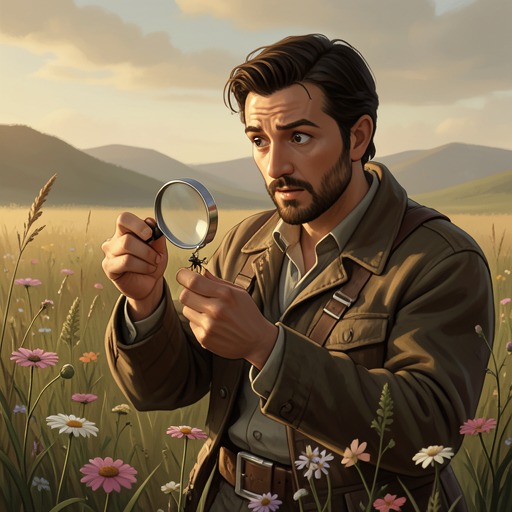
Ash’s natural-history work brings the problem into daily practice. During his stay in Yorkshire, he reads Lyell in the evenings and studies small marine organisms in plain yellow pie dishes set across the available surfaces of his dining-room. Their intricate structures and functions suggest to him that an Intelligence may have designed them; at the same time, he finds it difficult to dismiss the evidence for development through gradual changes produced by ordinary causes. Observation therefore gives him reasons to feel both wonder and doubt, rather than a simple route to either conclusion.
The landscape offers a parallel account of gradual formation. At Flamborough Head, Ash considers how salt water and fresh water shape chalk, caves, and other formations through sustained pressure and erosion. He asks whether, over immense periods, comparable processes might shape the channels of the ear and the vesicles of the heart. The analogy makes natural change imaginable across scales, from coastline to organism, but it does not answer how inherited form is transmitted. A tree cutting can grow roots and a crown, yet Ash cannot explain how the twig seems to know what to become. The unanswered question marks a limit within his scientific reasoning, not a return to certainty.
That limit is also generational. Ash calls his contemporaries a Faustian generation, seeking knowledge they may not have been designed to attain. The formulation casts inquiry as both an intellectual ambition and a source of risk: the desire to know presses beyond established explanations, while the possibility of design itself remains uncertain. His unease is not presented as a rejection of science, but as recognition that scientific investigation can sharpen questions without settling every one.
Faith in an Age of Questioning
Ellen encounters the same intellectual climate from within domestic and religious life. While Ash is away, she reads Lyell’s Principles of Geology partly to share her husband’s interests. She is drawn to the seriousness of his geological vision, yet unsettled by the immense spans of time it assigns to the formation of the earth’s crust, which remains in process of change. The contrast between intellectual attraction and emotional chill makes geological time a personal challenge, not merely an abstract proposition.
Ellen does not conclude that geological knowledge cancels faith. She considers whether the story of Noah’s Deluge might prove to be poetic invention, and whether its message about the universality of sin could still command attention. She sees a different and more troubling possibility in the life and death of Jesus Christ: if those too were treated as inventions, the consequences for belief would be more severe. Her distinctions show that religious meaning does not rest on every narrative in the same way, even as she confronts the unsettling prospect that historical claims may be questioned.
Her disagreement with Herbert Baulk reveals the gendered terms in which faith and reason are sometimes assigned. Baulk tells Ellen not to trouble her intellect with questions he considers vain, presenting intuition as womanly, virtuous, and pure. She assents to his assertion that her Redeemer lives, but wants him to resolve his own intellectual doubts so that their prayers might express honest praise and robust faith rather than remain darkly uncertain. Her assent is real, yet it does not erase her wish for intellectual honesty or make her questions disappear.
Spiritual Claims and Standards of Evidence
Ash’s skepticism about spiritualism extends the conflict from religious doctrine to the evidence used to make claims about the dead. In a letter to Mrs Cropper, he argues that séances may combine fraud with collective hysteria, emerging amid a society unsettled by materialism and the rigorous questioning of religious narratives. He does not claim that all spiritual phenomena are impossible: he allows that wandering spirits or traces of painful remembrance may exist. His objection is to treating a planchette, rappings, or public demonstrations as reliable shortcuts to knowledge.
Instead, Ash distinguishes direct spiritual interrogation from patient study. The dead, he argues, are more responsibly approached through sustained contemplation of past minds and living organisms, and through instruments such as the microscope and spectroscope. His position places historical interpretation and scientific observation on one side, and purported manifestations offered as immediate certainty on the other. The distinction matters because he regards the hunger for easy answers as dangerous: inquiry into the past requires a fragment to be thoroughly understood and handed on, not a shortcut that promises more certainty than it can support.
Ash’s letter also connects this methodological argument to religious doubt. He accepts that scientific and historical inquiry can make inroads into simple faith, and that even if such inquiries ultimately strengthen belief, the process will not be easy or immediate. He rejects comforting nostrums that promise solidity without a sound basis. In this account, skepticism does not automatically produce disbelief; rather, it challenges both religious confidence and easy substitutes for it.
Life, Death, and the Meaning of Development
Ash’s interest in reproduction and regeneration brings scientific explanation into direct contact with mortality. Influenced by Richard Owen’s work on parthenogenesis, he investigates hydras and plumed worms that can grow new heads or segments through gemmation. He also studies the relation between polyps and the apparently unfertilised buds that become jellyfish, and experiments by cutting hydra tentacles and dividing polyps into fragments that become new creatures. Such observations fascinate him because they suggest continuity and interdependence across forms of life.
That continuity carries a possible answer to the fear of individual death, especially as confidence in the promise of Heaven weakens. But the biological phenomena do not prove personal survival or resolve religious questions. They offer Ash a way to think about life persisting through transformation, while leaving the relation between biological continuation and religious immortality uncertain. The novel thus makes scientific knowledge consequential without allowing it to answer more than its evidence permits.
A Continuing, Unresolved Tension
The theme is sustained through contrasts rather than a final settlement: Ash’s delight in the design-like intricacy of organisms coexists with his attention to development; Ellen’s religious trust coexists with her awareness of geological time and doctrinal uncertainty; and Ash’s skepticism of séance claims coexists with his willingness to admit that reality may exceed established philosophy. Each position has boundaries. Faith cannot simply ignore new knowledge, while science cannot by itself settle every question about meaning, purpose, or death.
The novel’s treatment of the conflict is therefore neither a verdict against belief nor a claim that scientific discoveries confirm it. Its focus is the difficult work of living with evidence that revises inherited accounts, with questions that observation leaves open, and with convictions that may persist without intellectual ease. The tension remains productive precisely because neither inquiry nor faith is permitted to become an effortless certainty.