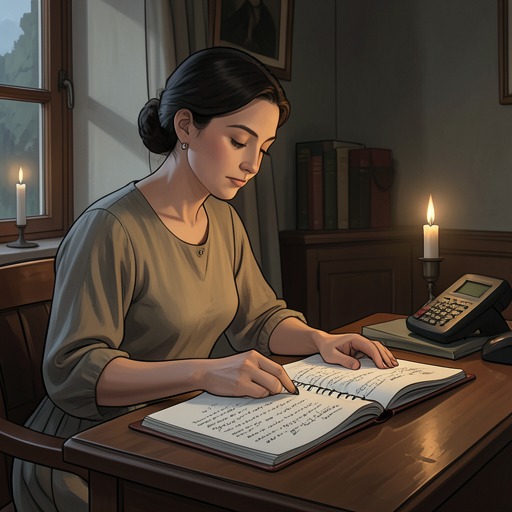
Women’s Writing and Creative Autonomy
PossessionWomen’s Writing and Creative Autonomy is a central concern in the novel: women’s authorship depends not only on possessing a voice, but on having the time, income, institutional access, and freedom from prescribed roles needed to use it. The pressure appears in several forms, from a male poet’s patronizing judgment of Christabel LaMotte’s poems to the everyday economic labor of Val and the exclusion of women scholars from academic decision-making. The novel also refuses an easy triumphal story. Blanche Glover’s testament recalls an ideal of independent shared life that proved difficult to sustain, while the work and arguments of women across generations preserve its claims.
The Female Pen and the right to write
In a letter to Randolph Henry Ash, Christabel LaMotte rejects the assumption that a woman writer’s work is merely a lesser version of men’s. She describes the familiar praise that a woman’s writing is good “for a woman,” alongside the restrictions on subjects women are permitted to treat and knowledge they are presumed to possess. Christabel does not deny that people may argue for differences between men’s and women’s capacities; she insists instead that the boundaries drawn around women are wrong. Women think, feel, and read, and should not be confined to the roles of moral ornament or vessel for virtuous thought.
Her defense is grounded in the practical history of her own writing. Before writing to Ash, Christabel had sent a small selection of poems to a celebrated, unnamed poet and asked whether they were poems and whether she had a voice. He praised them cautiously, but advised her to pursue “sweeter and weightier responsibilities.” The courteous wording makes the restriction more, not less, telling: artistic work is treated as an expendable pastime until a woman assumes conventionally approved responsibilities. Christabel asks Ash to understand that the need to write is not an idle diversion from life. Words have been her life, and the need to set them down is inseparable from her survival as an artist.
She figures that necessity through a spider carrying and spinning its own silk. The silk is home, safety, and sustenance as well as material for creation; if it is attacked or pulled down, the spider must begin again. Christabel’s image makes authorship at once vulnerable and self-renewing. Writing is neither a decorative accomplishment nor a claim dependent on male approval: it is the means by which she constructs a life and continues after its foundations have been threatened.
Work, income, and independence
The novel places artistic autonomy against the economic arrangements that often make it hard to achieve. After Roland Michell’s grant runs out, Val becomes the household’s breadwinner while he completes his PhD. She types academic work on an IBM golfball typewriter at home in the evenings and takes temporary jobs by day, working in the City, hospitals, shipping firms, and art galleries. She resists specializing and habitually calls her jobs “menial,” a word that conveys both the status assigned to her work and her rueful awareness of it. The typewriter’s clatter becomes part of Roland’s nights: intellectual work in the household rests on the labor that enables him to continue his studies.
Christabel’s move to Richmond offers another form of economic independence. In 1853, a small legacy from her aunt Antoinette de Kercoz allows her to set up house with Blanche Glover, a young woman she had met at a Ruskin lecture. The legacy creates room for artistic work and shared domestic life, but it does not erase the financial and social pressures surrounding them. Blanche’s later account of their experiment makes the material terms explicit: they hoped that independent single women could live useful, fully human lives together, frugally and without recourse to men or outside assistance. Their failure to secure that ideal does not, in Blanche’s judgment, prove the ideal worthless. She leaves open the possibility that stronger successors may take up the attempt.
Institutions and the costs of exclusion
The barriers to women’s authorship also operate inside professional institutions. At Prince Albert College, women were barred from the main Senior Common Room until the late 1960s. Decisions of consequence were made in the pub, where women were neither invited nor comfortable, yet exclusion from that setting also excluded them from departmental policy. Women could be grateful for employment and still be denied participation in the decisions shaping their work. The institution’s separate, smaller women’s room is a material sign of that unequal arrangement.
Beatrice Nest’s career shows both the possibilities and the limits of institutional advancement. Professor Bengtsson requires her to establish her suitability through evidence of scholarly work, prompting her to write a small book about the daily lives of the wives of famous men. The book wins her an assistant lectureship, and teaching becomes a source of pleasure as well as anxiety. Across the 1950s, 1960s, and 1970s, she teaches students about the sonnet, lyric poetry, and changing images of women. Yet her later sense of growing irrelevance, followed by early retirement, marks how a career can open doors without guaranteeing lasting authority. Her delayed work on Ash’s poems is bound up with the question of whether her editorial intervention is right and whether Christabel herself would have welcomed it.
The unfinished experiment and its legacy
Blanche Glover’s testament gives the struggle for autonomy a deliberately unsentimental measure. She identifies poverty, pride, and the failure of ideals as reasons for her decision. She cannot afford more paint and has sold little; she refuses to return to governess work, which she regards as a form of slavery, and will not make Christabel responsible for her support. Those circumstances expose the narrow alternatives available to a woman attempting to live by her own work: financial dependence, degrading employment, or precarious self-sufficiency.
Blanche also describes the Richmond household as an experiment in which women tried to live artistically, charitably, and philosophically in harmony with one another and with nature. She attributes its failure partly to a world hostile to the attempt and partly to the women’s own limits of resourcefulness and resolve. The two explanations remain in tension: structural hostility matters, but Blanche does not exempt herself or Christabel from the difficulties of sustaining their shared project. Her hope that other women may take up the task gives the experiment a legacy even in defeat.
Taken together, these episodes define creative autonomy as more than permission to publish. It requires a voice, but also the means to live, work, study, and take part in decisions. Christabel’s insistence on the life of words, Val’s labor supporting Roland’s scholarship, the college’s exclusion of women, Beatrice’s professional path, and Blanche’s account of a failed shared household illuminate different pressures on that freedom. The novel preserves both the force of women’s claims and the costs of trying to make them livable.