Scholarly possession and ownership
PossessionScholarly possession and ownership in Possession names the unstable boundary between finding a document, holding it, inheriting it, interpreting it, and having the right to make it public. The novel distinguishes physical custody from copyright and legal title, but it also shows how money, institutional authority, family memory, and private obligations shape what scholarship can reach. Manuscripts are not inert evidence: their order, concealment, return, and destruction affect both the histories scholars can tell and the lives of those whose words survive.
Discovery, Custody, and the Material Archive
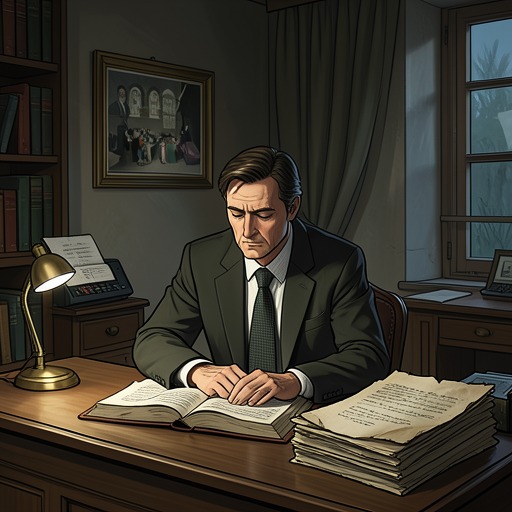
At the London Library, Roland Michell encounters Randolph Henry Ash’s own copy of Vico’s Principi di una Scienza Nuova. Undisturbed for perhaps generations, it releases faded leaves of notes when Roland undoes its bindings. The fragments, written on the backs of book-bills and letters, remain in their original sequence; soot-black page edges preserve the impression of mourning borders. The librarian permits Roland to study them but asks him not to disturb their arrangement before they have been listed and described. The scene makes archival access a practice of care as well as reading: the material order is itself evidence, and the researcher’s first responsibility is not to mistake discovery for ownership.
That responsibility becomes more fraught when Roland admits that he took the papers. He and Maud Bailey have considered how the newly discovered correspondence could transform scholarship on Ash and Christabel LaMotte, but Maud asks where the originals are. Roland confesses that he found them in a book and carried them away without thinking. His admission separates scholarly excitement from legitimate custody: the document’s historical importance does not erase the fact that he removed it from its place, nor settle who can properly decide what happens to it.
The archive is also defined by what has not survived. The papers deposited by Maud’s family at the Resource Centre derive largely from the contents of LaMotte’s desk, including manuscripts, scattered lyrics, revisions of Melusina, a commonplace book, friends’ letters, and Blanche Glover’s diary for only three years. LaMotte rewrote Melusina at least eight times, while the surviving collection remains small and its history incomplete. Maud says that little care was taken of the papers and that no further material has come to light. The collection therefore offers neither a complete life nor an unmediated author: scholarly possession begins from an uneven inheritance shaped by loss.
Markets, Institutions, and Competing Claims
Mortimer Cropper presents himself as the world’s leading Ash expert and as curator of the largest collection of Ash manuscripts. His approach joins scholarly ambition to financial power. He cites the £500 Sotheby’s price for a comparatively ordinary Ash letter and offers to pay six figures for a substantial group of letters, arguing that the papers would be preserved in Harmony City under carefully controlled conditions and made accessible to scholars of every nation. Sir George Bailey objects that English materials should remain in England. Cropper responds that microfilm and photocopying make national sentiment less decisive, while also offering to value any Ash material Sir George may possess.
The offer exposes the difference between preservation as a stated institutional ideal and acquisition as a competitive method. Cropper promises ideal conditions of air pressure, humidity, light, and scholarly access, yet his large cheque book makes possession itself a source of authority. James Blackadder hears of an unnamed client seeking a valuation of roughly fifty long Ash letters and learns that an offer in the region of six figures may already exist. He suspects Cropper has reached the papers first. Because Blackadder cannot inspect them, he faces a practical bind: making a generous estimate might allow a viewing, but could leave his institution without the funds needed to compete. The phrase “sight unseen” captures the irony: the papers’ possible scholarly value is being priced before the scholar has seen them.
Cropper’s effort to find material through Sir George also illustrates the reach of reputation and rumor. He tells Sir George that sources have led him to suspect there may be new manuscripts, then invites him to examine old LaMotte letters, diaries, and account books for Ash material. Sir George’s evasiveness convinces Cropper that something exists and that the family can reach it. Scholarship here depends not only on catalogues and formal deposits but on private networks, inferred possession, and the ability to turn a lead into a transaction.
Ownership, Copyright, and Inheritance
The novel makes legal distinctions explicit when Maud asks who owns the copyright in LaMotte’s poems and stories. Her family believes it holds the rights, while the manuscripts themselves have been deposited at the Women’s Studies Resource Centre in Lincoln. Euan MacIntyre later brings Maud a Xerox copy of LaMotte’s will, dictated to her sister Sophia Bailey in 1890 because LaMotte was too weak to write clearly. It leaves money and household goods to Sophia, makes a bequest to Jane Summers, and directs that all LaMotte’s books, papers, and copyrights pass to Maia Thomasine Bailey, in the hope that she will become interested in poetry.
The will’s provenance matters: Euan says it was folded among Sophia’s accounts, and those accounts indicate that Sophia found Jane Summers and paid the bequest. The surviving document thus connects a written intention to evidence of its execution, while also explaining how a crucial piece of literary history could remain among family papers rather than in a public archive. Maud’s descent from Maia gives her a claim grounded in inheritance, but the legal question is not simply answered by kinship or possession.
Euan explains the distinction between the manuscript as a physical object and copyright in its text. In general, the recipient owns a letter as an object, while copyright remains with its writer; in this case, however, LaMotte had asked Ash to return her letters, and Ash complied. The physical correspondence therefore passed back to LaMotte, while copyright in unpublished letters remained with their respective writers’ heirs. Euan argues that Maud is the legal owner of LaMotte’s side and almost certainly of the Ash manuscripts now held by Sir George, while copyright in Ash’s letters belongs to Ash’s heirs. He also notes that Maud’s father is the immediate heir in the family line but had already given the manuscripts inherited from Maia to Maud, who deposited them at the Centre.
These separate claims prevent ownership from collapsing into a single answer. A person may possess a manuscript without holding its copyright; a family may inherit papers but place them in an institution; a recipient may own a returned letter as an object while publication rights remain with the sender’s heirs. The legal account also leaves an uncertainty: Euan says it is not clear what Lord Ash would wish to happen, and reports that Cropper has induced Hildebrand Ash to promise him both the letters and copyright. The novel presents legal title as essential, but not as a complete resolution of what should be done with intimate documents.
Privacy, Destruction, and Scholarly Ethics
The conflict over access reaches beyond formal property rules into the ethics of biography. Maud suggests that Ellen Ash may have burned letters to prevent later scavengers from rummaging through the private lives of the dead; some, she believes, were buried with Ellen. In Ellen’s account, Randolph Ash had condemned the contemporary appetite for private memoranda and had asked her to burn what others should not see. She recalls the view that printing private letters could be a betrayal, like disclosing intimate conversation between friends. After Ash’s death, she burns some papers but cannot burn everything: she preserves the letters between Ash and LaMotte and lays them to rest with him, intending the earth to keep them until her own death.
Ellen’s act both safeguards and withholds. The hidden letters survive, but only because she removes them from ordinary scholarly circulation and places them in a grave. Their eventual discovery depends on choices that are at once intimate, protective, and consequential for future research. Her decision also complicates any simple opposition between preservation and destruction: she burns some documents to protect privacy, preserves others that she cannot bring herself to destroy, and buries the correspondence rather than entrusting it to an archive or an heir.
A further fragment found among Ellen’s papers intensifies the dispute without resolving it. An unsigned, unheaded sheet reproaches its recipient for keeping the writer’s evidence and asks that the writer be judged more carefully. Maud wonders whether it concerns a clandestine correspondence or a journey to the Yorkshire Coast, and whether Ellen had understood what she was holding. The paper supplies a claim about possession but not enough context to identify the evidence or settle the claim. In the novel’s archival world, a document can challenge a custodian’s authority and still leave the historian with an unanswered question.
Recovery and the Limits of Resolution
When the hidden contents of the Ashes’ grave are finally exposed, the dispute becomes material. Cropper opens Randolph Ash’s specimen container and removes an oiled-silk package containing a hair bracelet, a plaited lock of pale hair, a bundle of letters tied with ribbon, and a sealed envelope addressed to Ash. The objects arrive together, but their legal and emotional status is not the same. Cropper calls the bundle the love letters; Euan immediately points out that the unopened letter raises a further question: whether it belongs to its sender because it was never received, or to its addressee because it lies unopened in his grave.
The discovery does not end the ownership problem; it reveals its layers. Maud’s inheritance and the return of LaMotte’s letters support her claim to the physical manuscripts, while copyright remains divided according to authorship and inheritance. Sir George has held the materials, Cropper has sought to acquire them, and Hildebrand asserts that the specimen box will be his. Euan’s legal argument distinguishes Maud’s title to the letters from the box and from the rights in Ash’s writing. Even the recovered collection is not a single property with a single owner.
The novel’s central tension is therefore not simply whether scholarship should have access to documents. It asks who may grant that access, under what authority, and at what cost to the people whose private words become public evidence. Cropper’s promise of international scholarly access, Maud’s custodianship and family inheritance, Roland’s unauthorized taking, and Ellen’s deliberate burial each express a different relation to the archive. Together they show that literary history is produced not only by what survives, but by the hands that keep, return, conceal, sell, copy, publish, or destroy it.