Metamorphic Change
PossessionMetamorphic Change is a governing image in Christabel LaMotte’s writing and correspondence with Randolph Henry Ash, joining biological transformation to religious uncertainty and the changing conditions of human understanding. From a moth’s emergence to the image of a world shedding an old skin, change appears both as a process of life and as a possible crisis of perception: a new stage may bring renewal, but it may also require consciousness of how little can be known.
Natural Forms and the Creative Principle
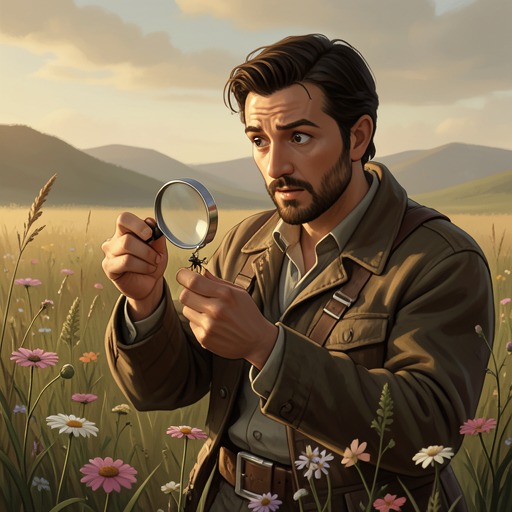
In a letter to Ash, LaMotte describes the living specimens kept in her household: a large house-spider, a moth in its chrysalis, and an unidentified many-legged worm. Their presence gives her thoughts about metamorphosis a concrete, domestic setting. The household has used microscopes and glasses, but has avoided pinned and chloroformed collections; its creatures remain temporary guests rather than specimens fixed for study. That distinction matters to the idea: observing life need not mean arresting it, and the smallest forms command attention as living processes rather than inert objects.
LaMotte’s enclosed poem, “METAMORPHOSIS,” begins by asking whether the ruffled silken flyer pauses to recall how she began. The question makes transformation a problem of memory as well as form: the creature’s present appearance may be separated from an earlier state that it cannot recall. Yet the poem resists treating change as a movement from nothing into self-sufficient life. Both the flyer and the speck of flesh from which its story began, it says, lay curled and known in their Creator’s sight; the Creator gave them form and life and remains their animator and their grave. Metamorphosis thus belongs to a larger continuity, in which beginning, development, and ending remain within a creative power.
Wonder-Tale, Doubt, and Religious Imagination
The letters place this natural image beside a dispute about what stories can make known. LaMotte worries that Ash’s treatment of pagan Ragnarök and Christian ideas of resurrection makes Holy Scripture seem like another wonder-tale, distinguished from other tales mainly by emphasis. She is not merely objecting to imaginative writing: she is testing whether a story can express religious possibility without reducing revelation to invention. Her doubts remain unresolved, but the exchange gives metamorphosis a theological dimension. Transformation may describe the changing forms of life while also offering a way to imagine resurrection and renewal.
Ash, in turn, insists that curiosity and questioning belong to the world as the Creator made it. He pictures human understanding as obscured by accumulated speculation, observation, and the material accretions of progress, much as a serpent is blinded by the old skin it must shed. The image holds loss and promise together: the crust impedes vision, but its shedding may precede a new, flexible brilliance. Metamorphosis is therefore not an uncomplicated emblem of improvement. The transformation may demand a period in which the old way of seeing has become inadequate and the new one is not yet clear.
Ignorance as a Stage of Change
Ash makes that uncertainty explicit when he asks whether the Creator has withdrawn from human vision so that mature minds must discover divine ways through their own diligence, or whether humanity has reached a necessary stage of ignorance and distance. His question refuses a simple opposition between intellectual progress and religious belief. Increased knowledge may bring new understanding, but it can also expose the limits that earlier confidence concealed; the resulting condition could be health or sickness.
His recollection of Ragnarök sharpens the point. In that poem, Odin becomes a wandering questioner in Middle-Earth and is destroyed, along with his works, on the final battlefield at the end of the last terrible winter. The god’s transformation from almighty figure into questioner makes knowledge inseparable from vulnerability and loss. Set beside the serpent’s shedding, the ending offers no assurance that change will preserve what came before. Metamorphosis can lead toward renewed perception, yet the old order may be destroyed before a new understanding is secured.
The Motif’s Literary Function
LaMotte’s poem and Ash’s reflections do not settle the theological questions they raise; they make uncertainty part of the motif’s meaning. The poem’s Creator holds the creature’s beginning and end within a timeless view, while Ash’s letter asks whether human beings have been left to approach divine purposes through imperfect, historically burdened minds. The contrast leaves open a distinction between the continuity of creation and the fragmentary experience of creatures changing within it.
The motif also connects different scales without making them identical. A moth’s transition from chrysalis to flyer, the persistence of life through a creature’s beginning and grave, the serpent’s loss of an obscuring skin, and the destruction of a mythic world all present change in different registers. Together they make metamorphosis a way of thinking about the relation between form, life, memory, and knowledge. The new form may disclose what the old could not, but neither the poem nor the correspondence promises that transformation will produce certainty or an uncomplicated advance.