Writing as craft and disciplined observation
PossessionWriting as craft and disciplined observation is the idea that literary ability is made through practice: experiment with language, record what life actually offers, and learn to see familiar things anew. In Sabine de Kercoz’s diary, Christabel LaMotte teaches this not as a promise of immediate inspiration but as a discipline of attention, one that prepares a writer to meet consequential experience when it comes. The advice also connects craft to privacy: writing for oneself may surrender some of the wish to charm, while gaining freedom and an adult seriousness.
Practice, Experiment, and Readiness
Christabel tells Sabine that a writer becomes a writer by practising, continually experimenting with language until the medium can be shaped with the fluency of clay or paint. The comparison makes craft active and material: writing is not merely the possession of a desire or a talent, but a practiced capacity to form language. Christabel’s further insistence that desire without the act is destructive gives the principle a sharper edge. Aspiration matters only when it enters the work.
Her method does not require waiting for extraordinary events. When Sabine fears that her daily life lacks passions or incidents suitable for poetry and fiction, Christabel urges her to record whatever can be noticed, even when it seems usual or dull. Daily writing is exercise for the future: it makes style flexible and observation exact, so that the writer is ready when something momentous demands telling. The discipline therefore joins routine to expectation. What looks uneventful is not an empty interval but the ground on which future perception and expression are trained.
The Ordinary Made Strange
Christabel’s counsel asks Sabine to look at her own surroundings as a stranger might. The rainy orchard, the difficult coastline, and the simple kitchen pots and platters are not to be discarded as too familiar for art; they are to be seen with renewed attention. Christabel’s comparison to a painter who makes harmony through sunlight and shade clarifies the difference between the object and the artistic act. A writer cannot paint a still life, but, if the craft is adequate, can make familiar experience newly legible through words.
This practice of attention carries an argument about value. Nothing, Christabel maintains, is dull in itself or without proper interest; dullness may instead mark the limits of the observer’s habitual vision. Recording ordinary things trains Sabine to notice their variety and colour before she knows what later use they might have. The diary thus makes observation a craft rather than a passive reception of facts: attention selects, discovers relations, and gives the commonplace the possibility of significance without needing to disguise it as something else.
Privacy and the Writer’s Audience
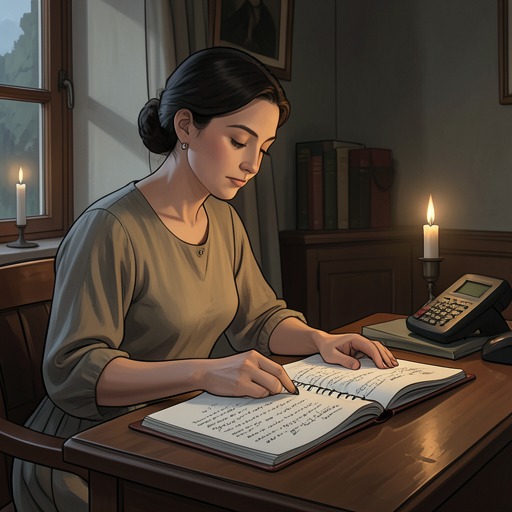
Sabine’s first account of writing turns the lesson toward the conditions under which a writer works. She wonders whether the notebook is meant for Christabel’s approval, like an exercise or an intimate letter, or whether it is a private record intended for her own truthful scrutiny. She decides to lock the volume away, at least in its early life, and to write for herself and the Supreme Being. The choice separates practice from performance: the notebook is not to be shaped chiefly to please the person whose teaching inspired it.
Sabine’s conclusion is not that private writing is simply superior. Writing for only the writer’s eyes, she reflects, loses some vitality but gains freedom and, unexpectedly, an adult quality. It loses the desire to charm, which she associates with both femininity and childhood. That trade-off makes the private notebook a testing space: it can loosen the pressure to present an appealing self, even as it gives up the energy that an imagined reader might bring. Craft develops through a shifting relation between expression and audience, not through an uncomplicated rejection of readers.
Reading, Revision, and Retelling
The principle extends from composing to reading. When Christabel responds to Sabine’s story of Dahud, she praises its ability to make the legendary figure both an individual human being and a symbolic truth, without forcing the tale into a single allegorical meaning. Her assessment values form as well as subject: the writer must preserve the clean, recognizable elements of an old story—the angry Ocean, the horse’s leap, Dahud’s fall from the crupper, and her engulfment—while adding something that makes the inherited material seem new and first seen.
Christabel’s response defines originality as transformation rather than appropriation. Old stories can be told again in different ways, but retelling requires both fidelity and invention: the basic structure must remain clear, while the new writer’s contribution must renew perception without enclosing the story within a merely private purpose. Sabine’s relief at having her work read as work shows the practical consequence of that account. Christabel treats the story as a made object whose choices can be recognized and discussed, while warning Sabine not to expect such understanding as a dependable feature of a writer’s life. Practice, observation, and attentive reading together make craft a means of finding fresh form in what is already known.