The Dog Siddhartha
SiddharthaThe Dog Siddhartha is the most violent self-condemnation in Hermann Hesse's novel, a phrase that erupts at the precise moment when Siddhartha, having abandoned his wealth, his city house, and his life as a merchant and lover, stands by the river and contemplates drowning himself. It is the verbal equivalent of the spiritual nadir he has reached after years of indulgence in Sansara, and it signals the final, necessary destruction of the ego that has kept him from true awakening.
Origin and Context of the Epithet
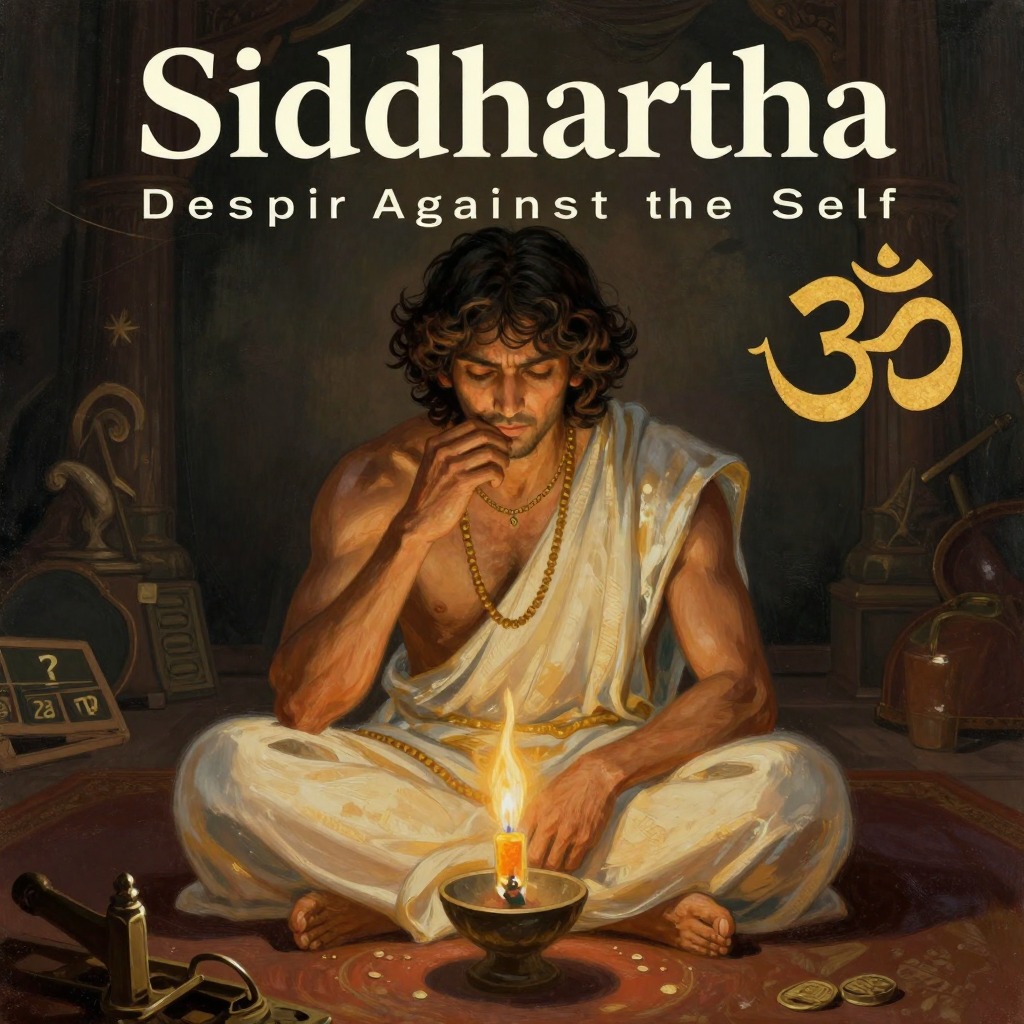
The phrase appears in the chapter "By the River," as Siddhartha, weakened by hunger and exhausted by disgust, leans against a coconut-tree on the riverbank and stares into the green water. He has left behind the city, Kamala, Kamaswami, and his life of gambling, fine food, and sensual pleasure, but he has not yet found a new path. The emptiness he feels is so complete that he wishes only to annihilate himself. "Let him be food for fishes, this dog Siddhartha, this lunatic, this depraved and rotten body, this weakened and abused soul! Let him be food for fishes and crocodiles, let him be chopped to bits by the daemons!" The epithet is not a casual insult but a deliberate, ritualistic self-abasement, a verbal act of casting out the old self as one would throw a carcass to scavengers.
The Self as an Object of Disgust
The phrase "The Dog Siddhartha" is the culmination of a long process of self-loathing that began much earlier. Even as a young Brahman, Siddhartha had felt that the love of his father, mother, and friend Govinda could not satisfy him, and that the sacred ablutions and offerings were merely water that could not wash off sin or heal the spirit's thirst. This early discontent grew into a systematic attempt to kill the self through ascetic practices with the Samanas, but those efforts only drove the self deeper into hiding. Later, in his years as a merchant and lover, he learned to trade, to enjoy power over people, to wear beautiful clothes, and to drink wine, but he also learned to gamble with dice, to lose money and jewelry, and to hate himself for his greed. The voice inside him that had once guided him grew silent, and he became aware of a "dying, quiet voice" that admonished him from deep in his chest. The epithet "The Dog Siddhartha" is the explosive expression of that accumulated disgust, the moment when the self he had tried to kill through asceticism and then through indulgence finally becomes unbearable.
The River's Response and the Sound of Om
Just as Siddhartha is about to let himself fall into the water, a sound stirs from the remote areas of his soul: the holy syllable Om, the word of words that he had learned to speak silently as a boy. The sound wakes his dormant spirit and makes him realize the foolishness of his actions. He collapses at the foot of the coconut-tree, mumbling Om, and falls into a deep, dreamless sleep. When he wakes, he feels as if ten years have passed, and he looks at the world as a new man. The epithet "The Dog Siddhartha" thus marks the boundary between the old life and the new: it is the last word of the self that must die, spoken just before the sacred syllable that brings rebirth.
The Transformation of Self-Love
After his awakening, Siddhartha's relationship with himself and with the world is fundamentally transformed. He no longer seeks to kill or dissect his self, but to learn from it. He realizes that his earlier attempts to overcome the self through fasting and penance were acts of arrogance, and that he had to lose himself to lust, power, and greed until the priest and Samana in him were dead. The river becomes his teacher, and he learns from it to listen with a quiet heart, without passion, without wish, without judgment. He learns that the river is everywhere at once, that there is no time, and that all voices—of joy and suffering, of children and men, of the dying and the laughing—are one. The epithet "The Dog Siddhartha" is never used again, because the self it named has been dissolved into the oneness of all life.
The Final Smile
In the novel's closing scene, when Govinda kisses Siddhartha's forehead, he sees a vision of all forms—fish, child, murderer, criminal, gods, animals—flowing into one another, and above them all, the smile of Siddhartha, which is precisely the same as the smile of Gotama the Buddha. The face that had once been called a dog's face now shines with the smile of the perfected ones. The epithet "The Dog Siddhartha" thus stands as the antithesis of this final smile: it is the name of the self that had to be annihilated so that the eternal self could be found.