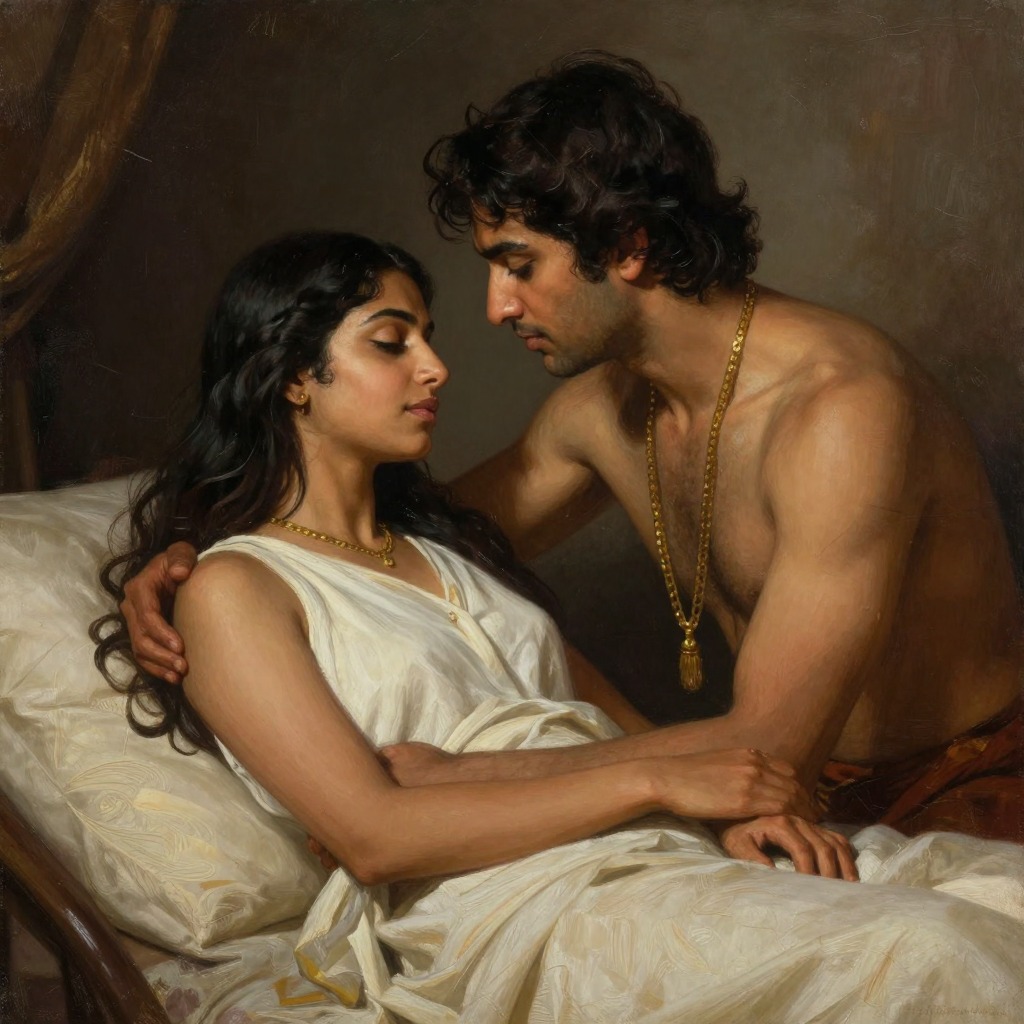
The Poem to Kamala
SiddharthaThe Poem to Kamala is a short, improvised verse that Siddhartha recites to the courtesan Kamala during their first encounter at the entrance to her pleasure-grove, outside the city where she lived. The poem functions as a gift, a declaration of his intent, and a key that unlocks the door to his new life of worldly experience, marking the moment he begins to trade the spiritual currency of his Samana past for the tangible pleasures of the material world.
Composition and Context
Siddhartha, having just arrived in the city after years as a Samana, had his beard shaved, his hair cut and oiled, and bathed in the river, preparing himself to approach Kamala. When he met her in her pavilion, she questioned his lack of fine clothes, shoes, and money, asking what he could possibly do. He replied that he could think, wait, fast, and also write poetry, offering to give her a kiss for a poem. After a moment of thought, he spoke the verses: "Into her shady grove stepped the pretty Kamala, / At the grove's entrance stood the brown Samana. / Deeply, seeing the lotus's blossom, / Bowed that man, and smiling Kamala thanked. / More lovely, thought the young man, than offerings for gods, / More lovely is offering to pretty Kamala." The poem is a direct, almost transactional offering, replacing the sacred offerings of his Brahmanical youth with a profane offering to a beautiful woman.
Immediate Consequence and Significance
Kamala was delighted by the verses, clapping her hands so that her golden bracelets clanged. She declared them beautiful and, true to her word, gave Siddhartha his first kiss from her mouth, which he had compared to a freshly cracked fig. This kiss was not a simple one; it was a lesson, as Siddhartha felt with deep astonishment how she taught him, controlled him, rejected him, and lured him, revealing a long, well-ordered sequence of kisses. The poem thus served as the immediate catalyst for his initiation into the art of love, a craft Kamala would teach him thoroughly. It also established the transactional nature of their relationship: he would need to acquire fine clothes, shoes, and money to continue, and the poem was his first successful currency in this new world.
Thematic Resonance and Later Echoes
The poem encapsulates a central pivot in Siddhartha's journey: the replacement of the sacred with the sensual. The line "More lovely, thought the young man, than offerings for gods, / More lovely is offering to pretty Kamala" directly contrasts the rituals of his Brahman upbringing with the new object of his devotion. This theme of offering and exchange recurs throughout his life with Kamala, who later tells him that love can be obtained by begging, buying, receiving it as a gift, or finding it in the street, but cannot be stolen. The poem's imagery of the "shady grove" and the "lotus's blossom" also connects to the broader symbolic landscape of the novel, where the river, the forest, and the garden are spaces of transformation. Years later, when Kamala, dying from a snakebite, is brought to Siddhartha's hut by the river, she recalls the young Samana who came to her without clothes and dusty feet, and Siddhartha recognizes her instantly. The poem, though never recited again, remains the foundational artifact of their bond, a verbal token of the moment he chose to enter the world of the childlike people.