The Veil of Maya
SiddharthaThe Veil of Maya is a recurring philosophical concept in Hermann Hesse's Siddhartha, drawn from Hindu and Buddhist traditions. It represents the world of appearances, a deceptive and illusory veil that conceals the true, unified essence of existence—the Brahman or Atman. Siddhartha's spiritual journey is defined by his evolving relationship with this veil: he begins by despising it as a distraction, then becomes entangled in its pleasures, and finally learns to see it not as a deception to be overcome but as a valid and beautiful expression of the oneness of all life.
The Veil as Deception and Distraction
In his youth as a Brahman's son and later as a Samana, Siddhartha views the visible world with deep distrust. He sees the diversity of colors, forms, and sensations—the blue sky, the yellow sun, the flowing river—as a "veil of Maya," a pointless and coincidental diversity of mere appearances that the deeply thinking Brahman scorns in his search for unity. This perspective is rooted in the teachings of the Brahmans, who taught that the true essence of the world lies beyond the visible, on "the other side" of appearances. Siddhartha's early ascetic practices are an attempt to penetrate this veil, to kill his senses and memory, and to escape the cycle of rebirth by denying the reality of the material world. He sees the world of merchants, lovers, and childlike people as a realm of lies and concealed putrefaction, a stinking illusion unworthy of his attention.
The Awakening to the World's Beauty
A profound shift occurs after Siddhartha's conversation with Gotama the Buddha and his subsequent awakening. Leaving the grove of Jetavana, he looks around as if seeing the world for the first time. The blue, the yellow, the green, the sky, the river, the forest, and the mountains are no longer a spell of Mara or a veil of Maya. Instead, they are beautiful, mysterious, and magical. He realizes that the purpose and essential properties of the divine are not hidden somewhere behind the things, but are in them, in everything. This marks the beginning of his liberation from the old, distrustful view. He no longer scorns the symbols and letters of the world but begins to read and love them, letter by letter. The visible world is no longer a deception to be destroyed by thought, but a realm to be experienced with a childlike, open heart.
The River's Teaching and the Oneness of All Life
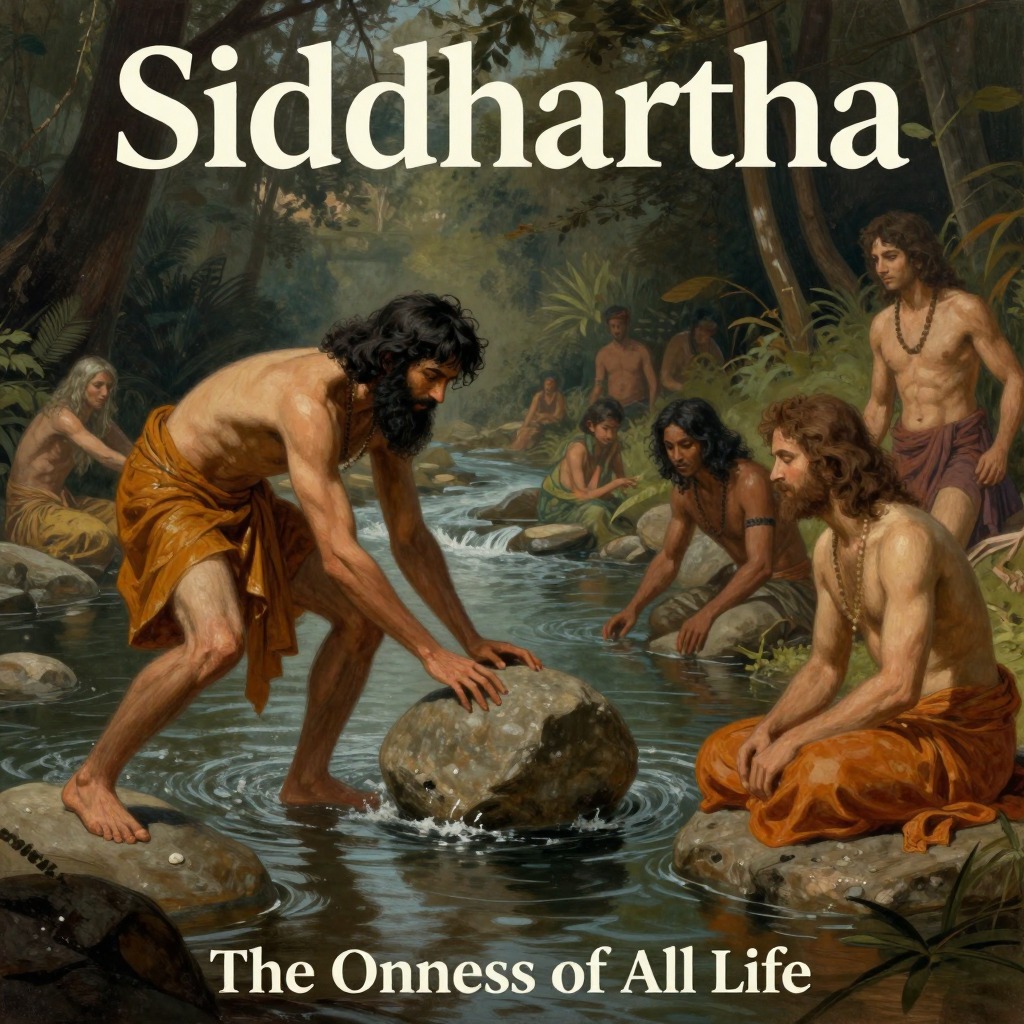
Siddhartha's most profound lessons about the nature of reality come from the river, which he learns to love and listen to under the guidance of the ferryman Vasudeva. The river teaches him that the world is not a veil of illusion but a perfect, unified whole. He learns that time is not real, that the river is everywhere at once—at its source, at its mouth, at the waterfall, at the ferry—and that there is only the present moment. This realization dissolves the gap between the world and eternity, between suffering and bliss. The river's thousand voices—of joy, suffering, laughter, and sadness—all belong together, and when heard as one, they form the single word "Om," the perfection. Siddhartha comes to see that the stone, the tree, the river, and the piece of bark are not illusions but are themselves Brahman, each one praying the Om in its own way. He learns to love these things, not for what they might become, but for what they already are.
The Final Reconciliation: Love for the World
In his final teaching to his old friend Govinda, Siddhartha articulates his mature understanding of the veil of Maya. He explains that the world is not imperfect or on a slow path toward perfection; it is perfect in every moment. All sin already carries divine forgiveness; all small children already have the old person in themselves; all dying people have eternal life. He no longer cares whether things are illusions or not, for if they are, then he himself is also an illusion, and they are like him. This makes them dear and worthy of veneration. His ultimate insight is that the most important thing is to be able to love the world, not to despise it, not to hate it, but to look upon it and all beings with love, admiration, and great respect. The veil of Maya is thus not torn away but is seen through, revealing that the world of appearances and the world of the eternal are one and the same.