The River Is Everywhere at Once
SiddharthaThe expression "The River Is Everywhere at Once" crystallizes the deepest philosophical insight Siddhartha attains during his years as a ferryman. It is not a doctrine he receives from a teacher but a truth he discovers by listening to the river with a quiet, open heart. The phrase names the realization that the river—and, by analogy, all of reality—is not bound by linear time but exists in a state of simultaneous, eternal presence.
Origin and Discovery
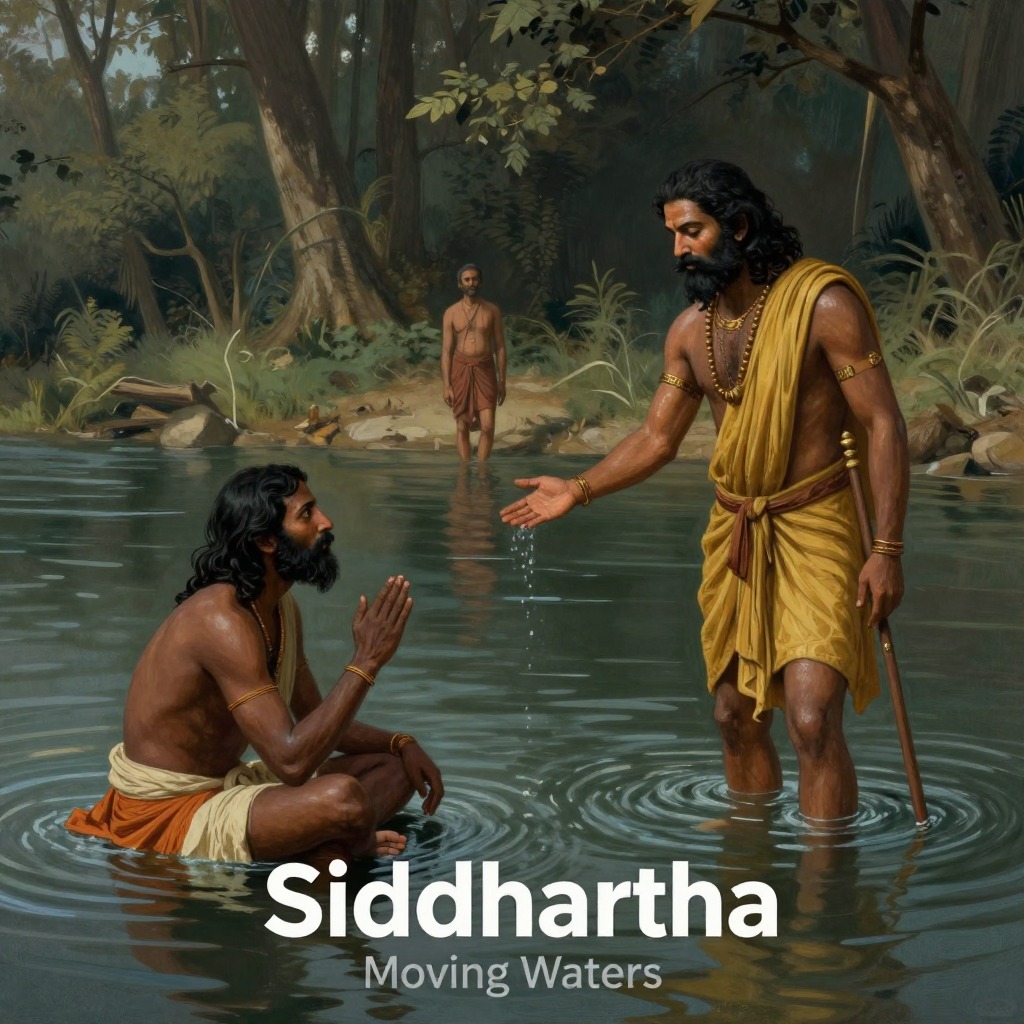
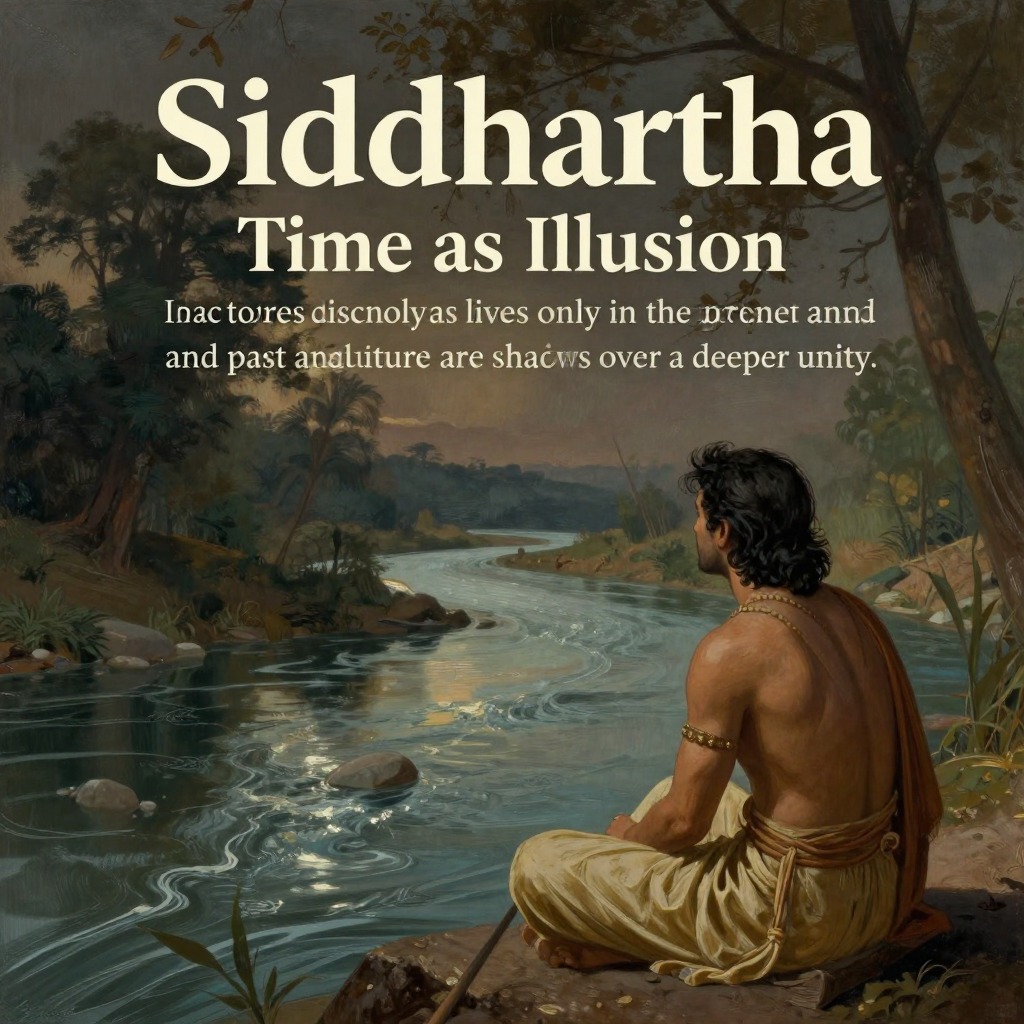
Siddhartha first encounters the idea of the river's timelessness during a conversation with Vasudeva, the ferryman who becomes his guide. After years of living by the water, Siddhartha asks Vasudeva directly: "Did you too learn that secret from the river: that there is no time?" Vasudeva's face fills with a bright smile as he confirms the insight, explaining that the river "is everywhere at once, at the source and at the mouth, at the waterfall, at the ferry, at the rapids, in the sea, in the mountains, everywhere at once, and that there is only the present time for it, not the shadow of the past, not the shadow of the future." This moment marks a turning point: Siddhartha has not merely heard a concept but has felt its truth resonate within him. He responds with ecstasy, realizing that his own life is also a river, and that "the boy Siddhartha was only separated from the man Siddhartha and from the old man Siddhartha by a shadow, not by something real." All suffering, he understands, is rooted in time—and once time is overcome, everything hostile in the world dissolves.
The River as Teacher
Long before this explicit formulation, the river had been teaching Siddhartha through its very nature. When he first crossed it as a young Samana, the ferryman told him: "Much can be learned from a river." Years later, after abandoning his life as a rich merchant and nearly drowning himself in despair, Siddhartha returns to the same river and feels a deep love for it. He decides to stay, thinking: "By this river I want to stay... it is the same which I have crossed a long time ago on my way to the childlike people." The river becomes his primary teacher. He learns from it "to listen, to pay close attention with a quiet heart, with a waiting, opened soul, without passion, without a wish, without judgement, without an opinion." Vasudeva confirms that the river has taught him everything: "The river has taught me to listen, from it you will learn it as well. It knows everything, the river, everything can be learned from it." The river's voice contains all voices—of kings, warriors, bulls, night birds, women giving birth, sighing men—and when Siddhartha learns to hear them all at once, they merge into the single word Om, the sound of perfection.
The River's Laugh and the Repetition of Fate
The river also possesses a distinct, almost mocking agency. When Siddhartha, still burning with the wound of his son's departure, considers returning to the city to find the boy, the river laughs at him. "The river laughed, it laughed brightly and clearly at the old ferryman." In that laughter, Siddhartha sees his own face reflected and recognizes his father's face—the Brahman he had left years ago. He realizes that his suffering for his son is exactly the same pain his father felt for him, and that "everything came back, which had not been suffered and solved up to its end." The river's laugh is not cruel but revelatory: it shows Siddhartha the cyclical nature of attachment and the futility of trying to control another's destiny. Vasudeva had already told him that the river laughs at their foolishness, saying "water wants to join water, youth wants to join youth." The river's laughter becomes a teaching tool, forcing Siddhartha to see his own story as part of a larger, repeating pattern.
The Stone and the Oneness of All Things
The insight that the river is everywhere at once extends to all objects. Siddhartha picks up a stone and explains to Govinda that it is not merely a stone that might one day become something else; it is already everything—animal, god, Buddha—in its present form. "It is this very fact, that it is a stone, that it appears to me now and today as a stone, this is why I love it." This understanding mirrors the river's simultaneity: just as the river is at the source and the mouth at once, the stone contains all its potential transformations in the present moment. Siddhartha has learned to see the eternal in the particular, the infinite in the finite. Vasudeva, who had spent years simply believing in the river, had already grasped this: he knew that "every wind, every cloud, every bird, every beetle was just as divine and knows just as much and can teach just as much as the worshipped river."
Significance and Final Wisdom
The expression "The River Is Everywhere at Once" is the key to Siddhartha's final state of peace. It represents the overcoming of time, the acceptance of all that is, and the recognition that every moment is perfect. When Siddhartha finally hears the river's thousand voices as a single word—Om—his wound blossoms, his suffering shines, and his self flows into oneness. He stops fighting his fate and becomes "full of sympathy for the pain of others, full of sympathy for the pleasure of others, devoted to the flow, belonging to the oneness." The river's timelessness is not an abstract concept but a lived reality: Siddhartha no longer sees his life as a sequence of separate events but as a single, eternal present. This wisdom cannot be taught in words—as he tells Govinda, "wisdom cannot be passed on"—but it can be found by anyone who learns to listen, as he did, to the river that is everywhere at once.