Brahman
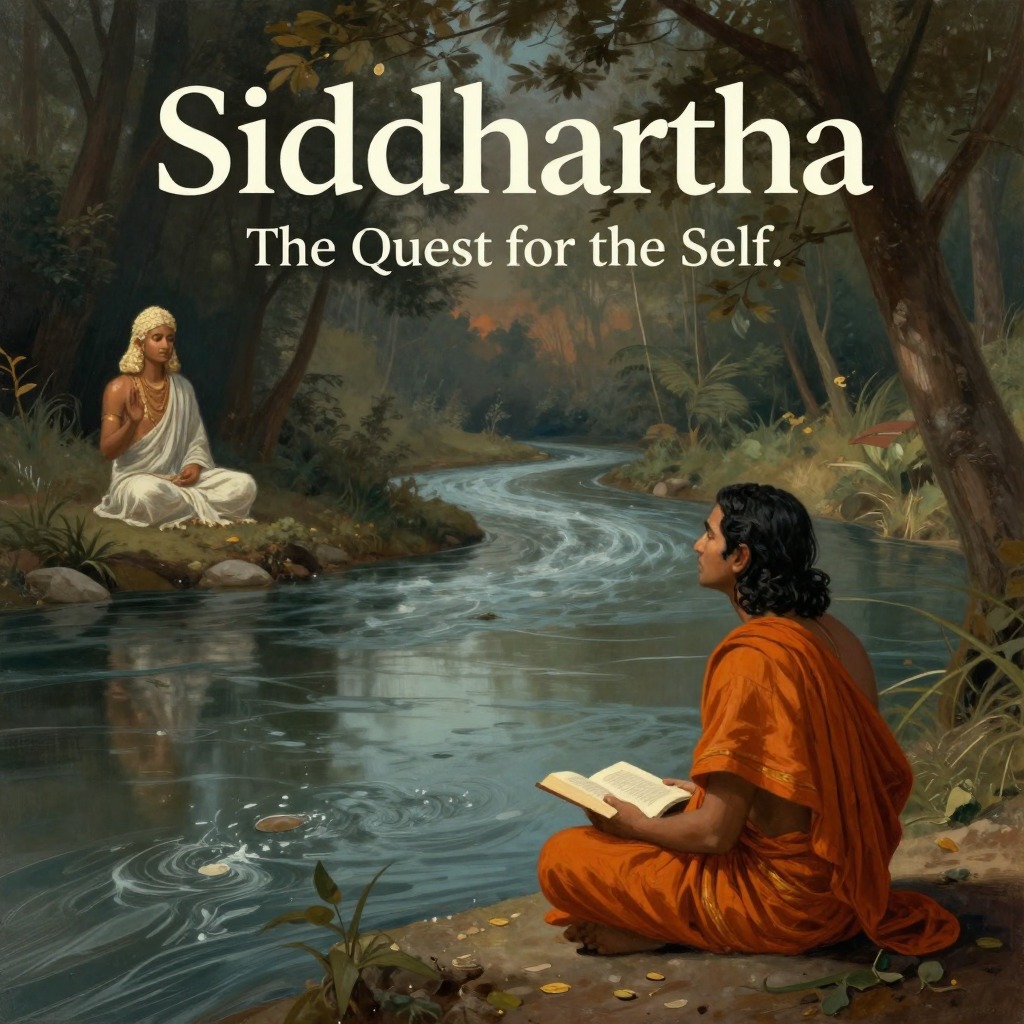
SiddharthaBrahman, the ultimate, singular, and eternal reality of the universe, is the central metaphysical concept that drives Siddhartha's quest from his earliest days. In the shade of the fig tree and the mango grove, the young Brahman's son already knew how to feel Atman in the depths of his being, indestructible and one with the universe. Yet this knowledge, inherited from his father and the wise Brahmans, soon became a source of restless thirst rather than satisfaction. Siddhartha began to suspect that the ablutions, the sacrifices, and the teachings of the holy books, for all their wisdom, could not reveal the one thing that mattered: where the Atman, the innermost self, actually resided. He questioned whether the gods themselves were not mere creations, subject to time, and whether the true object of worship was not the singular Atman, which everyone possessed within. The verses of the Upanishads spoke of this innermost part, promising that the soul was the whole world, but Siddhartha saw that even his venerable father, the pure scholar, was still a searching, thirsty man, daily striving for a cleansing he had not yet attained. The pristine source, Siddhartha concluded, had to be found in one's own self and possessed; everything else was a detour.
The Arrow of the Soul and the Goal of Emptiness
Siddhartha's early understanding of Brahman was one of a target to be hit with the arrow of the soul. Reciting the verse that Om is the bow, the soul the arrow, and Brahman the arrow's target, he would sit in meditation, his eyes rigidly focused on a distant goal, his soul sent after the Brahman as an arrow. This conception of Brahman as a distant, attainable object drove him to join the Samanas, where his single goal became to empty himself of all desire and selfhood, to become dead to himself, so that the ultimate part of his being, the innermost self that is no longer his self, might awake. He sought to kill his senses and memory, slipping out of his self into thousands of forms—animal, carrion, stone, water—only to awaken each time to find his old self again, still trapped in the cycle. The goal of reaching Brahman through self-denial proved elusive, and Siddhartha came to see that the Samanas' path, like the drunkard's escape, was merely a temporary numbing of the self, not its true dissolution.
The Teachings of Gotama and the Gap in Unity
When Siddhartha heard the teachings of Gotama, the Buddha, he admired their perfect clarity, presenting the world as an unbroken chain of causes and effects. Yet he perceived a fatal gap: the teachings of salvation, of overcoming the world, introduced an alien element that broke the very unity they described. Siddhartha argued that this small breach made the eternal law of the world void. Gotama replied that his goal was not to explain the world but to provide salvation from suffering, and that opinions were of no consequence. Siddhartha, however, realized that the Buddha's enlightenment had come not from teachings but from his own path of thought, meditation, and realization. He concluded that nobody could obtain salvation by means of teachings, for the mystery of what the exalted one had experienced in the hour of enlightenment could not be conveyed in words. This insight led him to depart from all teachers and teachings, determined to reach his goal by himself or to die.
Awakening to the World and the Loss of Brahman
After leaving Gotama, Siddhartha experienced a profound awakening. He realized that his lifelong search for Atman and Brahman had been a flight from himself; he had been willing to dissect his self to find the core, but had lost himself in the process. Now he resolved to learn from himself, to be his own student. He saw the world as if for the first time—blue, yellow, green, river and forest—and understood that the purpose and essential properties were not somewhere behind the things but in them, in everything. The visible world was no longer a veil of Maya to be scorned but a book to be read and loved. Yet this awakening also brought a cold realization of his utter aloneness: he was no longer a Brahman, a priest, or an ascetic, and he belonged to no caste. He was nothing but Siddhartha, the awoken one, standing alone like a star in the sky.
The Worldly Life and the Death of the Bird
Siddhartha entered the world of the childlike people, learning love from Kamala and trade from Kamaswami. He became rich, wore fine clothes, and indulged in gambling and wine. But the bright voice of his inner self, which had once guided him, grew silent. He envied the childlike people their passion and their ability to love, but he could not learn this from them. Slowly, the disease of the soul that rich people have—discontent, sloth, lack of love—grabbed hold of him. He dreamed of Kamala's singing bird, which had become mute and then lay dead in its golden cage. Throwing the dead bird away, he felt as if he had thrown away all value. This dream marked the end of his worldly life. He left the city, his garden, and his house, never to return.
The River, Om, and the Oneness of All Life
By the river, Siddhartha reached the point of utter despair and contemplated suicide. But as he leaned toward the water, the holy word Om stirred in his soul, and he realized the foolishness of his wish to annihilate his body. He fell into a deep, dreamless sleep, and when he awoke, he felt renewed, as if reborn. He met the ferryman Vasudeva, who taught him to listen to the river. From the river, Siddhartha learned that time is not real, that the river is everywhere at once, and that there is only the present. He learned that the river has a thousand voices—of a king, a warrior, a bull, a bird, a woman giving birth—and that when one hears them all at once, they speak the single word Om, the perfection. Through his love for his son and the pain of losing him, Siddhartha's wound blossomed, and his suffering shone. He came to see that the world is perfect in every moment, that sin already carries divine forgiveness, and that the opposite of every truth is just as true. He learned to love the world, not to despise it, and to see the Brahman in every stone, every tree, and every river. In his final meeting with Govinda, Siddhartha's smile became the smile of the perfected ones, the smile of oneness above the flowing forms of a thousand births and deaths, and Govinda saw that this smile was precisely the same as the smile of Gotama, the Buddha.