Love Is the Most Important Thing
SiddharthaLove Is the Most Important Thing is the final, hard-won conviction that Siddhartha reaches after a lifetime of seeking, and it stands as the most direct expression of his mature philosophy. It is not a doctrine he learned from a teacher but a realization that grew from the soil of his own experience—from his years as a Brahman's son, his asceticism with the Samanas, his encounter with Gotama, his immersion in the worldly life of commerce and sensuality, and his long apprenticeship to the river under the ferryman Vasudeva. The insight that love is the most important thing emerges only after he has passed through the full cycle of seeking, despair, and rebirth, and it marks the point at which his wisdom becomes inseparable from his being.
The Rejection of Teachings and the Embrace of Things
Siddhartha's path to this insight began with a deep distrust of teachings. As a young man, he had already concluded that wisdom cannot be passed on—that knowledge can be conveyed, but not wisdom, which must be found, lived, and carried by each person for themselves. This suspicion drove him away from the Samanas, from Gotama, and eventually from all teachers. What he came to value instead were "things"—the stone, the tree, the river—objects that could be loved because they were real, tangible, and present. "I can love a stone, Govinda, and also a tree or a piece of bark," he tells his old friend. "These are things, and things can be loved. But I cannot love words." This preference for the concrete over the abstract, for the thing over the word, is the foundation on which his final teaching rests. The river itself had taught him this: Vasudeva, the ferryman, had simply believed in the river for many years, and from that belief he had learned everything he needed to know, without teachers, without books.
The Journey Through Suffering and the Death of the Self
Before Siddhartha could arrive at love, he had to pass through the opposite: disgust, despair, and the wish for self-annihilation. As a Samana, his goal had been to become empty—empty of thirst, empty of wishing, empty of dreams, empty of joy and sorrow—to kill the self so that the ultimate part of him might awake. He had learned to escape the self through pain, through meditation, through holding his breath, but he later recognized that these were only temporary numbing, no different from the drunkard's escape into rice-wine. The same escape, the same short numbing, he realized, was what the driver of an ox-cart finds in the inn. This insight—that asceticism and intoxication were merely different forms of the same flight—was the first crack in his spiritual arrogance. Later, in the world of Kamaswami and Kamala, he lost himself to lust, greed, and gambling, until he was so disgusted with himself that he stood by the river ready to drown. It was only in that moment of utter hopelessness, when the sound of Om rose unbidden from his unconscious, that the old self began to die. He had to become a fool, he later understood, to find Atman in himself again. He had to sin, to be able to live again. The path had been necessary: he had to pass through so much stupidity, so many vices, so many errors, so much disgust and disappointment and woe, just to become a child again and to be able to start over.
The River's Teaching: Oneness and the Acceptance of All Things
Living by the river with Vasudeva, Siddhartha learned to listen. The river taught him that time is not real—that the boy Siddhartha, the man Siddhartha, and the old man Siddhartha are separated only by a shadow, not by something real. It taught him that the river is everywhere at once, at the source and at the mouth, and that there is only the present. From this understanding of timelessness came a deeper acceptance: the world is not imperfect, nor on a slow path toward perfection; it is perfect in every moment. All sin already carries divine forgiveness within itself; all small children already have the old person in themselves; all infants already have death; all dying people have eternal life. This vision of simultaneous existence—where the robber and the dice-gambler already contain the Buddha, and the Brahman already contains the robber—dissolves the very categories of good and evil, suffering and salvation, that had structured his earlier search. The world, he now saw, is never one-sided. A person or an act is never entirely Sansara or entirely Nirvana, never entirely holy or entirely sinful. This is why he can say that the opposite of every truth is just as true: any truth expressed in words is necessarily one-sided, lacking completeness, roundness, oneness.
The Wound of Love and the Transformation of Suffering
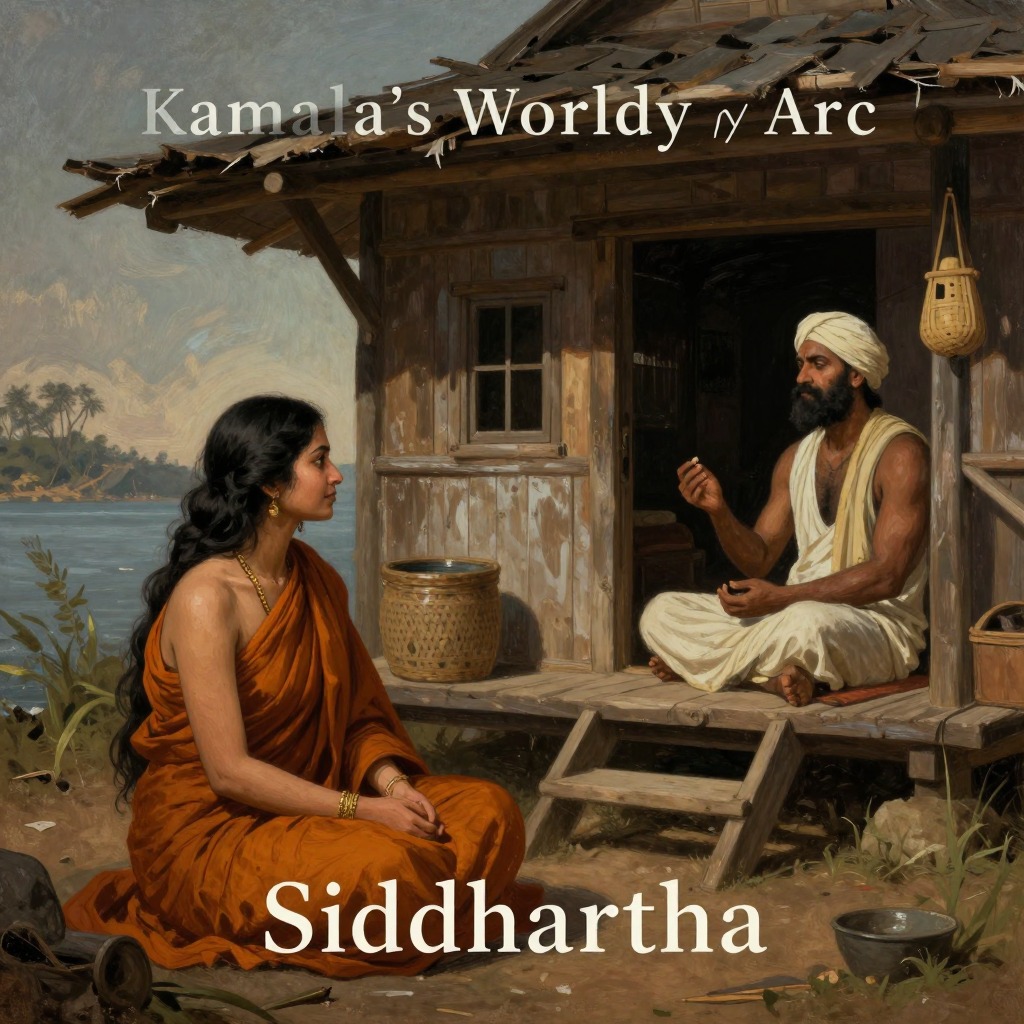
The final test of Siddhartha's wisdom came not through meditation but through love for his son. When Kamala died and the boy came to live with him, Siddhartha experienced a love unlike anything he had known before—a blind, suffering, possessive love that made him, for the first time, completely a childlike person. He who had once compared himself to a star and the childlike people to falling leaves now found himself lost in love, committing foolish acts, suffering miserably, and yet feeling renewed and enriched. The wound of this love burned for a long time. He envied fathers who had their children, he chased after his son when the boy ran away, and he stood by the gate of Kamala's garden, unable to let go. It was the river that finally taught him to release his son, showing him his own face reflected in the water and reminding him of his own father, whom he had left long ago and never seen again. The river laughed at him, and he understood: everything comes back, the same pain is suffered over and over again, until it is suffered through to the end. The wound did not disappear; it blossomed. His suffering began to shine. In the hour when he finally stopped fighting his fate, when he heard the thousand voices of the river as a single word—Om—his self flowed into the oneness, and his wound became a flower.
The Final Teaching: Love as the Highest Wisdom
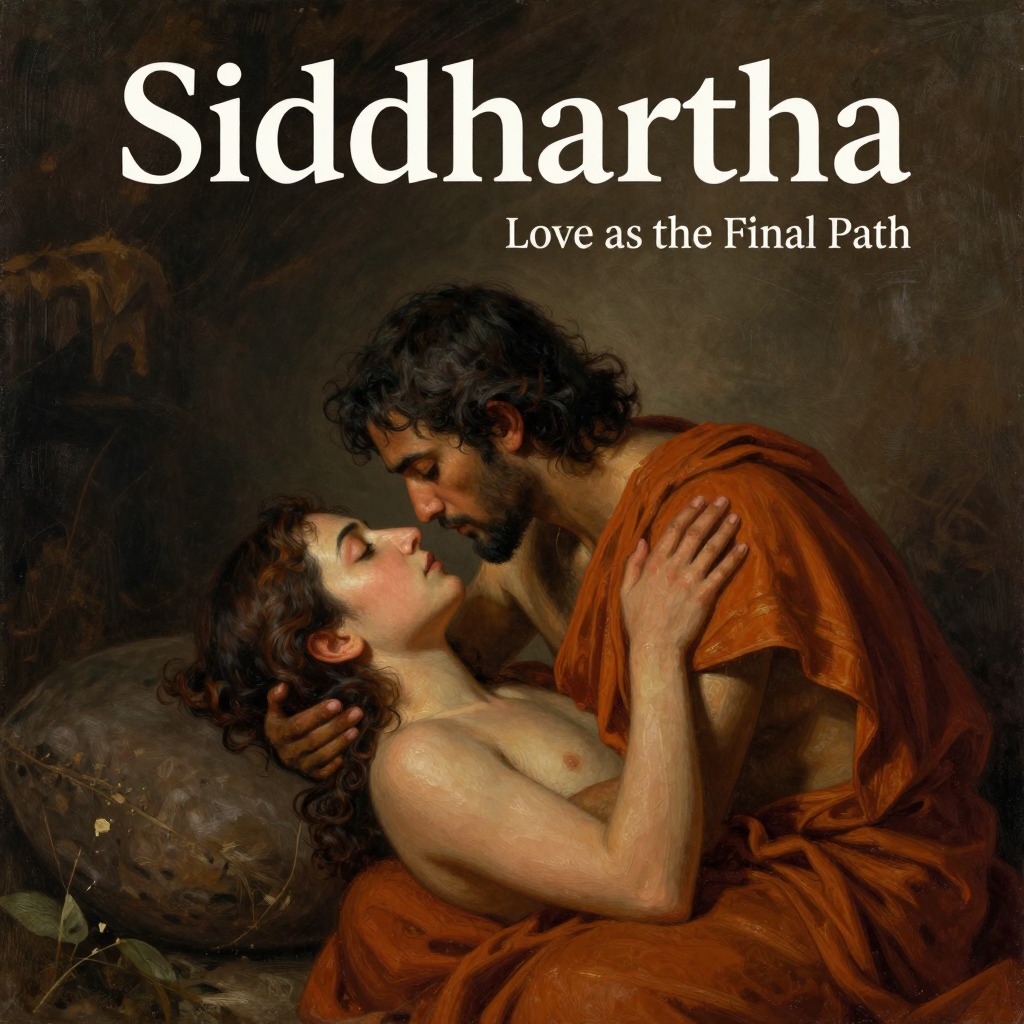
In his last conversation with Govinda, Siddhartha gives the fullest expression of his mature philosophy. He tells his old friend that wisdom cannot be passed on, that the opposite of every truth is just as true, and that the world is perfect in every moment. But the core of his teaching is this: "Love, oh Govinda, seems to me to be the most important thing of all. To thoroughly understand the world, to explain it, to despise it, may be the thing great thinkers do. But I'm only interested in being able to love the world, not to despise it, not to hate it and me, to be able to look upon it and me and all beings with love and admiration and great respect." This is not the love that Gotama taught—the Buddha commanded benevolence, clemency, sympathy, and tolerance, but not love, and he forbade his followers to tie their hearts to earthly things. Siddhartha acknowledges the contradiction but dismisses it as a deception of words. He knows that he is in agreement with Gotama, for how could the Buddha not have known love, he who spent a long, laborious life only to help and teach others? Siddhartha prefers the thing over the word, the act over the opinion, the life over the speech. And in the end, when Govinda kisses his forehead, he sees not Siddhartha's face but a river of faces—fish, children, murderers, gods, all flowing into one another, all covered by a thin, transparent mask that is Siddhartha's smile, the same smile as Gotama's, the smile of the perfected ones. In that vision, Govinda understands what Siddhartha has become: a holy man, not because of his teachings, but because of his gaze, his hand, his skin, his hair—every part of him shining with purity, calmness, cheerfulness, mildness, and holiness.