The River's Laugh
SiddharthaThe River's Laugh is a crucial symbolic expression in Hermann Hesse's Siddhartha, marking the moment when the river's voice becomes an unmistakable, mocking, and revelatory force. It is the sound that breaks through Siddhartha's lingering attachments and forces him to confront the cyclical, repetitive nature of his own suffering, ultimately guiding him toward the final realization of oneness and the end of his personal struggle.
The River's Voice and Its Mocking Laughter
The river, which Siddhartha first encountered as a young Samana and later returned to in despair, is not a silent entity. From the beginning, it is a source of teaching. The ferryman Vasudeva tells Siddhartha, "Much can be learned from a river," and that "everything is coming back." Siddhartha himself learns to listen to the river, to pay close attention with a quiet heart, without passion or judgment. The river has many voices—of a king, a warrior, a bull, a bird of the night, a woman giving birth, a sighing man, and a thousand others. When heard all at once, these voices coalesce into the single sacred word "Om," the sound of perfection. However, the river also possesses a distinct, mocking laughter. This laugh is not a gentle murmur but a clear, bright, and unmistakable sound that directly challenges Siddhartha's intentions.
The Laugh That Halts the Search for the Son
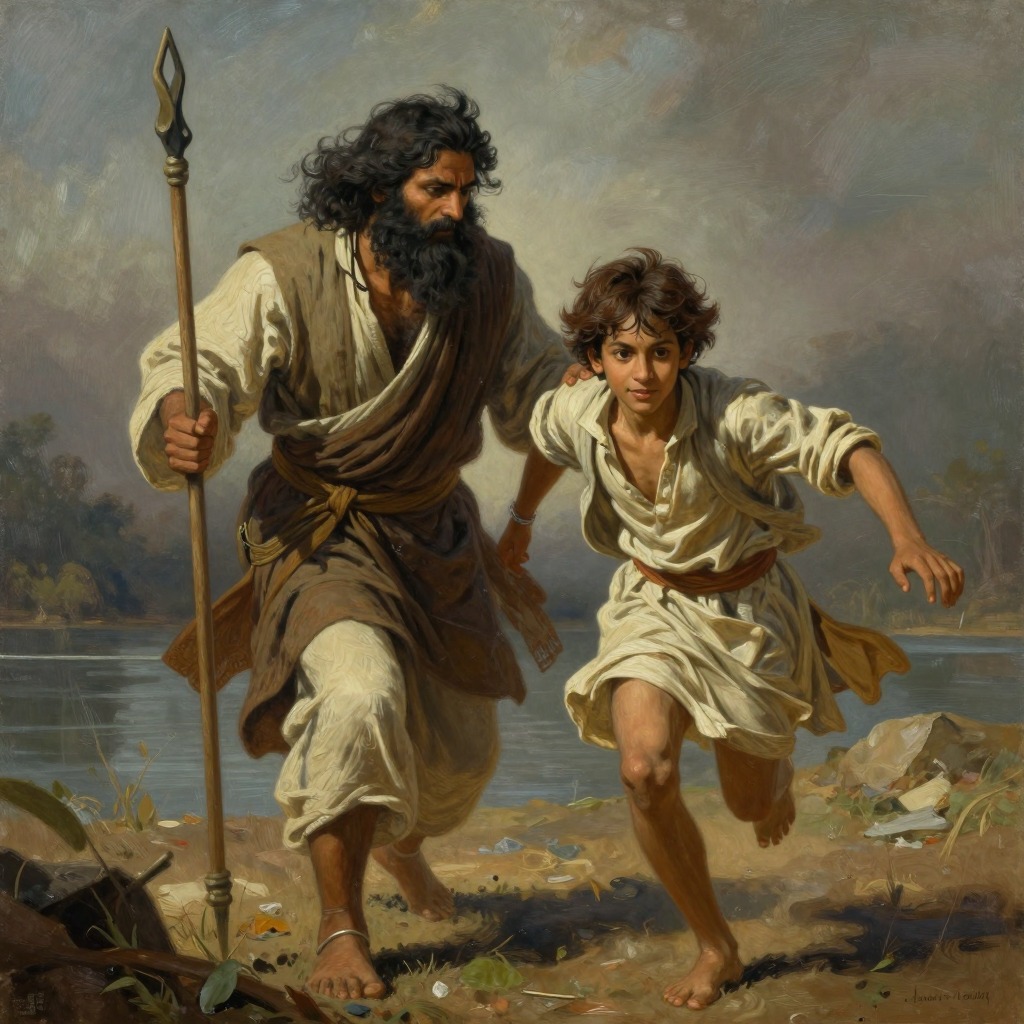
The most significant occurrence of the river's laugh takes place after Siddhartha's son has run away. Siddhartha, consumed by a burning wound of love and loss, is driven by a yearning to go to the city and find the boy. He gets into the boat to ferry across the river, intending to pursue his son. But the river, flowing softly and quietly in the dry season, sounds strange: it laughs. It laughs clearly and brightly at the old ferryman. Siddhartha stops, bends over the water to hear better, and sees his own face reflected. In that reflection, he recognizes something familiar: the face of his own father, the Brahman. He remembers how he, as a young man, had forced his father to let him go to the penitents, had left, and never returned. He realizes that his father must have suffered the same pain for him that he now suffers for his son. The river's laugh reveals this as a "comedy, a strange and stupid matter, this repetition, this running around in a fateful circle." The laugh forces Siddhartha to see that everything comes back, that the same pain is suffered over and over again until it is fully understood and released.
The Laugh as a Catalyst for Final Realization
The river's laugh does not merely mock; it is a catalyst for Siddhartha's final breakthrough. After hearing the laugh, Siddhartha returns to the hut, at odds with himself, tending toward despair but also toward laughing along at himself and the entire world. He confesses everything to Vasudeva, including how the river laughed at him. As he speaks, he feels his pain and fears flow into Vasudeva, who listens like the river itself. Vasudeva then leads him back to the riverbank to listen more deeply. This time, Siddhartha hears not just the laugh but the full symphony of the river's thousand voices—the lamentation of yearning, the laughter of the knowledgeable one, the scream of rage, the moaning of the dying. He no longer distinguishes between them; they all belong together, intertwined and connected. When he listens without tying his soul to any particular voice, the great song of a thousand voices consists of a single word: Om, the perfection. In this hour, Siddhartha stops fighting his fate and stops suffering. His wound blossoms, his suffering shines, and his self flows into the oneness. The river's laugh, therefore, is not a final judgment but a necessary, ironic commentary that breaks the spell of personal attachment and opens the door to a wisdom that transcends words and individual sorrow.
The Laugh as a Reflection of the River's Teaching
The river's laugh is a direct expression of the river's core teaching: that time is not real, that everything is simultaneous, and that the world is perfect in every moment. The laugh mocks the very idea of a linear quest or a goal to be reached. It is the sound of the world's own ironic self-awareness, a cosmic joke that Siddhartha must learn to appreciate. This laugh is also a manifestation of the river's agency as a teacher. It is not a passive symbol but an active force that intervenes in Siddhartha's life, using mockery as a pedagogical tool. The laugh is the river's way of saying that the search itself, driven by desire and a goal, is the obstacle. By laughing, the river reveals the absurdity of Siddhartha's clinging and points him toward the only true path: to let go, to listen, and to become one with the flow of existence.