Brigadier Aikens
WatchmenBrigadier Aikens is the commander of the Imperial Marines’ Mobile Force on Oran VI, a veteran officer whose confidence in his troops and concern for his fifty-five-year service record place him in direct conflict with Emil Vorgens. Surrounded by the Komani after a campaign intended merely to demonstrate Imperial strength, Aikens resists withdrawal even when the tactical defeat threatens to become the spark for a general uprising and a new galactic war. His decisive significance lies in that conflict: he embodies military prestige and institutional pride at the moment when responsible command requires political judgment, restraint, and willingness to surrender personal authority.
Identity and Command
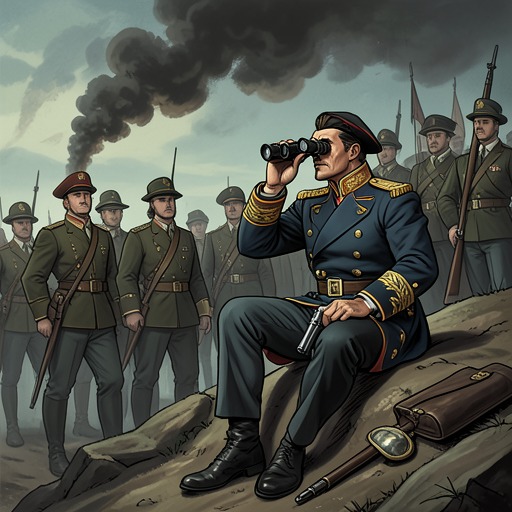
Aikens is presented as a conspicuous figure of Imperial military authority. He is a typical Terran, physically much larger than Vorgens, and his balding head and deeply creased face are the only visible signs of age. He has deliberately cultivated an image among his soldiers of a flamboyant, daring leader, and even during the crisis he wears the Imperial Marines’ green, red, and gold semi-dress uniform rather than the standard black-and-silver uniform of the Star Watch. His appearance therefore functions as part of his command persona: rank, ceremony, and performance reinforce one another.
The contrast with Vorgens is immediate and deliberate. Vorgens is small and wiry, with golden-brown skin and copper-colored hair marking him as non-Terran, while Aikens towers over him and outweighs him by half again. Yet the office encounter reverses the expected hierarchy of physical presence. Aikens sits behind the desk and initially controls the room, but Vorgens enters, salutes, sits at Aikens’s indication, and then gradually assumes the ethical and strategic burden of deciding what must happen to the Force.
The Oran VI Crisis
Aikens commands the Mobile Force dispatched to Oran VI to reinforce the Imperial garrison and restore order among the native population. When Komani raiders land, the Force receives orders to induce them to return home through a “demonstration of force.” Instead, the campaign lasts nearly three weeks. The Komani repeatedly evade attempts to pin them down, lead the Imperial troops into a valley, and surround them there. Aikens is forced to confront reports from every remaining patrol confirming that the Force is totally cut off.
His first response is disbelief. When told that the Force is surrounded, he snaps that the situation is impossible and studies the stereomap with visible anger. The Komani, however, are well armed with modern weapons, have shown masterful tactics, and appear eager to fight a full-scale battle. Aikens’s own account of the campaign admits that they have led him around by the nose for three weeks, but the admission does not yet produce strategic flexibility. He continues to interpret the crisis through the language of a military contest that his troops must win.
Vorgens sees a wider danger. The defeat of the Mobile Force could serve as the signal for a general uprising among the Komani clans, making the immediate battle only one part of a much larger political catastrophe. He argues that Aikens must withdraw and decline combat because a defeat at that time and place could trigger a new galactic war. Aikens rejects this reasoning as a challenge to his military competence, asking whether Vorgens is lecturing him on military concepts and insisting that his men can defeat any horde of undisciplined barbarians regardless of their numbers. His confidence is not simply tactical optimism; it is bound to the honor of his command and to the identity he has built over decades of service.
Conflict with Emil Vorgens
The confrontation between Aikens and Vorgens turns command into a moral dispute. Vorgens was sent to Shinar to arrange a truce, but he concludes that his immediate duty is to prevent the Komani from destroying the Mobile Force. He tells Aikens that avoiding the larger war must be achieved at all costs. Aikens hears this not as an appeal to responsibility but as an attempt to ruin him and erase a record of fifty-five years of service through what he calls Vorgens’s half-formed dreams of glory.
Vorgens answers by recounting how the war has already displaced him from his intended mission. He has been shunted from place to place by Aikens, the Komani, and some Shinarians; forced into killing people with whom he was meant to negotiate; reduced to a messenger; taken prisoner; and sentenced to death. He was rescued from a firing squad by an old man and a girl who recognized in him the possibility of bringing peace to Shinar. Against Aikens’s fear of professional ruin, Vorgens places a responsibility extending beyond any officer’s record: the lives of the Mobile Force and every man, woman, and child on Shinar.
Vorgens ultimately asks whether Aikens is willing to resume command of the Mobile Force. The question carries both practical and symbolic force. Vorgens has assumed command because he represents Star Watch Headquarters and because Aikens refused to follow the policies expressed in his orders. Yet he does not treat command as a prize or permanently deny Aikens’s authority. He offers him the opportunity to return to the post, making obedience to the broader policy rather than personal humiliation the condition of command.
Pride, Authority, and Consequence
Aikens’s central weakness is not lack of experience but the narrowing effect of experience converted into prestige. He knows how to think in terms of troops, weapons, numbers, and battlefield morale; he is less willing to accept that the apparent battlefield choice is governed by the political consequences of victory or defeat. The very qualities that helped sustain his authority—confidence, aggressiveness, and the cultivated image of a daring leader—become liabilities when the Komani conflict threatens to expand into a general war.
The narrative places Aikens beside technologies and institutions that complicate older ideas of command. The Star Watch’s authority, communications systems, and strategic assessment compete with the Imperial Marines’ conventional hierarchy, just as the dueling machine later complicates responsibility by isolating participants, recording conduct, and transforming aggression into controlled projection. Aikens’s crisis belongs to the same larger pattern: power is no longer measured only by who occupies the command seat, but by who can understand the network of political, military, and technological consequences attached to an order.
Aikens therefore serves as a threshold figure in Vorgens’s development. His refusal forces Vorgens to cross from negotiation and observation into command. The younger Watchman must act against a superior officer not from ambition but because formal authority has become detached from its purpose. Aikens’s threatened reputation gives the conflict its human cost, while the lives endangered by his decision give it its scale. The result is an inversion of the conventional military lesson: courage is not necessarily the willingness to fight, and command is not necessarily the right to insist on battle.
Narrative Role and Evaluation
As a character, Aikens dramatizes the collision between personal honor and public responsibility. His physical size, ornate uniform, and flamboyant reputation make him look like the natural heroic commander, but the crisis exposes the limits of that image. He is not reduced to a simple coward or incompetent; he is a seasoned officer whose pride makes a strategically necessary retreat appear to him as the destruction of his life’s meaning.
His importance lies in the pressure he places on the story’s political and ethical argument. The Komani are not merely an enemy to be defeated, and the Mobile Force is not merely a military unit seeking victory. Aikens’s decision can determine whether an isolated battle becomes the beginning of a general uprising and a new galactic war. By opposing Vorgens’s attempt to prevent that outcome, he becomes the embodiment of a system that confuses force with order. His confrontation with Vorgens consequently marks the point at which military command must answer to the survival of an entire society rather than to the preservation of one commander’s record.