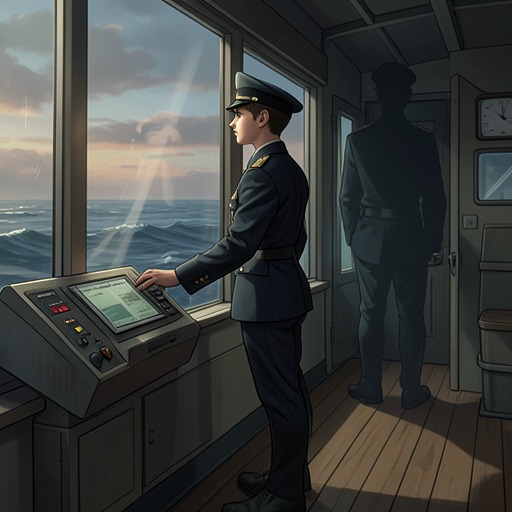
Sergeant McIntyre
WatchmenSergeant McIntyre is a seasoned soldier of the Mobile Force and one of Emil Vorgens’s most reliable companions on Shinar. His importance lies less in formal authority than in the concrete competence he brings to a collapsing campaign: he crosses hostile terrain, improvises weapons and medical repairs, participates in escape plans, and continues serving while wounded. His arc gives the war a physical scale. Strategy may be argued over maps and wardroom tables, but McIntyre experiences it through broken bones, scarce equipment, exhaustion, and the deaths of the men beside him.
Identity and Introduction
Sergeant McIntyre is introduced while making a difficult approach across the Valley in the heat of the afternoon. He scrambles over broken rocks and half tumbles down the steep slope beneath the blazing yellow sun of Oran before reaching the first outpost of the Mobile Force. The outpost consists of a scout car with its turret hatches open and several men taking shelter in the narrow shade it provides. His entrance therefore establishes him through movement and endurance rather than ceremony: he is a field soldier arriving from demanding terrain to resume the work of a force already operating under pressure.
His rank places him below the senior commanders, but his conduct repeatedly shows that he is trusted with responsibilities requiring judgment. He is close enough to Emil Vorgens to discuss escape plans and operational chances directly, and he serves as a practical counterweight to the larger claims made by Brigadier Aikens and the political calculations surrounding Shinar. The evidence presents him as a man whose authority is earned through usefulness, steadiness, and experience in danger.
Service Under Pressure
McIntyre’s resilience becomes especially clear after an attack leaves him inert and badly injured. While helping him, Vorgens finds a glass splinter embedded in his own palm, pulls it out, treats the wound, and then tells the sergeant not to move because his arm is broken. McIntyre is not removed from the campaign by that injury. Later, he is still working in front of a cruiser, carefully adjusting the firing sight of a one-man missile launcher with his uninjured hand because the wounded arm remains in a cast. The scene turns injury into a test of continuity: the cast limits him, but it does not make him abandon his post.
His practical intelligence is equally important. During captivity, McIntyre explains that four armed guards oppose three prisoners and reveals that he managed to conceal a stinger under his belt before being taken. The weapon is not lethal, but it can disable a guard for several hours, making it suitable for an escape attempt. He also accepts Vorgens’s concealed improvement to his cast, which has been strengthened until it can serve as a hard striking weapon. McIntyre’s apparent weakness thus becomes an advantage through cooperation and improvisation. The exchange shows a reciprocal trust between the two men: McIntyre has smuggled in the means to begin the escape, while Vorgens has transformed his injury into another means of resistance.
Alliance with Vorgens and the Shinarians
McIntyre’s role is set against the political and strategic crisis created by the Shinarian Rebellion and the Komani intervention. Clanthas’s demonstrations begin as organized resistance to Terran control, but they develop into riots, shootings, civilian deaths, the murder of the Terran governor, and the arrival of Imperial Marines and Komani warriors. Merdon later describes resistance as a decision to answer imperial force with force, while Vorgens refuses to abandon the Empire because he is a sworn officer of the Star Watch. McIntyre belongs to the military world shaped by that refusal, yet his conduct is not reduced to abstract loyalty. His solidarity is personal and operational, expressed through protecting comrades and finding ways for them to survive.
Vorgens also explains that the Terrans are rebuilding their Empire because they fear the Others, the ancient enemy that once nearly exterminated their distant ancestors. That explanation places Shinar inside a vast strategic project, but McIntyre’s actions keep the consequences immediate. The larger rationale cannot prevent a broken arm, a dangerous escape, or the loss of a sergeant in combat. His presence exposes the gap between imperial purpose and the bodily price paid by ordinary soldiers.
When Vorgens argues that the Mobile Force cannot defeat Okatar Kang without Shinarian assistance, he urges Clanthas to fight alongside the Terrans rather than allow the Komani to seize the planet as a base for a wider galactic war. The choice is political as well as military: the Shinarians must decide whether cooperation might lead toward self-government, even though Vorgens cannot guarantee that result. Clanthas eventually agrees to help. The alliance is then made concrete when Vorgens offers rapid transport—he can bring a squadron of vans and troop carriers within an hour—and Merdon agrees to place his people under the Watchman’s orders. McIntyre stands within this newly formed coalition as one of its dependable field agents, helping translate political agreement into military action.
The War of Attrition and Final Mission
The combined forces do not win through one decisive engagement. The Komani continue to outnumber the Imperial troops, while the Terrans repeatedly seek local superiority at particular moments and places. The conflict becomes a war of attrition in which fatigue, hunger, and mechanical breakdown matter as much as weapons. In the officers’ wardroom, Vorgens admits that the campaign is failing miserably, while Aikens insists that the force is holding its own. McIntyre is present among the officers, embodying the exhausted practical reality beneath the disagreement between optimistic military confidence and strategic alarm.
After more than six weeks of continued fighting without a decisive result, Merdon privately asks McIntyre about the possibility of reaching Okatar. The question recognizes McIntyre as more than a subordinate carrying out routine orders; it treats him as someone capable of judging whether a dangerous operation can succeed. His bulk contrasts with Merdon’s slim frame as they move through the passageway, but their conversation joins the Shinarian political leader to the soldier whose experience may determine the next step.
That step ends in catastrophe. Geri Dulaq returns to the wardroom exhausted, mud-caked, hollow-eyed, and grimy, announcing that Okatar has been killed. He immediately adds the price: the troops got Okatar, but the enemy got Sergeant McIntyre. Four men are dead and one is wounded, while Geri Dulaq and Trooper Martinis escaped untouched. McIntyre’s death is therefore inseparable from the operation’s success. The campaign gains a major victory by removing Okatar, yet the victory arrives in the form of a report delivered by a grieving survivor rather than a triumphant return.
Narrative Role and Significance
McIntyre functions as the campaign’s material conscience. He does not resolve the ideological dispute between Terran imperial order, Shinarian freedom, and Komani expansion, but he reveals what each position demands from the people sent to enforce it. His broken arm, one-handed work on a missile launcher, hidden stinger, reinforced cast, and final death form a continuous pattern of service under diminishing resources. Every improvement in the political or tactical position is shadowed by physical depletion.
His relationship with Vorgens also gives the military narrative its emotional structure. Vorgens supplies strategic perception and political flexibility; McIntyre supplies disciplined action and embodied courage. Together they represent a partnership in which survival depends on trust rather than rank alone. McIntyre’s final sacrifice prevents the killing of Okatar from becoming a clean or uncomplicated triumph. The Komani leader is removed, but the campaign has already consumed the sergeant and other soldiers, leaving victory marked by grief, fatigue, and the continuing uncertainty of the war’s political aftermath.