Dr. Leoh
WatchmenDr. Leoh is the scientist whose invention becomes the central technological and ethical instrument of the later story. First presented as an elderly, celebrated professor, he created the dueling machine to redirect aggression into a harmless shared dream; when others turned that device into an arena for assassination, coercion, and conquest, he was forced to recognize that a machine designed to prevent violence could also redistribute violence on a far larger scale. His decisive significance lies in that contradiction: Dr. Leoh is both the inventor of the system that enables the crisis and the person who accepts responsibility for repairing it.
Identity and Scientific Background
Dr. Leoh is an exceptionally old but still active scientist. When news of Emile Dulaq’s duel reaches him, he is lecturing at Carinae University, more than two thousand light-years from Acquatainia and still within the Terran Commonwealth. An assistant professor interrupts the lecture to whisper the news, and Dr. Leoh finishes speaking before accompanying him to the university president’s office. The scene establishes a man whose public identity is still that of a professor, but whose habitual sociability and humor have been temporarily replaced by grim concentration. He is described as balding and jowly, the oldest man known at the university, with a face marked by an almost habitual smile and alert, active eyes.
His age does not mean withdrawal from the world. During the two-week starship journey from Carinae to the Acquataine Cluster, Dr. Leoh spends much of his free time with the other passengers, proving himself gregarious, witty, and an engaging conversationalist. Yet the sociable surface alternates with long solitary hours in his state room, when memories return and he considers the path that brought him to the dueling machine. The contrast between public charm and private recollection gives his scientific authority a moral underside: he is not merely traveling to inspect a device, but returning to the consequences of his own intellectual history.
Invention of the Dueling Machine
Dr. Leoh originally worked in physics and electronics. He changed fields after realizing that he had played a part in the development of technologies that had worsened humanity’s collective mental condition. That realization leaves him with two opposing responses: deep personal and professional guilt, and an equally strong determination to restore some balance to human thought. Rather than retire, he begins again as a novice in psychology, becomes a student and researcher, and eventually works as a professor of psychophysiology. The career change is therefore not a decorative detail in his biography; it is his attempt to convert remorse into a disciplined form of intervention.
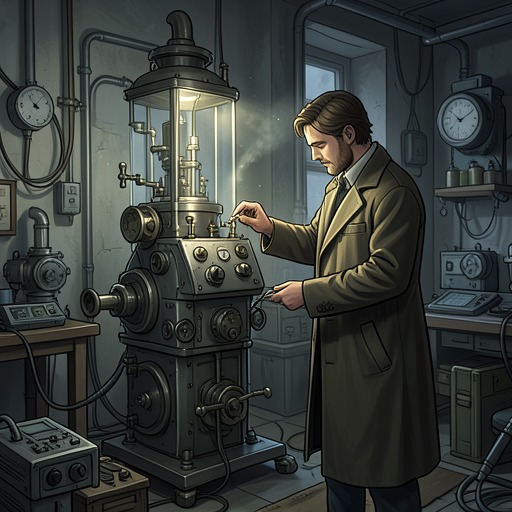
The dueling machine emerges from that effort. It combines an electroencephalograph with an autocomputer and amplifies a person’s imagination until the user can enter a fully realized private world shared with an opponent. Psychiatrists and psychotechnicians use such machines therapeutically, but Dr. Leoh imagines a broader social purpose. When two people have a dispute severe enough to invite legal action, they can enter the machine and enact their hostility without inflicting mental or physical injury. The machine is intended to replace passive legal conflict with a controlled imaginative release, allowing aggression to be expressed while preserving the bodies of the participants and those around them.
That ideal is already shadowed by the device’s material power. Dr. Leoh chooses the stat-wand as his own weapon and selects a crowded, noisy metropolis known and loved since childhood as his duel environment. The machine can make a confrontation intensely personal by combining an invented weapon with a meaningful place, even while insisting that no one is actually hurt. Its promise of harmlessness depends on strict isolation between the imagined world and the outside world; once that boundary is breached, the machine ceases to be a therapeutic substitute for violence and becomes a channel through which violence can reach real bodies and governments.
Confronting the Machine’s Misuse
Dr. Leoh’s crisis becomes explicit after Fernd Massan is removed from the dueling machine dead. While Dr. Leoh sits in a restaurant, Hector receives information from the meditechs, Major Par Odal leaves for the Kerak embassy under heavy escort, and the government of the Acquataine Cluster collapses into political paralysis. Within an hour of the duel, Chancellor Kanus’s troops land on the major planets of the Szarno Confederacy, completing its annexation. Dr. Leoh responds by condemning himself: he believes he has sat back as an old professor and played academic games while younger, more vigorous men have used the machine for their own purposes.
The recognition changes his role. He is no longer content to regard the dueling machine as a technical object whose operation can be studied from a safe distance. The political consequences of the duels force him to treat the machine as an actor within a network of scientists, technicians, governments, soldiers, and contestants. His responsibility is not limited to whether the original design was benevolent; it extends to the conditions under which the design can be appropriated. This is why his response combines engineering with direct confrontation rather than simple repudiation of the invention.
Dr. Leoh and Hector test the machine intensively. At first they play hide-and-seek, selecting environments ranging from jungles and cities to glaciers and interplanetary voids while remaining inside the booths. Once Dr. Leoh is satisfied that the machine reproduces and amplifies thought patterns faithfully, they begin light duels with blunted foils and then experiment with pistols, sonic beams, and grenades while imagining protective equipment. Hector possesses superior fencing reflexes and weapons training, and the machine does not improve either a user’s knowledge or physical ability. Nevertheless, Dr. Leoh wins most of their encounters. His advantage is not speed or marksmanship; it appears when the two men confront one another directly, suggesting that the machine projects personality as well as thought.
Their work becomes physically punishing. They remain in the booths for twelve or more hours a day, driving themselves and the regular staff toward exhaustion. Meals are gulped between duels, and the two men fall asleep in Dr. Leoh’s office while discussing their results. The method is scientific, but it is also a form of self-exposure: Dr. Leoh uses the machine to investigate how character enters technology, and the investigation demands that he risk his own emotional and psychological resources.
Repair, Safeguards, and Teleportation
Dr. Leoh’s later redesign directly addresses the catastrophe enabled by Major Par Odal. He explains that three new circuits have been added. The first psychonically isolates the duelists, making it impossible for either participant to contact the outside world while the machine is operating. The second monitors the entire duel so that, if either side requests it, the chief meditech can review the recording and determine whether the rules were broken. These changes do more than improve reliability: they establish containment, inspection, and accountability as necessary parts of the device’s operation.
The rebuilt machine also becomes the laboratory for a new physical possibility. After Hector and Dr. Leoh are together again, they begin cautiously by having Hector teleport from one booth to another. He repeats the jump twelve times on the first day while Dr. Leoh measures transit time and power consumption. The average transit takes four picoseconds, but the energy drain is approximately equal to that of a starship’s drive engines pushing a mass equal to Hector’s weight. The experiment therefore joins psychological technology to unprecedented transport power, while the precise measurements preserve Dr. Leoh’s characteristic insistence that wonder must be tested rather than merely celebrated.
The implications widen when Major Par Odal appears in the farther booth on Acquatainia after the teleportation apparatus has seemingly failed to move a pile of materials. Geri Dulaq reacts with uncontrolled hysteria, and Sir Harold Spencer, visible through a tri-di image from what appears to be a starship cabin, asks whether Major Par Odal has actually jumped from Kerak to Acquatainia. Dr. Leoh’s laboratory thus becomes the site where a device created to mediate human aggression opens onto instantaneous interplanetary movement. The same technological boundary that once separated dream violence from real violence now separates places—and may no longer hold.
Narrative Role and Thematic Significance
Dr. Leoh embodies the story’s argument that invention cannot be separated from responsibility. He begins with a humane purpose: the dueling machine should let people express hostility without harming themselves or anyone else. Yet his invention is absorbed into struggles involving duels, government collapse, annexation, and military power. The machine’s apparent neutrality is exposed as inadequate; its design determines what actions become possible, while the intentions of users determine what those possibilities become.
His response is neither denial nor surrender. Guilt leads him back into psychology, technical failure drives him into harder experiments, and political misuse forces him to impose safeguards. His characteristic movement is from abstraction toward accountability: from physics to psychophysiology, from invention to observation, from observation to participation. Even when he first regards himself as an inactive academic, the later work shows that he can no longer remain outside the consequences of his creation. Dr. Leoh’s importance lies in this ethical reversal. The inventor of a machine meant to make violence harmless must learn that safety is not a promise built into an apparatus once and for all; it is a continuing social, technical, and moral obligation.