Major Par Odal
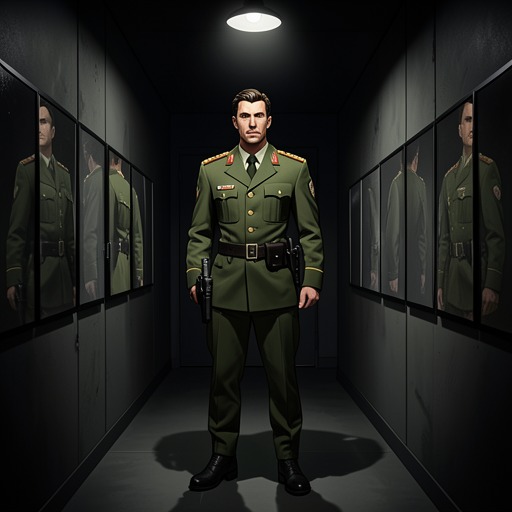
WatchmenMajor Par Odal is a tall, lean, blond Kerak officer and an expert with weapons, introduced as the “icy professional” opposing Emile Dulaq in a psychonic duel. His decisive significance lies in the contradiction he embodies: he is presented as an emotionless instrument of Chancellor Kanus, yet the technology that turns his mind into a weapon eventually exposes the history, violence, and vulnerability concealed behind that disciplined exterior.
Identity and Military Formation
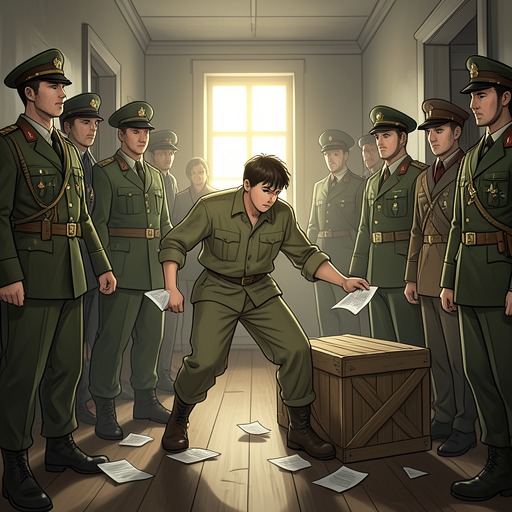
Major Par Odal is defined first by professional mastery. He is described as an expert with all weapons, physically formidable, and marked by cool precision. His military identity has been formed in the camps of the Kerak Worlds, far from the civilian metropolis of Acquatainia; unlike Emile Dulaq, who knows the city intimately, Odal has spent most of his life in military environments on Kerak, sixty light-years away. This contrast makes the first duel unequal in a subtle way: Odal possesses superior general combat training, but he enters an unfamiliar urban world and has never used a stat-wand before the duel begins.
The stat-wand is not merely equipment supplied to him by the state. Emile Dulaq chooses the stubby cylindrical weapon as his own invention and selects his crowded city as the battlefield, expecting Odal to be helpless in surroundings that Dulaq knows by memory and affection. The dueling machine normally prevents physical or mental injury, allowing antagonists to settle scores and discharge aggression within a controlled simulation, but Odal’s presence gives the contest political weight far beyond a private quarrel.
Instrument of Kerak Expansion
Chancellor Kanus explicitly assigns Odal a central role in the Kerak Worlds’ planned conquest. After Dulaq’s defeat, Kanus tells him that he will be a primary instrument in the first steps of expansion. Kanus treats the victory as proof that the Acquatainians have been deprived of their directing intelligence: without Dulaq, the coalition against Kerak supposedly has no brain. Odal is therefore valued not as an independent political actor but as a precise instrument through which Kanus intends to convert a duel into military and imperial advantage.
Odal responds by bowing stiffly and expressing hope that he can serve his Leader and his Worlds. The exchange establishes his formal loyalty and his subordination at once. Kanus’s praise, accompanied by a token presented in a small ebony box, turns Odal’s violence into an official honor. The ceremony also reveals the regime’s logic: conquest is translated into service, and the destruction of an opponent is repackaged as a gift from the state.
Odal’s role is part of a wider historical struggle over imperial legitimacy. The Terrans once defeated the Masters and established themselves as rulers over Shinar; Komani leaders now argue that the Terran Empire has grown vulnerable through the weakness and division of its subject peoples. Okatar Kang claims that the people of Shinar and the wider galaxy have learned to hate the Terrans and that a successful Komani victory could encourage other clans to join him. Against that background, Odal is not simply a duelist. He is one of the trained agents through whom Kerak seeks to exploit imperial instability and turn a local triumph into conquest.
Duels and the Logic of the Machine
The public account of Odal’s contest with Emile Dulaq states that Dulaq, Prime Minister of the Acquataine Cluster and leader of the coalition against Chancellor Kanus, failed in the first part of the psychonic duel. The antagonists then undergo routine medical and psychological checks before renewing the contest. The announcement makes the duel a public political event, mediated by news technology and watched as an index of the balance between Acquatainia and the Kerak Worlds.
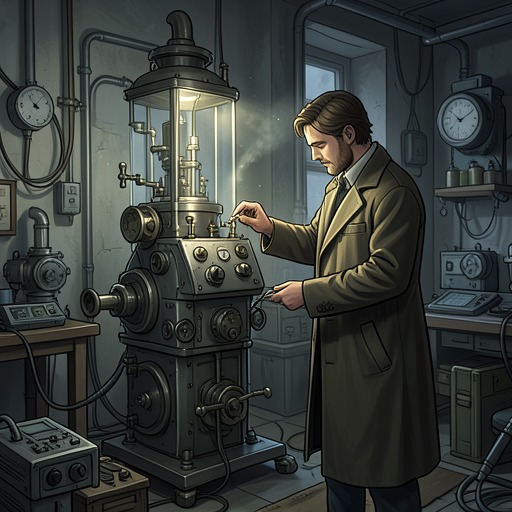
Major Par Odal’s apparent invulnerability is complicated by the experiments conducted by Dr. Leoh and Hector. At first they use the dueling machine for hide-and-seek across jungles, cities, glaciers, and interplanetary voids, never leaving the booths. Once Dr. Leoh confirms that the machine reproduces and amplifies thought patterns faithfully, they test combat with foils, pistols, sonic beams, and grenades while imagining protective equipment. Hector’s training makes him the better conventional fighter, yet Dr. Leoh wins most of their direct bouts. The machine, Dr. Leoh realizes, projects personality as well as thought and skill; this principle helps explain why combat in the machine cannot be reduced to physical expertise alone and why Odal’s inner formation becomes as important as his weapons training.
The system is later redesigned to prevent the kind of danger associated with Odal. Dr. Leoh adds a circuit that psychonically isolates duelists from the outside world, making contact with external people impossible while the machine operates. A second circuit records and monitors the entire duel so that the chief meditech can review it if either participant requests an investigation into broken rules. These safeguards transform the machine from a potentially lethal political instrument into a more accountable public mechanism, while also preserving the memory that Major Par Odal had actually killed people through its earlier operation.
Conflict with Hector and the Fusion of Minds
Odal remains an active threat even after the public safeguards are discussed. In the office of the Kerak ambassador, he receives the attention of Minister Kor, who speaks to him through a viewscreen and asks whether he seems relieved. The scene places Odal within the private machinery of Kerak authority: ambassadors, intelligence officials, and military officers operate together, while Odal’s individual state is judged by those who command him.
The conflict reaches its most radical form when Odal and Hector become linked through the dueling machine. Odal is seated in the Acquatainian machine and thinking about Geri Dulaq when, in an instant, he knows that he is in Kerak and that Hector is in the machine with him. Their minds are open to one another; amplified and cross-linked by the machine’s circuits, they fuse inescapably. The experience is physical as well as mental, wrenching both bodies as though immense electrical force were passing through them.
The fusion destroys the clean separation on which Odal’s professional identity depends. Hector can look into Odal’s mind as if it were his own, while Odal becomes Hector at the same time that Hector becomes Odal. Their identities do not simply exchange information; each is compelled to inhabit the other’s history. Hector experiences files of cadets marching in heavy gray uniforms, the weight of their field packs, and the heat of the sun. Odal experiences the thrill of a boy’s first sight of a starship floating in orbit. The two men therefore encounter not abstract profiles but embodied memories, sensations, and formative images.
Most disturbing is the memory of Hector running with teenagers in brown uniforms through the streets of an ancient town, clubs in hand, smashing the windows and homes marked with a special symbol and attacking anyone who protested. The fusion places this history beside Odal’s military formation and makes the soldier’s present inseparable from the violence that shaped him. It also reverses the normal hierarchy between observer and weapon: the officer who once appeared to be an emotionless tool becomes legible through the intimate, involuntary contact of minds.
Narrative and Thematic Significance
Major Par Odal connects several forms of power that the novel repeatedly brings into contact: military discipline, political command, public spectacle, and experimental technology. Kanus names him as an instrument of conquest, while the newsman presents him as one antagonist in a regulated duel. Dr. Leoh’s revisions attempt to contain the dangers associated with such contests, yet the machine ultimately produces its most consequential revelation by allowing Odal and Hector to cross the boundaries between separate selves.
His characterization also complicates the stark opposition between Terran imperial rule and Kerak resistance. Earlier history shows Terrans as conquerors who replaced the Masters, while Komani and Kerak actors invoke liberation to justify new violence. Odal belongs to the side that condemns imperial weakness, but his service to Kerak reproduces the same structure of instrumental domination: a state converts a person’s abilities into an extension of its political will. The result is an irony sharper than a simple hero-versus-villain arrangement. Odal is dangerous because he has been perfected for obedience, yet the fusion reveals that no political system can fully reduce a human consciousness to a weapon.
The character’s strongest transformation is therefore not a declared change of allegiance but an enforced expansion of identity. Through contact with Hector, Odal becomes both subject and object of knowledge, carrying another person’s memories while exposing his own. The narrative’s emphasis on bodily shock, shared perception, and doubled consciousness makes his fate a test of whether a trained warrior can remain psychologically sealed. Major Par Odal begins as the polished representative of Kerak power; he becomes, through the machine, evidence that even the most disciplined instrument contains a history that authority cannot completely control.