Merdon
WatchmenMerdon is a young Shinarian rebel and the only son of the merchant Clanthas. He initially treats the Komani as invited allies in Shinar’s struggle against Terran rule, but his confidence in that alliance collapses when he recognizes that Okatar Kang regards Shinar chiefly as a stepping-stone toward a wider war against the Empire. Merdon’s eventual willingness to follow Emil Vorgens’s military direction and fight beside the Terran forces transforms him from an insurgent opponent into an essential intermediary between Shinarian resistance and the defense of his homeworld.
Identity and Background
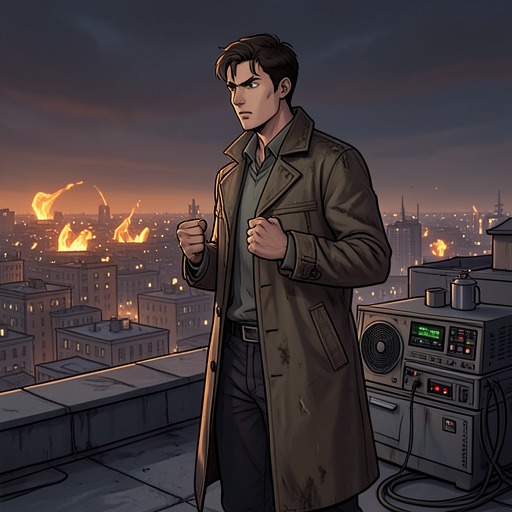
Merdon is introduced through his relationship with Clanthas, whose physical appearance he resembles in a younger, stronger form. The father and son share prominent cheekbones, a broad brow, and a massive, stubborn jaw; Merdon is tall, broad, and strong-limbed. The resemblance makes their political disagreement more than a conflict between abstract positions. Clanthas sees in his son the force of youth that he himself once possessed, while Merdon represents the generation prepared to act where his father has tried to preserve stability.
Clanthas calls Merdon the ringleader of the movement that has brought disaster upon their planet and people. He reproaches him for remaining silent about a plot against the governor’s life, for failing to oppose plans to shoot back at the Terrans, and for going farther than the hot-blooded young men around him. Merdon does not immediately answer the accusations; he waits while his father’s anger runs its course. That silence suggests both the depth of the family rupture and the confidence with which Merdon had previously defended his political course.
Merdon’s rebellion is also shaped by a historical ideal of freedom. Clanthas recalls a quotation that his son had encountered while studying galactic history: freedom depends on the intelligence and courage to stand independently, and on collective strength against enslavement. The words, spoken more than a century earlier by Geoffrey Knowland, the Terran conqueror who defeated the Masters and established Terran rule over Shinar, carry an inherent irony. Merdon draws an anti-imperial lesson from a history associated with the very power he opposes, while Clanthas recognizes that rhetoric of freedom can become dangerous when converted into insurrection without political judgment.
Rebellion and the Komani Alliance
Merdon supports the gathering of forces under Okatar Kang. He reports that Okatar is collecting men from every corner of the planet, that Shinarian fighting units are joining him, and that warriors from other Komani clans may land on Shinar. Okatar intends to build overwhelming strength before attacking the Terrans and to destroy them completely. Merdon’s early position therefore rests not on passive resentment but on a deliberate military alliance and an expectation of decisive victory.
When Emil Vorgens and Sittas encounter him in the Komani encampment, Merdon states openly that the Komani are in Shinar because the rebels invited them. He describes them as guests and allies helping the Shinarians fight the Terrans, rejecting the Terran commanders’ belief that Shinar has merely become an unwitting pawn in a Komani conquest plan. Merdon insists that the Komani are working for Shinar rather than using Shinar for themselves. This claim reveals his central political miscalculation: he understands the need for outside military strength, but assumes that an invited ally will remain subordinate to the cause that summoned it.
Merdon tries to extend that alliance even to Vorgens. Because Vorgens’s people once fought against the Empire, Merdon urges him to join the rebellion, help free Shinar, and perhaps eventually destroy the Empire and liberate Vorgens’s own people. Vorgens refuses. He acknowledges that he is not a native Terran and that his people once opposed the Terrans, but he also identifies himself as an Imperial citizen and a sworn officer of the Star Watch. He will not abandon his word or fight the men with whom he has served. The exchange clarifies the difference between Merdon’s politics of liberation and Vorgens’s politics of sworn duty, while leaving open the possibility that both men can oppose the Komani for different reasons.
Recognition of the Komani Threat
Merdon’s confidence is challenged by Okatar’s own declaration of purpose. Okatar promises that the Komani will soon leave Shinar after wiping out the Terrans, then strike elsewhere nearer the heart of the Empire. He presents Shinar’s liberation as a temporary consequence of a larger campaign and dismisses the Komani motive as irrelevant so long as Terran rule is removed. Merdon objects that Shinar is being used as a stepping-stone. Okatar answers that this is precisely what he intends.
The revelation forces Merdon to distinguish between an ally’s immediate assistance and an ally’s strategic objective. The Komani may help expel the Terrans, but their victory would not establish Shinarian control over Shinar; it would place the planet inside Okatar’s expansionist design. Merdon’s earlier assurance that the Komani were working for the Shinarians is consequently exposed as incomplete. He has invited a force whose success could replace one form of domination with another and could provide the launch point for a galactic war.
This conflict also places Merdon between his own people and the Komani commanders. He has political credibility among the Shinarians because he helped create the alliance, yet that same responsibility makes the danger impossible to evade. The rebellion’s foreign allies are no longer simply instruments of liberation. They are an independent power with the capacity to decide Shinar’s future by force.
Alliance with the Terran Forces
After Emil Vorgens survives the Komani crisis, he presents the Shinarians with a stark choice: fight for their own world alongside the Terrans against the Komani, or allow the Komani to take over Shinar and use it as the springboard for galactic war. Vorgens cannot guarantee that the Empire will reward cooperation with self-government, but he argues that resistance can delay Okatar until Star Watch reinforcements arrive. The proposal turns the question of autonomy into an immediate strategic decision rather than a promise of political reward.
Merdon becomes part of that new calculation. Clanthas later informs Vorgens that the other Shinarian leaders have accepted his word and will help the Terrans while working against the Komani. Merdon’s earlier policy has therefore been reversed at the level of the wider movement: the people who invited the Komani now join the forces seeking to stop them. The shift is not presented as a simple conversion to Terran rule. It is a defensive alliance formed because the Komani threat has made Shinarian survival more urgent than the rebellion’s original military alignment.
During the emergency at Katan, Merdon admits that he lacks enough groundcars to reach the city quickly. Vorgens answers that he can send a squadron of vans and troop carriers within the hour. The practical detail matters: their partnership is built not only on speeches or shared enemies but on the coordination of transport, troops, and local authority. Merdon then acknowledges that he has been wrong about many things, above all about Vorgens, and tells the Watchman that he will order his people to follow Vorgens’s commands.
Merdon does not stop at issuing orders from a safe distance. He offers to remain and fight beside Vorgens if Vorgens is willing to have him. Vorgens answers without a speech, extending his hand. Merdon takes it firmly, and the two go down together to the waiting people. The handshake gives visible form to the political reversal: the former rebel leader and the Star Watch officer do not erase their differences, but they recognize a common responsibility in the defense of Shinar.
Change and Narrative Significance
Merdon’s arc moves from ideological certainty to accountable judgment. At first he treats opposition to the Terrans as sufficient reason to trust the Komani and assumes that military victory will naturally produce freedom. His father warns that the rebellion threatens the planet, while Merdon’s own reports show how rapidly the conflict is widening. Okatar’s candid admission of imperial ambition finally makes the cost of Merdon’s strategy unmistakable.
The change is therefore not a rejection of freedom but a refinement of what defending freedom requires. Merdon must accept that liberation cannot be measured solely by the removal of a familiar ruler; it also depends on who controls the armed force that fills the resulting vacuum. Vorgens’s proposal forces him to choose between political suspicion of the Empire and the concrete defense of Shinar. Merdon chooses cooperation without receiving a guarantee of self-government, accepting uncertainty rather than allowing the Komani to determine his world’s fate.
His final decision also reverses the novel’s initial political geometry. Vorgens arrives intending to negotiate with the Komani chief and remind the raiders that the Komani clans had sworn loyalty to the Terran Council. Merdon, by contrast, has made the Komani an invited military presence. By the time the crisis reaches Katan, the alliance has changed sides: Shinarian forces are prepared to follow a Star Watch officer against the foreign warriors they once summoned. Merdon’s willingness to stand beside Vorgens makes that reversal credible at the personal and military levels, and establishes him as the rebel whose growth helps convert a fractured uprising into a defense of Shinar itself.