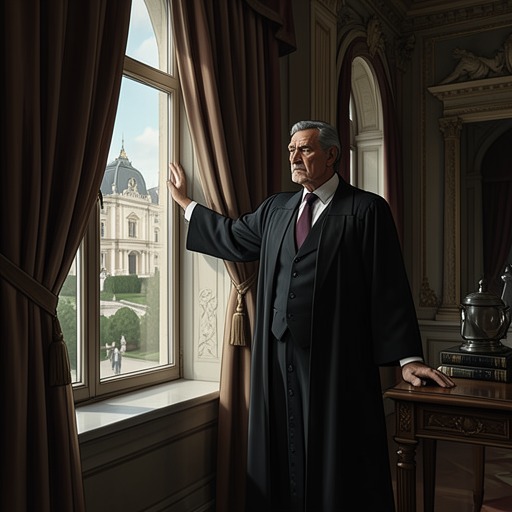
Sir Harold Spencer
WatchmenSir Harold Spencer is the Commander in Chief of the Star Watch and one of the book’s clearest embodiments of institutional authority under pressure. His significance lies in the range of his responsibilities: he oversees the Star Watch’s military and political reach, intervenes when the dueling machine becomes a tool of assassination, and treats the safety of individual Watchmen as a matter capable of deciding relations between entire worlds. Although age and weariness mark his perspective, his authority remains active, mobile, and formidable.
Identity and Authority
Spencer’s position gives him an unusual freedom of movement. While visiting Earth, he reflects that one advantage of being Commander in Chief is the ability to visit any planet in the Commonwealth. The observation is personal as well as official: Earth is his home world, the land of his birth, and the place he most wants to see as he grows older and wearier, even though the Star Watch’s official headquarters lies elsewhere, in a star cluster nearer the Commonwealth’s center. This contrast defines him as both a distant administrator and a man with a specific attachment to home.
His authority is not merely ceremonial. When a discussion turns to Major Par Odal’s latest duel, Spencer recognizes that the reported death cannot be treated as an ordinary accident. The dueling machine is supposed to be incapable of causing physical or mental harm unless someone has tampered with it. Spencer therefore evaluates the danger through the Star Watch’s institutional responsibility: the organization cannot act officially without sufficient grounds, but it can still respond through a controlled, unofficial deployment.
Judgment and Institutional Response
After hearing that an industrialist who had spoken against Chancellor Kanus was killed in the dueling machine, Spencer remains silent for a moment, weighing the matter before deciding. His solution is precise rather than impulsive. The Star Watch will not intervene openly, but Spencer will dispatch an officer to the Acquataine Cluster on detached duty to serve as a liaison. The arrangement preserves formal jurisdiction while creating a channel through which the Star Watch can monitor the crisis and influence events.
That balance between restraint and intervention recurs in his dealings with the wider political emergency. Spencer is officially present to attend the inauguration of General Martine as the new Prime Minister of Acquatainia. His actual purpose is more consequential: he hopes to persuade General Martine to join the Commonwealth or at least sign an alliance treaty. Acquatainia’s former allies have either been absorbed by the Kerak government or frightened away, leaving the planet dangerously isolated. Spencer judges that membership in the Commonwealth, or a formal alliance with it, could deter Chancellor Kanus from attacking.
The scene establishes Spencer as a statesman who understands that power may operate through promises before it operates through weapons. He does not deny the possibility of war; instead, he seeks to make war less likely by changing Acquatainia’s strategic position. Diplomacy is therefore not a retreat from Star Watch power but one of its instruments.
Command, Loyalty, and Crisis
Spencer’s response becomes more direct when Lieutenant Hector is held as a hostage during an impending upheaval in the Kerak government. Romis explains that Major Odal is safer where he is and that the conspirators intend to retain Lieutenant Hector so the Star Watch will not interfere. Spencer listens silently for several seconds, then identifies the political calculation plainly: the Kerak conspirators are preparing to overthrow their government and intend to use a Star Watchman’s life as leverage.
His warning is uncompromising. He permits the upheaval to proceed, but declares that any harm to a Star Watchman will bring an invasion as quickly as starships can reach the Kerak worlds. He will not wait for authorization from the Terran Council or observe other formalities; he will crush those responsible. The threat reveals the limit of his institutional caution. Spencer respects procedure when procedure can protect lives and preserve legitimacy, but hostage-taking crosses into a form of coercion that he answers with personal command authority.
This response also clarifies the relationship between the individual Watchman and the organization he serves. Hector is not treated as expendable merely because his capture is politically inconvenient. Spencer’s willingness to risk a military escalation shows that Star Watch identity carries collective protection, and that an assault on one Watchman can become an assault on the Star Watch itself.
Relations with Other Leaders
Spencer’s conversations with Dr. Leoh show a mixture of familiarity, scrutiny, and political concern. He recognizes that Leoh’s scientific investigations have drawn him into political affairs and jokes that Leoh may eventually seek Spencer’s position. Even Hector laughs at the exchange, which briefly makes Spencer less a remote commander than an older colleague capable of teasing the scientists and officers around him.
The humor does not weaken the seriousness of their relationship. Spencer is alert to the consequences of Leoh’s work, especially when the dueling machine and psychonic teleportation begin to affect governments and military calculations. His role is to connect discoveries made by individuals to the dangers faced by institutions and populations. Where Leoh follows the scientific mystery, Spencer must ask what the discovery will do to the balance among worlds.
His confrontation with the Kerak conspirators provides the harder counterpart to that familiarity. There, Spencer does not negotiate over the principle involved. He allows the opposing side to understand exactly what protection the Star Watch offers and exactly what consequence will follow if that protection is tested.
Narrative Role and Significance
Spencer functions as a stabilizing counterweight to commanders who confuse authority with temper, rulers who treat subjects as instruments, and conspirators who mistake procedural hesitation for weakness. His power is expressed through several distinct forms: personal mobility across the Commonwealth, knowledge of military jurisdiction, diplomatic strategy, and the ability to authorize action when formal institutions are too slow.
Yet the narrative does not present him as an abstract embodiment of government. His attachment to Earth and his awareness of growing older and wearier give his authority a human limit. He is a commander who can visit any planet, but the planet he most wants to see is still the one he calls home. That private orientation coexists with a public duty extending across star systems.
Spencer’s decisive significance is therefore ethical as well as political. He treats power as something that must be calibrated—restrained in the Acquataine investigation, diplomatic in the effort to prevent war, and absolute when a Star Watchman is held hostage. Through him, the Star Watch becomes more than a distant bureaucracy: it becomes a body whose laws, officers, and promises possess consequences in the lived crises of individual people.